

Ebook Info
- Published: 2001
- Number of pages: 808 pages
- Format: PDF
- File Size: 29.51 MB
- Authors: F. S. Levin
Description
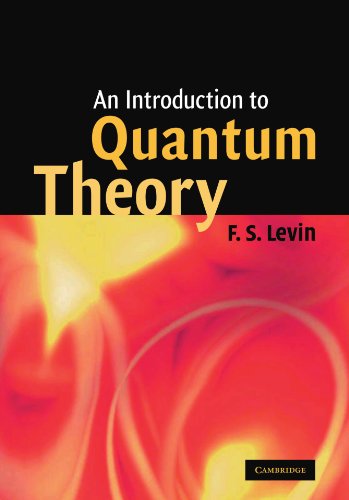
Underpinning the axiomatic formulation of quantum theory presented in this undergraduate textbook is a review of early experiments, a comparison of classical and quantal terminology, a Schroedinger-equation treatment of the one-dimensional quantum box, and a survey of relevant mathematics. Among the many concepts comprehensively discussed are: operators; state vectors and wave functions; experimental observables; classical/quantal connections; and symmetry properties. The theory is applied to a wide variety of systems including the non-relativistic H-atom, external electromagnetic fields, and spin. Collisions are described using wave packets. Various time-dependent and time-independent approximations are discussed; applications include electromagnetic transition rates and corrections to the H-atom energies. The final chapter deals with identical-particle symmetries and their application to the He atom, the Periodic Table and diatomic molecules.
User’s Reviews
Editorial Reviews: Review ‘… [a] sound reliable text, suitable for students with the appropriate abilities and background.’ Alastair Rae, The Times Higher Education Supplement Book Description An undergraduate introductory quantum mechanics textbook with a large number of figures and exercises. About the Author F. S. Levin received his undergraduate degree from The Johns Hopkins University and his Ph.D. from University of Maryland. Following post-doctoral positions at Rice University, Brookhaven National Laboratory, and the United Kingdom Atomic Energy Author-ity, he accepted an appointment in the Physics Department at Brown University, where he remained for 31 years until his retirement in 1998. Read more
Reviews from Amazon users which were colected at the time this book was published on the website:
⭐I don’t know why this wonderful textbook does not get more attention. Levin is more detailed and more formal than other introductory QM texts I have studied, e.g. Miller
⭐, Townsend
⭐, Das/Melissinos
⭐or poked my nose into online at Amazon or google books, e.g. Griffiths
⭐, Zettili
⭐. I would personally classify it as an intermediate text, at least from the perspective of self-study, because the demands on the reader are substantial. It really is meant for serious students who want more quantum mechanics under their belts than provided by typical standard introductions. Because of its substantial breadth and depth, it’s also a good reference and a useful supplement to other textbooks. The exposition is very clear. For very dedicated autodidacts, it is eminently suitable for self-study (but note that there are no solutions to exercises).As one reviewer notes, the first 5 chapters are somewhat ponderous; in fact, I skipped them at first and then went back to them later, but I had already read most of Miller and Townsend and some other material on the formal foundations of Hilbert spaces and QM, e.g., some of Shankar
⭐; cf. my other reviews and ListMania.Here’s the early chapter roster: Ch. 1: The Need for a Non-classical Description of Microscopic Phenomenon (pp. 1-26); Ch. 2 Classical Concepts and Quantal Inequivalences (pp. 27-45); Ch 3. Introducing Quantum Mechanics: a Comparison of the Classical Stretched String and the Quantal Box (pp. 46-83); Ch. 4 Mathematical Background (pp. 84-128); Ch. 5 The Postulates of Quantum Mechanics (pp. 129-173). Only then in Ch. 6 (Applications of the Postulates: Bound States in One Dimension) does one get into the nitty gritty of some interesting quantum physics.Nevertheless the introductory first 5 chapters are very well written, very informative and well worth the effort of reading if one is unfamiliar with this material. I came away with a much better understanding of various fundamentals.Levin covers a number of topics that in other introductory books are either ignored or treated inadequately. For example, section 3.4 (The concept of Hermiticity) discusses the Sturm-Liouville operator in some detail and its relationship to the Dirac delta function; section 4.5 Functions of operators provides a serious discussion of unbounded operators, including Stone’s theorem; and Ch 8.2 provides an introduction to the path integral formulation of QM.Overall, very highly recommended for the dedicated autodidact.
⭐I wasn’t in the market for a quantum book, but happened to pass by this one at the store, and had to get it. First off the book is beautiful. They have done a great job making the text clear and visually comfortable, the equations read beautifully, and the book “feels” light for being over 700 pages (big pages).Topic wise the book is very thorough. Both in the sense of many topics are covered and they are generally covered thoroughly and formally. I really think Levin does a great job of balancing rigor with clarity. Although I haven’t made it all the way through the text, I’ve peeked ahead to several sections and been impressed with content. Likewise I haven’t sat down with the pencil and paper and worked out the problems, but the problem sets I read through looked polished.As far as complaints go, I’ve have a couple, generally mild — ok this first one is actually pretty picky. The author uses the phrases “vis.” and “quantal” all of the time. After a couple of days it became less annoying, but now I find myself saying quantal from time to time — almost like getting a song stuck in your head.The other complaint isn’t really on my behalf, but on the behalf of a first time student. I think many of the early chapters don’t get to “it” quick enough. The basic 1-d problems aren’t really attacked until chapter 6, page 175. Everything before that provides motivation and formalism. I think that may be a little too far of a lead-in for the uninitiated student, so if its used in a intro QM class, the teacher probably shouldn’t strictly follow the text’s path.Otherwise this book if fantastic. It goes above and beyond the content needed for a first year course, while keeping that content accessible. I think this text has more than will be swallowed by most first year undergrad classes, and could probably be used by many universities graduate QM classes. It’s been several years, so I won’t directly compare this to the texts I used, but even if you aren’t assigned this text, I would recommend picking it up as a reference (especially if you are an undergrad using say Griffiths, who is looking to continue into grad school).
⭐If you’ve been looking for THE quantum theory book for undergraduate studies, say “bingo” because you just found it. Some pretty serious problems in there, it’ll satisfy all you people looking for challenges.
⭐This is a great book for the physics undergrad willing to engage in serious mathematical and physics thinking. It covers expert coverage of many topics not covered at this level. However, I must say that I have bought two copies of this book, and both of them had terrible printing quality. The first copy I bought was printed entirely in a very small font, not suitable for a great study. The second copy I bought has the first two chapters in very small font, but the rest is in a larger more spaced-out print which is “OK”. How long have you been in business CUP?
⭐Levin’s undergraduate book is very complete. A course like this would be an excellent foundation for a graduate course later on. If you’ve ever looked at gasiorowicz, which is also quite complete, it’s like that plus all the words/explaination that G-wicz is missing. I highly recommend this book.
⭐I was doing a lot of reading in solid state physics, which later prompted me to review quantum mechanics more thoroughly once again. So, I choose this book.This book reminds me of my undergrad textbook that I used many years ago, but this book takes the subject a little beyond with greater depth of the subject. I would say it prepares the student to go directly to a graduate-level book with little difficulty. It certainly brings back the memories of matrix mechanics and its heavy use in angular momentum, spin, and perturbation theory and the hours I spent working through the problems to learn this topic.A wonderful book on exploring and learning QM that gets the mind to critically think.
Keywords
Free Download An Introduction to Quantum Theory 1st Edition in PDF format
An Introduction to Quantum Theory 1st Edition PDF Free Download
Download An Introduction to Quantum Theory 1st Edition 2001 PDF Free
An Introduction to Quantum Theory 1st Edition 2001 PDF Free Download
Download An Introduction to Quantum Theory 1st Edition PDF
Free Download Ebook An Introduction to Quantum Theory 1st Edition