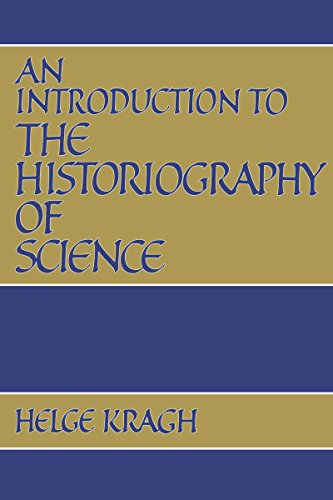
Ebook Info
- Published: 1989
- Number of pages: 244 pages
- Format: PDF
- File Size: 5.90 MB
- Authors: Helge S. Kragh
Description
This book introduces the methodological and philosophical problems with which modern history of science is concerned, offering a comprehensive and critical review through description and evaluation of significant historiographical viewpoints. Incorporating discussion of key problems in general historical writing, with examples drawn from a range of disciplines, this non-elementary introduction bridges the gap between general history and history of science. Following a review of the early development of the history of science, the theory of history as applied to science history is introduced, examining the basic problems which this generates, including problems of periodisation, ideological functions, and the conflict between diachronical and anachronical historiography. Finally, the book considers the critical use, and analysis, of historical sources, and the possibility of the experiemental reconstruction of history. Aimed primarily at students, the book’s broad scope and integration of historical, philosophical and scientific matters will interest philosophers, sociologists and general historians, for whom there is no alternative introduction to the subject at this level.
User’s Reviews
Reviews from Amazon users which were colected at the time this book was published on the website:
⭐In “An Introduction to the Historiography of Science”, Helge Kragh writes of the justification of the study, “The truly historical perspective that the study of the past is of value in itself and therefore not in need of legitimation with regard to the present, barely existed before the 19th century” (pg. 5). In the eighteenth century, the study of science was bound into a teleological view with progress (pg. 6). Kragh continues, “It was not until the turn of the century that the scattered activities were organized and history of science began to be established as an independent profession” (pg. 15).Of the historians, Kragh writes, “The agents of the history of science are the individuals who have, in fact, helped to collect knowledge about nature or what has been thought to be so” (pg. 25). Of the study itself, Kragh writes, “History of science ought to function as an analytical instrument for the critical evaluation of methods and concepts that appear in modern science” (pg. 32-33). In this way, “History of science can be used, and ought to be used, to analyse the interplay between science, technology, and society. But empirical evidence that science always or just usually results in technology is weak. By making use of examples from history one could easily construct a case for arguing that science does not, as a rule, lead to technology or that science and technology do not normally contribute to people’s welfare and safety” (pg. 35).For the historian, “Scientific occurrences ought to be evaluated and explained in accordance with the norm or norms prevailing at the time they took place. A period’s norm can be regarded as everything that is taken for granted by the scientific community during that period” (pg. 61). Unfortunately, “History of science has been dominated by the physical sciences and, to a somewhat less extent, biology. Although recently less glamorous sciences, like geology, have also met with increasing historical interest, the preoccupation with physics continues” (pg. 78). While historians try to avoid projecting their own views backward, “in practice, anachronical history of science is widespread and difficult to avoid. The doctrine is connected to the presentist view of history which may be seen as a theoretical justification of anachronical historiography” (pg. 89). To this end, “history of science has its own ‘imperialism’ that partly reflects the fact that viewed historically and socially science is almost purely a western phenomenon, concentrated on a few, rich countries. While science may be international, history of science is not” (pg. 111).Looking at biography, Kragh writes, “The biographical approach to the history of science can be accused of giving a narrow, individualized and internalist picture of the development of science; of focusing on the individual genius at the expense of the collective and social currents” (pg. 171). Kragh continues, “In the first place biography is only one solitary instrument in the history of science orchestra. And in the second place the focusing of biography on the individual will not necessarily happen at the expense of collective and social factors. In fact biography, in one version, can be decidedly externalist; it can, for example, depict the subject of the biography as a mere medium for social and economic currents typical of the time” (pg. 171).
⭐This is a perfectly fine survey text. In my review I wish to focus on one of its main themes, namely the question of the goal or justification of the history of science as a field of study. The modern consensus is that no goal or justification is needed, or even that any such goal or justification would corrupt the field. Thus Kragh quotes with tacit approval the words of I.B. Cohen:”It is surely no longer necessary to justify the study of history of science. … Not far off is the time when historians of science will be so numerous that they may produce scholarly works which need satisfy only the members of their own profession, the only requirement being that of high standards.” (p. 38)Indeed, modern historians seem determined to realise this incestuous utopia, as is evident to anyone who has opened a recent issue of a history of science journal. To my mind, this is far from a desirable goal, but rather a sure-fire recipe for disaster. The very idea of having a field of study with “high standards” but no justification or purpose is madness, and its outcome predictable. Since the field has no purpose or justification, there are no grounds on which to evaluate or question the standards. Thus the “high standards” cannot be meaningfully defined except circularly, as synonymous with the style of work of the self-appointed priesthood. By definition, then, sycophancy becomes an entrance requirement for any aspiring apprentice. “Before jumping on the bandwagon, the common guildsman should wait the nod of the hogen-mogens to be sure it joins the right parade,” as Truesdell aptly observed.It may do us well to remember that history of science had a purpose once. Thus for example Leibniz argued that “it is of great advantage to get to know the real sources of great discoveries” since “the art of discovery expands when one finds the path of research in outstanding examples” (p. 5). Whewell made the same point: “The examination of the steps by which our ancestors acquired our intellectual estate … may teach us how to improve and increase our store … and afford us some indication of the most promising mode of directing our future efforts to add to its extent and completeness.” (pp. 5-6). This used to be an “important theme” (p. 5) in the justification of history.Another good argument for studying history was expressed thus by Mach: “The historical investigation of the development of a science is most needful, lest the principles treasured up in it becomes a system of half-understood prescripts, or worse, a system of prejudices.” (p. 10) Kragh also quotes Duhem (p. 17) and Jammer (p. 33) making the same point, and notes that “the view that fundamental scientific concepts can only be correctly understood via the critical-historical method is widespread” (p. 33).In more recent times, people such as Sarton (pp. 17-19) and Conant (pp. 34-35) have advocated successfully for the place of history of science in academia on grounds of its usefulness for the present. It is all too easy today to dismiss them as “naive” and “ahistorical” (p. 18) promulgators of “propaganda for the gospel of the scientific society” (p. 35). It would be more constructive to learn from their success. At least to them history had a purpose, which is more than can be said for the modern historian who pulls his head out of the sand only to request that more money be thrown into his pit.
Keywords
Free Download An Introduction to the Historiography of Science in PDF format
An Introduction to the Historiography of Science PDF Free Download
Download An Introduction to the Historiography of Science 1989 PDF Free
An Introduction to the Historiography of Science 1989 PDF Free Download
Download An Introduction to the Historiography of Science PDF
Free Download Ebook An Introduction to the Historiography of Science