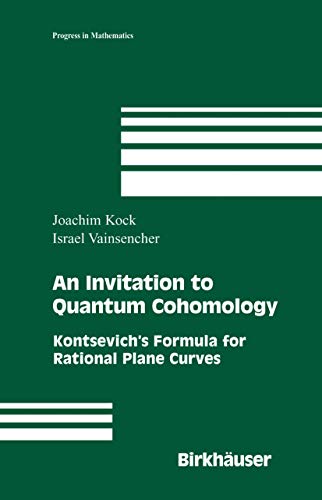
Ebook Info
- Published: 2007
- Number of pages: 176 pages
- Format: PDF
- File Size: 7.14 MB
- Authors: Joachim Kock
Description
Elementary introduction to stable maps and quantum cohomology presents the problem of counting rational plane curvesViewpoint is mostly that of enumerative geometryEmphasis is on examples, heuristic discussions, and simple applications to best convey the intuition behind the subjectIdeal for self-study, for a mini-course in quantum cohomology, or as a special topics text in a standard course in intersection theory
User’s Reviews
Editorial Reviews: Review “The book seems to be ideally designed for a semester course or ambitious self-study.” ―Mathematical Reviews”The book is intended to be a friendly introduction to quantum cohomology. It makes the reader acquainted with the notions of stable curves and stable maps, and their moduli spaces. These notions are central in the field. … Each chapter ends with references for further readings, and also with a set of exercices which help fixing the ideas introduced in that chapter. This makes the book especially useful for graduate courses, and for graduate students who wish to learn about quantum cohomology.” ―Zentralblatt Math”…The book is ideal for self-study, as a text for a mini-course in quantum cohomology, or a special topics text in a standard course in intersection theory. The book will prove equally useful to graduate students in the classroom setting as to researchers in geometry and physics who wish to learn about the subject” ―Analele Stiintifice ale Universitatii “Al. I. Cuza” din Iasi From the Back Cover This book is an elementary introduction to stable maps and quantum cohomology, starting with an introduction to stable pointed curves, and culminating with a proof of the associativity of the quantum product. The viewpoint is mostly that of enumerative geometry, and the red thread of the exposition is the problem of counting rational plane curves. Kontsevich’s formula is initially established in the framework of classical enumerative geometry, then as a statement about reconstruction for Gromov–Witten invariants, and finally, using generating functions, as a special case of the associativity of the quantum product.Emphasis is given throughout the exposition to examples, heuristic discussions, and simple applications of the basic tools to best convey the intuition behind the subject. The book demystifies these new quantum techniques by showing how they fit into classical algebraic geometry. Some familiarity with basic algebraic geometry and elementary intersection theory is assumed. Each chapter concludes with some historical comments and an outline of key topics and themes as a guide for further study, followed by a collection of exercises that complement the material covered and reinforce computational skills. As such, the book is ideal for self-study, as a text for a mini-course in quantum cohomology, or as a special topics text in a standard course in intersection theory. The book will prove equally useful to graduate students in the classroom setting as to researchers in geometry and physics who wish to learn about the subject.
Reviews from Amazon users which were colected at the time this book was published on the website:
⭐The Kontsevich combinatorial formula of stable algebraic curves can be loosely described as being a generalization of what is done for Grassmann varieties in the context of vector bundles. A Grassmann variety Gr(k, n) is a collection L of k-dimensional linear subspaces of a complex n-dimensional vector space. The geometry of Gr(k, n) can be viewed as a kind of measure of how complicated things can get if L is permitted to vary in families. A family can be viewed as a collection of linear spaces parametrized by points of a base space B, and this leads naturally to the concept of a locally trivial vector bundle over B. One can then obtain a ‘tautological’ vector bundle Ltaut over Gr(k, n) consisting merely of pairs (L, v) where v is an element of L. Forgetting v gives a map from Ltaut to Gk(r, n) with fiber L. Given a map from B into Gr(k, n) there is a ‘pull-back’ of Ltaut which happens to be a vector bundle over B of rank k. It turns out that this procedure for n arbitrarily large and for B compact is gives a lot of information and is “universal” in the sense that there is a bijection between homotopy classes of maps from B to Gr(k, n) and the set of isomorphism classes of rank n vector bundles on B. In the context of algebraic geometry a natural question to ask is whether this “universality” can be repeated when the families of linear spaces are replaced by families of curves of genus g. In other words, given a family F of smooth algebraic curves of genus g parametrized by some base space B, does there exist a natural map from B to a “moduli space” of curves that gives the essential information about F?As is known, and as brought out in this book the answer to this question is in general no. If Mg is defined to be the moduli space of smooth curves of genus g then a family of curves with base B is a morphism from F to B of algebraic varieties whose fibers are smooth complete curves of genus g. Any map phi from B to Mg needs to be algebraic and in general F will not be the pull-back of any universal family over Mg. For g = 0, one-dimensional projective space P(1) there exists a trivial map to a point, but there exists complicated families with fibers isomorphic to P(1) because of a “large” automorphism group which can enable the construction of complex objects from simple ones. It is the presence of this automorphism group that makes it difficult to find a universal family of curves over Mg.However, if the automorphism group is finite, then this can be dealt with by putting “marked” points on the curves. The number of marked points must be greater than or equal to 3 for the case of genus 0 and greater than or equal to 1 for the case of genus 1 curves. There are some straightforward examples of marking in the book, and the authors show just how one needs to change the moduli space Mg to M(g, n), where n is the number of marked points, in order to eventually lead to a theory where one can discuss intersections of curves and a formula for computing the number of points of intersection.The first issue that must be dealt with is that families of curves over a base space B typically have singular fibers, and these fibers give valuable information about the geometry of the fiber. How are these singular fibers to be dealt with? The answer involves only worrying about the so-called ‘stable’ curves of genus g with n marked points. One thus obtains a ‘compactification’ of M(g ,n) which consists of stable curves, i.e only those curves that are complete and connected, have only nodal singularities, and only finitely many automorphisms. This procedure allows more control over the fibers over B.Through helpful diagrams the authors show how to deal with the phenomenon where marked points can approach each other. In more advanced treatments of this subject, this procedure is called ‘normalization’ of the curve. In particular when the base B is one-dimensional a family of curves over B is a map from the fibers F to B, where the fibers are curves of the family. Marking n points on the curves gives essentially n sections of the map, i.e. n maps from the base to F. There may be a point in the base where these sections (i.e. the marked points) coincide, and this will result in a curve that is not stable. The ‘normalization’ procedure is to “blow up” this “bad” point on F, giving a new family of curves over B and at the bad point has an additional contribution called the ‘effective divisor’ and the resulting combination will be a stable curve with two marked points which is essentially the “stable” limit of the old curves as points in the base B approach the bad point.In general then, if a marked point on a curve C approaches another, then C will “bubble” off a P(1) with these two points on it. For a family of curves with a smooth one-dimensional base B that are stable except at a bad point in the base, one can apply a sequence of blow-ups and blow-downs so that a new family is obtained which has stable fibers and where the fiber over the bad point is determined uniquely. This is called ‘stable reduction’.The real goal behind all this marking and consequent stable reduction is to use the compactified moduli space to do intersection theory and arrive at a general formula for the number of points of intersection. This is done by looking at the line bundle of a (stable) curve C over the n marked points and intersecting the first Chern class of this line bundle. If pi: F -> B is family of stable pointed curves and phi: B -> compactification(M(g, n)) is the induced map then sections of the pull-back phi* of the tangent space at the marked points are vector fields on points s of the fibers of pi that are tangent to the fibers of pi. This procedure gives a section of the normal bundle to the points s in the fiber F, and the degree of this normal bundle is the self-intersection of the points s on F, and is equal to the integral over B of the first Chern class of phi* of the tangent space at the marked points.The first Chern classes are the “psi’s” that one sees in the vast literature on quantum cohomology and its connection with intersection. The computation of the intersections of the psi’s with compactification(M(g, n)) is the subject of Gromov-Witten theory and the authors show how this is connected with the quantum cohomology and enumerative combinatorics. Readers with a physics background will find that the designation of this cohomology as being “quantum’ is only because of the historical origins of the subject in the area of quantum gravity. One should not in that regard view quantum cohomology as being a “quantization” of some underlying cohomology theory. It should rather be viewed as a deformation of the ordinary cup-product multiplication that is found in discussions on Chern classes of Grassmann varieties in algebraic geometry or in the Chow ring of P(r). The use of “generating functions” is also reminiscent of what is done in quantum field theory and quantum statistical mechanics, but since the resulting “quantum” product, which amazingly produces the right enumerative information, is commutative, the analogy to quantization is rather loose, given that quantization typically results in operations that are non-commutative.
⭐I like this book because it gives a thorough explanation of the background behind the theory of Gromov-Witten invariants. Not a lot of physics is presented (I have not read the whole book yet) but as a physicist I would not say this is any physics or even mathematical physics book. It is an algebraic geometry book and I think it does a fine job in introducing the subject although sometimes it could had be written more clearly. Stable maps are explained in big detail as well as their moduli spaces. The author then proceeds to enumerative geometry and finally to Gromov-Witten invariants but without any mention to any topological field theory A-model from the physics perspective, no mention of CY 3folds, D-branes, relation to Donaldson-Thomas invariants, Gopakumar-Vafa invariants etc.My biggest concern is that someone who wants to start computing Gromov-Witten invariants or immediately seem them and understand them will have to go through a lot of material. It is not a quick introduction and is not very suitable for physicists who want to dig into computations. Still, the analysis of the stable maps and the enumerative geometry is very detailed.
⭐Difficult reading without extensive mathematical background in quantum mechanics and modular theory.Equations require a PhD in advanced physics conceptually excellent
⭐This book is an elementary introduction to some ideas and techniques that have revolutionized enumerative geometry: stable maps and quantum cohomology. It uses as a basis Kontsevich’s formula and provides a complete proof of the formula.The book assumes some basic algebraic geometry and some elementary intersection theory. This would include algebraic curves, divisors and line bundles, blowup, Grassmannians.This book was originally published in Portuguese in 1999 as part of a mini-course. The further developments in the field have and the need for a more introductory book than Fulton and Pandharipande ‘Notes on Stable Maps and Quantum Cohomology’ have led to this revised, expanded and English language translation.
⭐Not found.
Keywords
Free Download An Invitation to Quantum Cohomology: Kontsevich’s Formula for Rational Plane Curves (Progress in Mathematics, 249) 2007th Edition in PDF format
An Invitation to Quantum Cohomology: Kontsevich’s Formula for Rational Plane Curves (Progress in Mathematics, 249) 2007th Edition PDF Free Download
Download An Invitation to Quantum Cohomology: Kontsevich’s Formula for Rational Plane Curves (Progress in Mathematics, 249) 2007th Edition 2007 PDF Free
An Invitation to Quantum Cohomology: Kontsevich’s Formula for Rational Plane Curves (Progress in Mathematics, 249) 2007th Edition 2007 PDF Free Download
Download An Invitation to Quantum Cohomology: Kontsevich’s Formula for Rational Plane Curves (Progress in Mathematics, 249) 2007th Edition PDF
Free Download Ebook An Invitation to Quantum Cohomology: Kontsevich’s Formula for Rational Plane Curves (Progress in Mathematics, 249) 2007th Edition