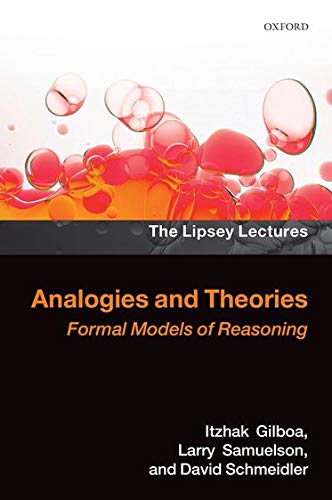
Ebook Info
- Published: 2015
- Number of pages: 160 pages
- Format: PDF
- File Size: 0.87 MB
- Authors: Itzhak Gilboa
Description
The book describes formal models of reasoning that are aimed at capturing the way that economic agents, and decision makers in general think about their environment and make predictions based on their past experience. The focus is on analogies (case-based reasoning) and general theories (rule-based reasoning), and on the interaction between them, as well as between them and Bayesian reasoning. A unified approach allows one to study the dynamics of inductive reasoning in terms of the mode of reasoning that is used to generate predictions.
User’s Reviews
Editorial Reviews: About the Author Itzhak Gilboa, Chair of Economic Theory and Decision Theory, Tel-Aviv University; AXA Chair of Decision Sciences, HEC, Paris,Larry Samuelson, A. Douglas Melamed Professor of Economics, Yale University,David Schmeidler, Professor Emeritus, Tel-Aviv University and Ohio State UniversityItzhak Gilboa obtained a BSc in mathematics and computer science and a BA in economics. He studied mathematical economics with David Schmeidler and obtained his MA (1984) and his PhD (1987) in the field of decision theory. Gilboa’s research focuses on decision under uncertainty, and has worked extensively with David Schmeidler on axiomatic foundation of non-Bayesian decision theory. He has also contributed to complexity in game theory, evolutionary game theory, and social choice. He has published three books, an Econometric Society Monograph Series text entitled Theory of Decision under Uncertainty, and two textbooks entitled Rational Choice, and Making Better Decisions. Professor Gilboa holds the AXA Chair of Decision Sciences at HEC, Paris, the Chair of Economic Theory and Decision Theory at Tel-Aviv University.Larry Samuelson received BA, MA, and PhD degrees from the University of Illinois. After appointments at Penn State and the University of Wisconsin, he has, since 2007, been a professor of economics at Yale University, and is the A. Douglas Melamed Professor of Economics at Yale. He has served as a co-editor of Econometrica and the American Economic Review. Professor Samuelson’s research has focussed on game theory, with emphasis on the evolutionary foundations of behaviour in games and on behaviour in repeated games. David Schmeidler is Professor Emeritus at Tel-Aviv University and at The Ohio State University. He received his PhD in Mathematics from the Hebrew University of Jerusalem under the supervision of Robert Aumann. HE has worked on cooperative games, general equilibrium analysis, social justice, implementation, and other fields. Over the past few decades he has focused on decision under uncertainty, mostly in the absence of well-defined probabilities.
Reviews from Amazon users which were colected at the time this book was published on the website:
⭐Analogies and Theories is a formal approach to how inferences can be made from observations. Each of the six chapters — effectively self-standing essays — has an introductory section which sets out the issues and draws general conclusions, followed by a section of mathematical logic which demonstrates a series of propositions which can be used in a formal sense.The underlying rationale for this book is that a vast number of high level policy, economic and intervention decisions are now based on widely gathered statistical evidence, but that, frequently, this evidence is used in an unsophisticated fashion. A good example, given in the first chapter, is the union of two sets of memories of a coin toss — one being the 1,000 times the coin was tails, and the other being the 1,000 times the coin came up heads. The union of these two sets of data shows that the coin is not biased: the result is exactly 50% heads, 50% tails, but the union of the two conclusions, i.e., ‘the coin is biased & the coin is biased’ would produce the opposite result. While this example is trivially obvious (which is what makes it a good example), the misapplication of decision making can have far-reaching and hard-to-identify consequences.A substantial amount of mathematical knowledge and ability is required to fully understand the proposition sections. A lesser degree, but still relatively specialised, is required to understand the introductory sections.This book summarises some important contributions to decision theory, and attempts to model many of the arguments that are often considered to be compelling in political and economic discourse. However, a level of second-translation is necessary for much of it to become commonly understood and widely accepted among the people who are making these decisions.
⭐The book is a collaboration written by mathematicians and economists on what I would loosely call game theory. The three authors have pulled together research to produce a number of formulated models that can be applied to certain criteria and situations to predict reasoning, looking at past behaviours and actions to predict outcomes. I think that they are using this book to give a starting point for others to further develop these ideas. Its something of a beginners guide, take it on board and then have ago yourself.There is no one size fits all algorithm and the authors do in fact state this and admit that they have kept to simple models.I had hoped that there would have been more psychology and philosophy in the book. The authors freely admit that they are are primarily interested in the mathematics rather than any rule-based or biases with reasoning. It would have been interesting to have had a collaboration with these different fields.Even after dusting off my maths A level head I found the things extremely hard going but not entirely impossible, if truth be told I am no true mathematician, intriguing ideas though and food for thought.Can you predict outcomes purely by mathematics? If so why do so many economists get it wrong most of the time. Is it that we base these theories on rational thought rather than the irrational world we live in? If you were to find that perfect algorithm then you would be able to predict the future, that would either make you very rich or very dangerous.We are just too complicated to predict, if Deep Thought took 7 million years to compute theanswer to the Ultimate Question of Life, The Universe, and Everything, which incidentally is 42, what chance have we got to predict the outcome of the next City v United game. Give me an algorithm for that if you can.As to this book, it’s only for the real die hard economists out there, if you are looking for an easy read you’ll not find it here. 4 Stars because I am still non the wiser.
⭐This academic book written by authors of professorial standard and represents papers delivered as part of the Lipsey Lectures, themselves a legacy of the founding professor of economics at the University of Essex. The chapters represent independent lectures and have their own footnotes and endnotes. With the exception of the first chapter, a strong mathematics background is assumed, mainly in the realm of probability theory. If you are a student of economic theory this book is a worthwhile addition to your bookcase, but if you are not serious about this, the maths may be too much for you! I suppose what I am saying is that this is not really a book that you would pick up out of a casual interest, but the number of mathematical proofs offered is impressive if you are that way inclined.Having said this, the book is written well and no detail is omitted in its attempt to address issues of prediction in reasoning. As a formal summary of this lecture series it remains an excellent reference and tool and it inspires those involved in the discipline to further study.A serious tome that is well written
⭐This book consists of a series of lectures about reasoning. As such, although the content is interesting, it falls short of a definitive and coherent book on the subject. The input of a skilled technical author / editor would have made the book more accessible without losing the detailed content that is important in an academic context.The lectures tend to focus on formal proofs and therefore is probably not for anyone without a reasonable level of mathematical literacy. I would have liked more descriptive proofs, but that is a personal preference.I found this book an interesting and challenging read. However, I am not sure it added much to my knowledge of reasoning and decision-making.
⭐This is a tough read, not for a casual observer nor for anyone with a passing interest in economical subject matter.Despite the authors’ claim that they have kept things simplified, due to there being no catch-all algorithm for what they’re trying to explain (they also admit this in the text) the book seemed anything but simple.I found the maths difficult to follow, and I’m not particularly slow in the maths arena (though admittedly its been a while since I got those particular qualifications).This book would appeal to front-line economists, and for people with a curious predilection for mathematics. There wasn’t enough prose-based theory for my liking, nor for my ability level in this subject matter.
⭐
Keywords
Free Download Analogies and Theories: Formal Models of Reasoning (Lipsey Lectures) in PDF format
Analogies and Theories: Formal Models of Reasoning (Lipsey Lectures) PDF Free Download
Download Analogies and Theories: Formal Models of Reasoning (Lipsey Lectures) 2015 PDF Free
Analogies and Theories: Formal Models of Reasoning (Lipsey Lectures) 2015 PDF Free Download
Download Analogies and Theories: Formal Models of Reasoning (Lipsey Lectures) PDF
Free Download Ebook Analogies and Theories: Formal Models of Reasoning (Lipsey Lectures)