

Ebook Info
- Published: 2001
- Number of pages: 267 pages
- Format: PDF
- File Size: 6.25 MB
- Authors: H.A. David
Description
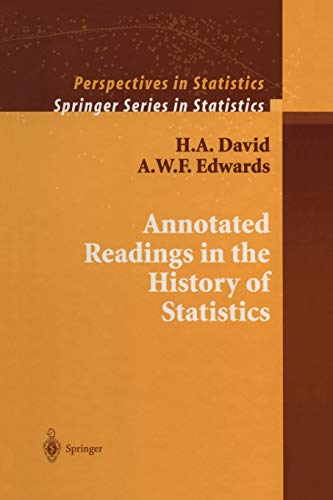
This book provides a selection of pioneering papers or extracts ranging from Pascal (1654) to R.A. Fisher (1930). The editors’annotations put the articles in perspective for the modern reader. A special feature of the book is the large number of translations, nearly all made by the authors. There are several reasons for studying the history of statistics: intrinsic interest in how the field of statistics developed, learning from often brilliant ideas and not reinventing the wheel, and livening up general courses in statistics by reference to important contributors.
User’s Reviews
Editorial Reviews: Review From the reviews:MATHEMATICAL REVIEWS”The book will be a useful addition to libraries and to the collections of those with a special interest in the history of statistical science.”CHOICE MAGAZINE”David (Iowa State Univ., Ames) and Edwards (Gonville & Caius College, UK) offer an interesting general historical book treating some aspects of the statistical literature. Because of increasing interest in historical development of probability and statistics, numerous good books and journal papers have appeared that either discuss such developments over a certain period or introduce certain specified and particular topics. This book provides access to some contributions neglected earlier, due either to lack of translation or to renewed interest. The origins of the following statistical concepts are included in the compilation: expectation, test of significance, accuracy of observations, coincidences and the inclusion and exclusion technique, asymptotic relative efficiency, logistic growth curve, goodness-of-fit statistics, distribution of sample variance from a normal population, random walk, estimating a binomial parameter by using likelihood functions, extreme-value theory, tournament outcomes, and confidence limits. Appendixes with short list of collected papers and source books cited; first occurrence of terms commonly used in statistics/probability; useful name and subject indexes; lists of references. The authors have done a great job in taking this task of filling the gaps in the historical introduction into literature of some statistical concepts, and this work will interest all engaged in studying or researching the history of statistics/probability. Highly recommended. Upper-division undergraduates through faculty.SHORT BOOK REVIEWS”Each article is introduced by an essay called ‘Comments on…’; these comments are informative, interesting and beautifully written, and contains numerous modern connected references. The production is first class…The collection is fun to browse. Statistics history buffs and browsers should order this book immediately.””If you enjoy the history of statistical and probabilistic ideas, you will enjoy this interesting book. It makes good reading … . This book is a useful addition to the literature on this increasingly popular subject, and I particularly recommend it to graduate students in statistics. There are many ideas that we think of as essentially modern but that have a long history. This book provides interesting background on quite a few of them.” (William E. Strawderman, Journal of the American Statistical Association, 2004)”This book contains ‘a selection of pioneering papers or extracts ranging from Pascal (1654) to R. A. Fisher (1930)’ … . The authors present a fascinating collection of articles. The accompanying commentaries are well written, easy to read and very instructive. … The book may be used as part of a course on the history of statistics or by lecturers wishing to provide a historical context … . It is also pleasurable recreational reading. I would recommend that libraries purchase a copy.” (Paul Northrop, Journal of Applied Statistics, Vol. 30 (1), 2003)”This book contains … seminal papers, translated into English where necessary, and prefaced by a commentary. In all there are seventeen articles, taken in chronological order, with publication dates spanning nearly three centuries. … The book will be a useful addition to libraries and to the collections of those with a special interest in the history of statistical science.” (C. C. Heyde, Mathematical Reviews, Issue 2002 e)
Reviews from Amazon users which were colected at the time this book was published on the website:
⭐The selection of papers in this volume is guided by no principle whatsoever other than the editors’ policy to collect “a number of contributions … which have hitherto been relatively neglected … or which seems to us to merit reassessment”. Such a haphazard collection can of course not do justice to bread-and-butter papers ripped out of their scientific context, and so it would seem that this book is doomed to be a library dust-collecting volume. But there is some reward in dusting it off not only for a particular reference but also for some papers that stand up well on their own.My favourite is the hilarious 1710 paper by Arbuthnott on the existence of God. A naive probability argument is supposed to show that the fact that “Nature, by the disposal of its wise Creator, brings forth more Males than Females”, supported by birth statistics, cannot be explained as a result of chance. The “wise Creator” has apparently taken into account the “Oeconomy of Nature”, namely that males “must seek their Food with danger”.In another delightful paper, Verhulst (1845) presents a simple population model. As long as there is non-exploited fertile land the population will grow in proportion to its size. The U.S. provides such a good fit to this thesis that Verhulst boldly claims that immigration must be cancelled by “obstacles that slavery puts in the way of the multiplication of blacks”. Once the land is more exploited, as in Europe, a correction factor comes into play, and the model predicts explicit maximum populations for European nations for when land exploitation and improvement will have reached their limit.Venn (1888) discusses “the conception of randomness”, partly “by appealing to graphical aid”, which involves creating a random walk from the digits of pi.Zermelo (1929) develops a way of ranking chess players from the results of a possibly interrupted tournament. The idea is simple and “amounts to regarding the relative strengths of the players as probabilities to be determined so that the probability of the occurrence of the observed tournament results is maximized”.
Keywords
Free Download Annotated Readings in the History of Statistics (Springer Series in Statistics) in PDF format
Annotated Readings in the History of Statistics (Springer Series in Statistics) PDF Free Download
Download Annotated Readings in the History of Statistics (Springer Series in Statistics) 2001 PDF Free
Annotated Readings in the History of Statistics (Springer Series in Statistics) 2001 PDF Free Download
Download Annotated Readings in the History of Statistics (Springer Series in Statistics) PDF
Free Download Ebook Annotated Readings in the History of Statistics (Springer Series in Statistics)