

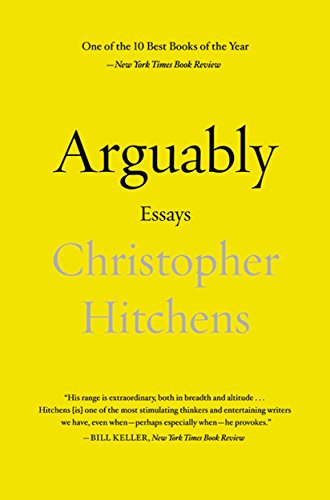
Ebook Info
- Published: 2011
- Number of pages: 758 pages
- Format: PDF
- File Size: 3.16 MB
- Authors: Christopher Hitchens
Description
“All first-rate criticism first defines what we are confronting,” the late, great jazz critic Whitney Balliett once wrote. By that measure, the essays of Christopher Hitchens are in the first tier. For nearly four decades, Hitchens has been telling us, in pitch-perfect prose, what we confront when we grapple with first principles-the principles of reason and tolerance and skepticism that define and inform the foundations of our civilization-principles that, to endure, must be defended anew by every generation. “A short list of the greatest living conversationalists in English,” said The Economist, “would probably have to include Christopher Hitchens, Sir Patrick Leigh-Fermor, and Sir Tom Stoppard. Great brilliance, fantastic powers of recall, and quick wit are clearly valuable in sustaining conversation at these cosmic levels. Charm may be helpful, too.” Hitchens-who staunchly declines all offers of knighthood-hereby invites you to take a seat at a democratic conversation, to be engaged, and to be reasoned with. His knowledge is formidable, an encyclopedic treasure, and yet one has the feeling, reading him, of hearing a person thinking out loud, following the inexorable logic of his thought, wherever it might lead, unafraid to expose fraudulence, denounce injustice, and excoriate hypocrisy. Legions of readers, admirers and detractors alike, have learned to read Hitchens with something approaching awe at his felicity of language, the oxygen in every sentence, the enviable wit and his readiness, even eagerness, to fight a foe or mount the ramparts. Here, he supplies fresh perceptions of such figures as varied as Charles Dickens, Karl Marx, Rebecca West, George Orwell, J.G. Ballard, and Philip Larkin are matched in brilliance by his pungent discussions and intrepid observations, gathered from a lifetime of traveling and reporting from such destinations as Iran, China, and Pakistan. Hitchens’s directness, elegance, lightly carried erudition, critical and psychological insight, humor, and sympathy-applied as they are here to a dazzling variety of subjects-all set a standard for the essayist that has rarely been matched in our time. What emerges from this indispensable volume is an intellectual self-portrait of a writer with an exemplary steadiness of purpose and a love affair with the delights and seductions of the English language, a man anchored in a profound and humane vision of the human longing for reason and justice.
User’s Reviews
Reviews from Amazon users which were colected at the time this book was published on the website:
⭐A masterful collection. Here is Hitchens as dream dinner party guest, slightly sloshed, louche but animated still, a couple of buttons down on the shirt, perspiring, smiling. His hands move as he makes his point. You have forgotten already about dessert. This Hitchens is still alive and well on the many “Hitch-slapped” compilations put up on YouTube.A large book, to be dipped into when, as Durant said of Nietzsche, you need “a bracing wind across a courtyard after a long and stuffy service in Church”. Here is Hitchens on the Kennedy’s:”A new volume by Ed Klein, portentously titled “The Kennedy Curse”, revealed the brief marriage of John Kennedy Jr. to Carolyn Bessemer to have been a cauldron of low-level misery, infidelity and addiction”: JFK: In Sickness and By Stealth, Times Literary Supplement 2003. . It’s the “low-level” that twists the knife here.The essay on JFK, a review of JFK: An Unfinished Life (“a title portentous and platitudinous at the same time”) by Robert Dallek, is undoubtedly the standout star of Part 1 All American, which slightly bizarrely has Hitchens, an Oxbridge educated English privileged public schoolboy and former champagne socialist, writing on historical American figures such as Jefferson, Franklin and Lincoln.Part 2 has Hitchens on more local ground writing on early and later 20th century English literary figures such as PG Wodehouse, Anthony Powell, Philip Larkin and Evelyn Waugh. Amusingly it’s titled “Eclectic”, presumably because the editor decided that the American reader might have little idea or care who those people were. The final review here is actually of the final Harry Potter book, where Hitchens, whilst generally kind and acknowledging that these books get young people to read, still skewers Rowling:”The repeated tactic of deus ex machina has a deplorable effect on both plot and dialogue”.Part 3 contains perhaps the most controversial (bizarrely) of all the writings “Why women aren’t funny”, written for an unimaginative, publicity seeking editor of Vanity Fair. Still managing to quote an interesting Kipling poem this disappointing rushed hack piece feels authored by a less talented Hitchens ghostwriter from GQ magazine. Definitely not disappointing in this section is Hitchens on Prince Charles:”A hereditary head of state, as Thomas Paine so crisply phrased it, is as absurd a proposition as a hereditary physician. To this innate absurdity, Prince Charles manages to bring fatuities that are entirely his own”.Charles, Prince of Piffle. Slate, June 14, 2010.Part 4 is Offshore Accounts. Disraeli said in Tancred “the East is a career” and Hitchens partly took this to heart, writing extensively on politics, Islamism and Orientalism in the Middle East. It is on religion that Hitchens has shown much of his intellectual rigor and bravery. The reader may find in his review of Orientalism and It’s Discontents by Robert Irwin in The Atlantic, March 2007 a description of a certain key religious figure as “a sex-craved brigand whose preachments were either plagiarized or falsified”.This reader does not quite share the same fascination with this area of the world but one of the best essays in the book is here, a review of Edward Said’s Orientalism, from the Atlantic, September 2003 – a book that was de rigor to be on your bookshelf when I was an MSc student in the late 1990s. Hitchens is quite fair to Said, although still slices him open with his accusation of membership of the “post-Foucault academy”.Part 5, Legacies of Totalitarianism, ups the intellectual and moral ante. It is worth remembering that Hitchens was once a committed socialist, as documented in his entertaining memoir Hitch 22. Heavy reviews here include Churchill, Hitler and Unnecessary War by Pat Buchanan – a book I have reviewed on Amazon – Human Smoke by Nicholson Baker, and Klemperer’s I Will Bear Witness (Klemperer was a Jew married to an Aryan who survived the war. This is sobering stuff and a reminder of the madness that could be inflicted on the world again by extremism and total war. Hitchens’ quote from Sebald on the aftermath of the fire bombings of Dresden by the ‘good guys’ says it all:”In the altmarket in Dresden, where 6,865 corpses were burned on pyres in February 1945 by an SS detachment which had gained its experience in Treblinka”. On the Natural History of Destruction by W.G. Sebald.
⭐As a Christian, I’ve always said that there are only two atheists whose arguments are worth listening to in order to sharpen one’s own faith. One of those is Hitchens. Despite his vigorous, and sometimes vociferous, arguments as a self proclaimed anti-theist, he shows his interlocutor respect, unless the interlocutor doesn’t deserve it. His debates with the likes of John Lennox and Douglas Wilson are cases in point. HIs courage in standing against the mindless acts of religions obsessed with rage and revenge is exemplary. In this book, his keen insights into politics, ideology and faith are nothing short of staggering. Whether it’s reflecting on the genius of Thomas Jefferson, or brutal acts of torture defying the Conventions of Geneva, Hitchens shows remarkable understanding of the complexities of these issues without jettisoning his deep commitment to morality and ethical conduct. His turn of phrase is sharp and his wit incisive. I would heartily commend this book to anyone who has an independent mind and a respect for truth.
⭐People hailed Christopher Hitchens as the greatest polemicist of our time — I don’t think that quite captures the essence of his writing. To borrow a quote from Tommy Boy, the man could sell a ketchup popsicle to a woman in white gloves, yes. He had vast knowledge, yes. He could wow you with his vocabulary, yes. But, the truly astonishing thing in his writing was his masterful use of imagery. Read his essay (in this book) on why women aren’t funny — the subtle imagery, even the sounds of the words he chooses to convey his meanings are cloaked in eroticism; a man subtly (and sometimes not so subtly) physically admiring women, under the pretext of insulting them. What an incredible writer! Even if you don’t agree with him — *especially* if you don’t agree with him — you should at least respect the works of someone who uses the language so well on so many different levels.
⭐I really miss Christopher Hitchens. He was, in my estimation, the most intelligent person I have ever heard, much less read. He is so well-versed in such a vast amount of topics that it is shocking. He demonstrates this in his book “Arguably.” As Dr. Richard Dawkins said, “If you are invited to debate Christopher Hitchens, decline.” What I love most about Christopher is he always, without exception, backs up every belief or perception he has about something with undeniable facts. This is why it was a disaster when anyone tried to debate this savant. This book is just another example of what a Renaissance man he was. Read this book, because you will learn–a lot.
⭐Hitchens is opinionated and can be an ass, but always in a very English way. His education bleeds through every letter. Too bad with all of his smarts, his taste for alcohol and cancer sticks could not be set aside and I think, perhaps, If he have found a farmhouse in the Hebrides to work from, instead of being in the bright light he coveted, he would be alive now and have written a decent novel, instead of settling down to professional polemics and writing about others. To me he’s a later, more modern version of George Orwell.
⭐This collection of late Hitchens’ writing is divided by subjects (literature, politics, miscellaneous, etc). If you are a fan, like me, this book is indispensable. Even when you don’t agree with the ideas of Hitch, you’re forced to admire the strength of his arguments – a man that advices you to “seek out argument and disputation for their own sake”. Wether talking about Wodehouse’s books or writing about the fascism in North Korea, Christopher Hitchens masters the rhetoric and, mainly, exposes his ideas with an envious transparency that makes you want to transcript his text word-by-word just to learn how to do it. I use to underline my favorite excerpts of a book. This one, I must say, is thoroughly underlined.
⭐The author is so well read, with so many connections to the authors that he himself reviews, that I confess I feel inadequate to the task of reviewing this work. Whether or not one agrees with the analysis, or the political perspective on offer, the author marshalls his arguments masterfully, embellishing them with personal witness furnished by his journalist experience. Simply awesome.
⭐Much missed Christopher Hitchens – I cannot tire of this book, such a wealthy collection of essays, beautifully written, argued and opens the mind to objective thought and questions the general opinion. Highly intellectual, every word melts in the brain.
⭐Obviously well written by an expert on American politics, but I found it heavy going. However, more serious-minded people will enjoy this look back at American thinking over the last 150 years. I bought it thinking it was about English politics which is my mistake.
⭐Hitchens is hugely well-informed, tremendously eloquent, and argues devastating well. He is liberal (without a trace of wishy-washyness), and radical (without seeming extremist). Reading him feels authentic – considering his massive breadth of reading, he writes a good deal from experience.In one particularly characteristic essay, he condemns the jihadist atrocities in postwar Iraq – urging us to recognise fundamentalist terrorism clearly for what it is, and not to interpret it as a somehow understandable response to the decision to oust Saddam. (His support of that decision is well known, and is reiterated here. Also, he asks, why is supposedly so difficult to believe that Saddam’s WMD were hidden/sold/otherwise transferred ?)Elsewhere in the volume he targets other established anti-liberal forces : The Ten Commandments (one-by-one); the wearing of burkas; capital punishment of psychiatrically disturbed children in the US. Reciprocally, one moving piece captures the hope felt in Afghanistan after the Taliban’s 2004 defeat.Also victim to the laser of his `arguing’ falls anti-science quasi-spiritual mumbo-jumbo, in this case its unfortunate proponent being Prince Charles.There are lighter, entertaining pieces too: slightly mischievous reflections on gender differences in sense of humour; and on the inexorably global adoption of the English vernacular f*** off.I feel that he can occasionally overstrain an argument, and that he is sometimes over-critical, but I can forgive him both tendencies, in view of this wealth of frequently perceptive, often courageous, and sometimes quite brilliant observational writing.
Keywords
Free Download Arguably: Essays by Christopher Hitchens in PDF format
Arguably: Essays by Christopher Hitchens PDF Free Download
Download Arguably: Essays by Christopher Hitchens 2011 PDF Free
Arguably: Essays by Christopher Hitchens 2011 PDF Free Download
Download Arguably: Essays by Christopher Hitchens PDF
Free Download Ebook Arguably: Essays by Christopher Hitchens