Ebook Info
- Published: 2017
- Number of pages: 300 pages
- Format: PDF
- File Size: 1.98 MB
- Authors: Philip F. Esler
Description
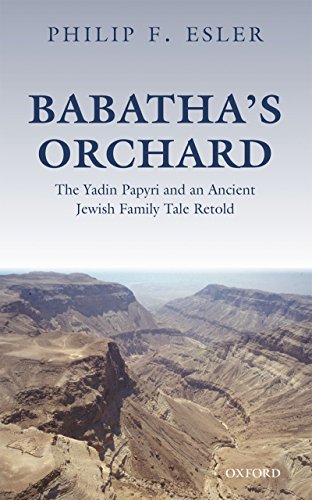
In 1961 archaeologists discovered a family archive of legal papyri in a cave near the Dead Sea where their owner, the Jewish woman Babatha, had hidden them in 135 CE at the end of the Bar Kokhba revolt. Babatha’s Orchard analyzes the oldest four of these papyri to argue that underlying them is a hitherto undetected and surprising train of events concerning how Babatha’s father, Shim’on, purchased a date-palm orchard in Maoza on the southern shore of the DeadSea in 99 CE that he later gave to Babatha. The central features of the story, untold for two millennia, relate to how a high Nabatean official had purchased the orchard only a month before, but suddenly rescinded the purchase, and how Shim’on then acquired it, in enlarged form, from the vendor. Teasing outthe details involves deploying the new methodology of archival ethnography, combined with a fresh scrutiny of the papyri (written in Nabatean Aramaic), to investigate the Nabatean and Jewish individuals mentioned and their relationships within the social, ethnic, economic, and political realities of Nabatea at that time. Aspects of this context which are thrown into sharp relief by Babatha’s Orchard include: the prominence of wealthy Nabatean women and their husbands’ financialreliance on them; the high returns and steep losses possible in date cultivation; the sophistication of Nabatean law and lawyers; the lingering effect of the Nabateans’ nomadic past in lessening the social distance between elite and non-elite; and the good ethnic relations between Nabateans and Jews.
User’s Reviews
Reviews from Amazon users which were colected at the time this book was published on the website:
⭐The author wrote this book because he has a certain theory about the connection of the first four papyri of the Babatha archive (no spoilers in this review). He explains the theory and adds a rich ethnographic commentary about the Nabataean society of 130CE. The result is highly competent, but also somewhat speculative and verbose in my view.This is not a book you want to read without previous knowledge of the Babatha archive. On a literal level, the author does not assume that you know the extensive previous work on the archive. Still, the book is best understood as a commentary on previous work on a particularly challenging fraction of that archive.
⭐this was ordered on February 26 in Kindle format, but never arrived. I read a friend’s copy and have now purchased it as a used hardcover book on April 28, 2017. It is extremely rare that and order from Amazon does not arrive, but if you read my “Account and Lists” you will see that it is clearly noted as not sent. Thus, my reorder in different format.Dr. Marilyn Ekdahl Ravicz
⭐On March 5 2017, Gloucestershire Live published an article about an “Indiana Jones” biblical scholar who made a great discovery. Usually that’s a warning to count the spoons and brace for impact. But the scholar in question is Philip Esler — just about the last name you would associate with crackpot archaeology. So what is Babatha’s Orchard about?In the first pages of this Esler assures us: “There are no Arks of the Covenant, hidden temple vessels, Holy Grails, lost Gospels or Mary Magdalens here. Instead this is a tale of domestic life. It is the story of how, around 99 CE, Shim’on, Babatha’s father, unexpectedly came to acquire an irrigated date-palm orchard in his village of Maoza, on the southern shore of the Dead Sea, in the kingdom of Nabatea.”Babatha’s Orchard is exciting to read because it’s real. It offers a window onto everyday life in antiquity, unencumbered by sensationalism. That window is provided by the Babatha collection, discovered in 1961 by a team of archaeologists, which are the possessions of a second-century Jewish woman including sandals, balls of yarn, key-rings, knives, bowls, waterskins, and other items — and also a pouch containing 35 legal documents. These documents are dated between 94 and 132 AD, and consist of various contracts for purchase of property, loans, weddings, and the registration of land.Esler is concerned with the earliest four documents, Papyri Yadin 1-4, the first of which dates to 94, the other three to 99. P. Yadin 2 and 3 describe the purchase of a date-palm orchard, first by a Nabatean high-ranking official named Archelaus, second by a Judean (Jew) named Shim’on (the future father of Babatha) only a month later — but purchased both times from the same woman. Esler not only reconstructs what went on between P. Yadin 2 and 3, he also argues that P. Yadin 1 and 4 bear on the same issue. “No one seems to have asked,” says Esler, “why the first and fourth documents were found in the archive in the first place.” Why did Babatha, years later, keep copies of these legal documents? They presumably had some relevance to the orchard acquired by her father and should help make sense of that event.The mystery of P. Yadin 1P. Yadin 1 describes a transaction in 94 AD that at first blush seems to have nothing to do with the orchard sale (and resale) in 99. Basically a Nabatean named Muqima borrowed money from his wife’s dowry to purchase a lease of property, and to share the investment risk enlisted a partner whose name was Abad-Amanu. What no one seems to have realized before Esler is that the Abad-Amanu of P. Yadi 1 is none other than the father of Archelaus, the buyer of the orchard in P. Yadin 2 — a link that proves of “critical importance in unlocking the mystery behind these documents” (p 111).The mystery is how Abi-adan (the woman who owned the orchard) sold the orchard to Archelaus (P. Yadin 2) and then only a month later sold it to Shim’on (P. Yadin 3). Scholars have suggested that Abi-adan annulled her agreement with Archelaus when Shim’on offered a better deal, but Esler refutes this, for there is no way Abi-adan could simply have reneged on her deal which gave Archelaus legal rights. Not to mention the extreme unlikelihood that a non-elite woman would act in such a capricious way towards a strategos (a government official charged with both civil and military duties, as Archelaus was) (p 140). No, it must have been that Archelaus himself backed out of the agreement, requesting that Abi-adan annul the contract and refund his money. But why?Esler spots the reason under our noses in P. Yadin 1 — and the reason for which that seemingly unrelated document is in the Babatha collection to begin with. The partner of that earlier transaction, Abad-Amanu, died soon after Archelaus bought the orchard in 99, and he was Archelaus’ father. At this point the woman (Amat-Isi) was still owed money under the loan agreement with her husband Muqima and Abad-Amanu. Esler argues that Nabatean law provided for universal succession (like the legal systems of Mesopotomia, Rome, and certain Judean provinces), which means that an heir (like Archelaus) received the entire estate of the deceased (Abad-Amanu), benefits and debt included. Amat-Isi would have been calling on Archelaus to pay Abad-Amanu’s debt, and his honor as a strategos was at stake. So he appealed to Abi-adan to rescind the bargain of P. Yadin 2. That turn of fate immensely benefited the Judean (Jewish) Shim’on, who was probably passed over the first go-around in favor of the strategos, and was now waiting in the wings to buy the orchard.The mystery of P. Yadin 4That triggers the second mystery, the one of P. Yadin 4, which survives as a fragmentary document without any legible names, but which Esler believes to allow more restoration than scholars have realized. Through brilliant detective work he shows that P. Yadin 4 is a grant (a cross between a gift and a sale, or a transfer of property where the return wasn’t necessarily a purchase price), and indeed the very grant mentioned in P. Yadin 3. Shim’on wanted to buy a larger portion of the orchard than Archelaus did, and Abi-adan was apparently planning to acquire that extra piece of orchard from a certain “son of Lutay”, who would give it to her as a grant. In P. Yadin 4 we have exactly that: someone saying that he will grant an orchard to a female.More sleuthing on Esler’s part makes everything fall into place, as this “son of Lutay” emerges as the likely husband of Abi-adan. He acknowledges that he is debt to her in P. Yadin 4, and that he will reduce his debt by transferring the extra piece of orchard to her (which he was currently leasing to someone else, to expire in a few months). Esler points out that when men are indebted to women, it’s almost invariably the case of husbands indebted to their wives for having drawn on the wife’s dowry. Also, back in P. Yadin 3, Abi-adan and the son of Lutay are referred to together solely by their first names, which is a familiar manner of designation suggesting a married pair.The relevance of Nabatean cultureLike any Philip Esler book, Babatha’s Orchard is prefaced by chapters of background history and cultural cues. I hadn’t realized how egalitarian the Nabateans were compared to their contemporaries, and that the ethic apparently pervaded all the way up to the kingship. Esler cites Strabo who describes the Nabatean king as a “man of the people” who served them at banquets, and who accounted for himself at popular assemblies where his means and methods were scrutinized. That’s a humble model of kingship hard to find elsewhere in the ancient Mediterranean.Esler accounts for this in terms of the nomadic mindset. From their earliest days (in the fourth century BC) the Nabateans jealously guarded their independence and freedom. They were able to take refuge in the desert when forces invaded, and were hard for enemies to overcome because of secret wells they could access. Fredrik Barth has explained how nomadic household leaders had a freedom that was incompatible with the hierarchical structures of agrarian societies. “Unlike a sedentary community, which persists unless the members abandon their house and land and depart, a camp community of nomads can only persist through a continuous re-affirmation by all its members. Every day the members of the camp must agree in their decision on the vital question of whether to move on, or to stay camped, and if they move, by which route and how far they should move. Every household head has an opinion, and the prosperity of the household is dependent on his decision.” (p 38)Even after the emergence of a sedentary lifestyle and the kingship (in the second century BC), the Nabateans retained a nomadic dimension to their existence right up into the second century AD. The king and the elites were in sync with this.This becomes relevant when Esler is able to illuminate things in surprising ways. For example, in his reconstruction, Amat-Isi (the woman of P. Yadin 1) called on Archelaus to collect the debt his father owed her. But Archelaus was a strategos, and in most places in the Mediterranean, it would have been a bold if not suicidal move on the part of a woman (or non-elite man, for that matter) to risk affronting an elite. As a rule, however, the Nabateans disdained elitist superiority and didn’t go out of their way to make life difficult for “presumptuous” commoners: “Influenced by the nomadic traditions still operative among the Nabatean elite, Archelaus was not someone filled with his own sense of importance and was not likely to hold it against Amat-Isi in the future that she had asked him for the money his father had owed.” (p 224)Not exactly how things worked in Judea and Galilee.The UpshotIf I could write a book like Babatha’s Orchard, I’d be very proud. Rarely can scholars piece together missing and obscured information so compellingly, and in a way that allows us to read it as a story. Esler writes that story in the final chapter — how a Jew living in Nabatea bought a date-palm orchard from a woman after a high-ranking official failed to do so — bringing to life a complex web of events, personal motives, and social relations. It’s a story one could easily get a novel from. The book is also impressive as a study for its own sake and not as a means to an end. “I am not concerned,” says Esler, “to interpret New Testament texts against a social context known from the Nabatean legal papyri. Rather, I am seeking to understand better that context itself.” That’s fresh air, and the kind of thing I’d love to see more from our New Testament scholars.The post-script to Babatha’s story is a tragic one. In the Jewish revolt of 135 AD, she was captured by the Romans and in all likelihood killed or enslaved. But not before hiding her collection in a cave by the Dead Sea, to await discovery in 1961. Esler’s book honors her in the best possible way.
Keywords
Free Download Babatha’s Orchard: The Yadin Papyri and an Ancient Jewish Family Tale Retold 1st Edition in PDF format
Babatha’s Orchard: The Yadin Papyri and an Ancient Jewish Family Tale Retold 1st Edition PDF Free Download
Download Babatha’s Orchard: The Yadin Papyri and an Ancient Jewish Family Tale Retold 1st Edition 2017 PDF Free
Babatha’s Orchard: The Yadin Papyri and an Ancient Jewish Family Tale Retold 1st Edition 2017 PDF Free Download
Download Babatha’s Orchard: The Yadin Papyri and an Ancient Jewish Family Tale Retold 1st Edition PDF
Free Download Ebook Babatha’s Orchard: The Yadin Papyri and an Ancient Jewish Family Tale Retold 1st Edition