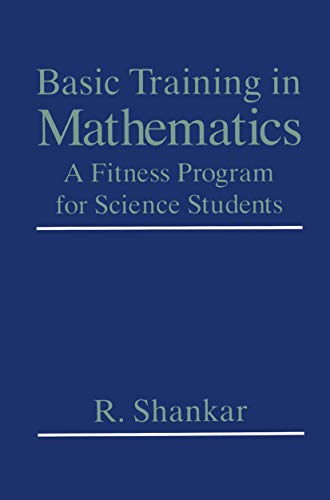
Ebook Info
- Published: 2013
- Number of pages: 371 pages
- Format: PDF
- File Size: 23.91 MB
- Authors: R. Shankar
Description
Based on course material used by the author at Yale University, this practical text addresses the widening gap found between the mathematics required for upper-level courses in the physical sciences and the knowledge of incoming students. This superb book offers students an excellent opportunity to strengthen their mathematical skills by solving various problems in differential calculus. By covering material in its simplest form, students can look forward to a smooth entry into any course in the physical sciences.
User’s Reviews
Reviews from Amazon users which were colected at the time this book was published on the website:
⭐I purchased this book out of curiosity, being a big fan of the author’s volume on Quantum Mechanics. I read this book with the spirit of going through a fun refresher of some concepts I am already familiar with but haven’t seen in some time (I obtained B.A. in both Mathematics and Physics about a decade ago and have only sporadically practiced the craft on my free time in specific areas of interest).Having gone through the whole book and worked through many of the nice non-trivial problems it presents, I feel this book achieves in a fair way the objective that it sets upon doing, provided you are already familiar with most of the topics presented. Also, you must be ok with the un-rigorousness of the presentation and its informal attitude: I personally think it’s a good and fun way of going through the bare-essentials in a timely way, but if you are more mathematically-inclined you may not like this approach.The only critique I have is that the quality of the presentation is of too great of variability. Certain parts are quite beautifully treated (the chapter on vector analysis particularly comes to mind and a beautiful self-contained digression on its application to electromagnetism; the quick review of real analysis is also fairly well-presented; some of the more intuitive motivations of the theory of vector spaces also have some very enlightening discussions). Others, I feel, fail in the attempt to bring a clear presentation or a well-structured re-capitulation of known material: it reverts instead to the prescription of “look-it-elsewhere” far too often on critical parts (whether explicitly or not).For this reason I feel this volume may be recommended only to those already very familiar to the material presented in the book, and are ready to go through the author’s fun idiosyncratic presentational style, and thus exposed to the beautiful many little gems dispersed across the book. If that is not the case, the reader might find it more profitable to his/her own understanding picking up a more comprehensive book on mathematical methods on this same level of presentation (such as Mary L. Boas’ Mathematical Methods in the Physical Sciences), and go through the chapters covering the techniques of interests. A combination of the two (reading prof. Shankar’s volume in conjunction of other more comprehensive treatments) may also be a profitable third alternative.
⭐Shankar is a physics professor at Princeton who teaches mathematical methods to undergraduates, though from this book you’d think he teaches rigourous pure math to math majors. The biggest problem with this book is that every single topic in it is covered in such a way that you’re hopeless if you haven’t had at least a basic introduction to it elsewhere. I love math but he throws odd notation at you without explaining it, he skips steps and is too brief explaining things. He’ll say things like “
⭐It seems that most negative reviews argue that it has a huge amount of mathematics in a short book, but that is exactly was it was designed to be. As physics students know too well, professors often expect you to know – or at least be able to learn on your own – a certain subset of fairly complicated mathematics that physicists call upon most frequently. This book is WAY shorter than the traditional textbook that we used in my “mathematics for physicists” course, but was infinitely more clear and helpful. This is a book that one can use on their own as needed to truly learn the math being used to simplify or defend a professor as he or she moves through a proof. It’s the math they assume you learned somewhere, in a beautifully clear and compact form. Shankar is up there with Griffiths for his ability to make a complex topic clear. Its small and light enough to carry with you wherever. I love love love this book!!!
⭐Good Reference book – not a learning book.For learning the mathematics use the following books instead “Mathematical Methods in the Physical Sciences” by Boas, “Mathematical Methods for Physics and Engineering” by Riley, Hobson, Bence, “Mathematical Methods for Science Students” by G. Stephenson, “Advanced Mathematical Methods for Engineering and Science Students” by G. Stephenson, “Partial Differential Equations for Scientists and Engineers” by G. Stephenson, “An Introduction to Matrices, Sets and Groups for Science Students” by G. Stephenson, “Modern Engineering Mathematics” by Glyn James, “Advanced Modern Engineering Mathematics” by Glyn James and of course the old classic “Applied Mathematics for Engineers and Physicists (3rd Ed.) by Pipes and Harvill.
⭐Its a good intro book to many of the key subject matters needed for for university. Every high school library should have one.
⭐In diesem Buch werden die mathematischen Grundlagen für ein Physikstudium beschrieben. Der Autor schreibt gewohnt frisch und mitunter auch witzig. Es gelingt ihm meiner Meinung nach sehr gut auch die schwierigeren Themen anschaulich zu erklären. Im Text sind einfache Aufgaben eingebunden, die das Verständnis erleichtern.Ich habe das Buch in kurzer Zeit von vorne bis hinten gelesen und alle Aufgaben gerechnet. Für mich war das Buch wie vom Autor beschrieben eine Trainingseinheit in allen Gebieten der Mathematik, die ich während meines Physikstudiums und meiner Arbeit in der Theoretischen Physik benötigte. Auch wenn ich das Buch zum Ende meines Studiums gelesen habe und daher in vielen der beschriebenen Themen schon versiert war, bin ich der Meinung, dass jeder Physikstudent nach dem zweiten Semester das Buch ähnlich zügig und gewinnbringend wie ich lesen kann.Ich empfehle das Buch jedem Studenten, der sich entweder auf eine Prüfung in den Mathematischen Methoden der Naturwisenschaften vorbereitet oder der sich (vielleicht während des Besuchs von Vorlesungen der Theoretischen Physik) etwas unsicher im Umgang mit seinem mathematischen “Werkzeug” fühlt. Das Buch versteht es, einen sehr schnell auf einen Stand zu bringen, auf dem man grundlegende wissenschaftliche Rechnungen anstellen kann. Meine vollste Empfehlung an alle naturwissenschaftlich Interessierten.Wem dieses Buch gefällt, der sollte auch die anderen Werke des Autors lesen. R. Shankar ist ein Meister im Schreiben von Lehrbüchern für den normalen Studenten oder an Physik Interessierten. Ich kann jedem meine uneingeschränkte Empfehlung aller von ihm verfassten Lehrbücher geben. Vom “Basic Training in Mathematics” bis zum anspruchsvolleren aber wunderschönen “Principles of Quantum Mechanics” sind aller Werke ein Genuss für jeden, der sich intensiv mit Physik auseinandersetzen möchte.Die Kindle-Version ist wohl ein Witz?! Das Buch fängt irgendwo in der Mitte an und danach folgtein wildes Aufeinanderfolgen von schlechten PDF-Seiten? Sieht mir nach einer mißlungenen Raubkopieaus! Gibt es bei Amazon keine Qualitätkontrolle für Kindle???The Kindler version is horrible, the pages are all broken and jumping numbers.
Keywords
Free Download Basic Training in Mathematics: A Fitness Program for Science Students 1995th Edition in PDF format
Basic Training in Mathematics: A Fitness Program for Science Students 1995th Edition PDF Free Download
Download Basic Training in Mathematics: A Fitness Program for Science Students 1995th Edition 2013 PDF Free
Basic Training in Mathematics: A Fitness Program for Science Students 1995th Edition 2013 PDF Free Download
Download Basic Training in Mathematics: A Fitness Program for Science Students 1995th Edition PDF
Free Download Ebook Basic Training in Mathematics: A Fitness Program for Science Students 1995th Edition