

Ebook Info
- Published: 2013
- Number of pages: 675 pages
- Format: PDF
- File Size: 13.83 MB
- Authors: Andrew Gelman
Description
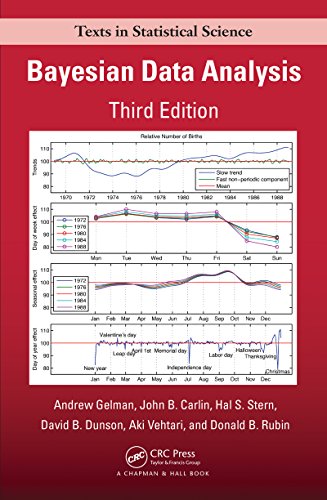
Winner of the 2016 De Groot Prize from the International Society for Bayesian AnalysisNow in its third edition, this classic book is widely considered the leading text on Bayesian methods, lauded for its accessible, practical approach to analyzing data and solving research problems. Bayesian Data Analysis, Third Edition continues to take an applied approach to analysis using up-to-date Bayesian methods. The authors—all leaders in the statistics community—introduce basic concepts from a data-analytic perspective before presenting advanced methods. Throughout the text, numerous worked examples drawn from real applications and research emphasize the use of Bayesian inference in practice.New to the Third EditionFour new chapters on nonparametric modelingCoverage of weakly informative priors and boundary-avoiding priorsUpdated discussion of cross-validation and predictive information criteriaImproved convergence monitoring and effective sample size calculations for iterative simulationPresentations of Hamiltonian Monte Carlo, variational Bayes, and expectation propagationNew and revised software codeThe book can be used in three different ways. For undergraduate students, it introduces Bayesian inference starting from first principles. For graduate students, the text presents effective current approaches to Bayesian modeling and computation in statistics and related fields. For researchers, it provides an assortment of Bayesian methods in applied statistics. Additional materials, including data sets used in the examples, solutions to selected exercises, and software instructions, are available on the book’s web page.
User’s Reviews
Reviews from Amazon users which were colected at the time this book was published on the website:
⭐Almost every statistical literature I’ve seen that has any mention of bayesian analysis references this book. This is what brought me into finally purchasing a copy and reading it almost cover to cover.First I want to comment on the bayesian vs frequentist debate, and why one may want to use bayesian methods. Anyone who objects to bayesian paradigm on the basis of subjectivity has to realize that all statistical models are subjective. The decision to use a linear model, logistic regression, or normal distribution for your data, to list a few examples, are subjective decisions. It’s no more subjective than putting a prior on your parameters. A prior doesn’t have to be very informative, but can encode reasonable range of values for the parameters, such as person’s height is between 0 and 10 feet, or that the number of siblings is less than 100, rather than having data completely determine the parameters. When properly incorporated, prior knowledge will help produce more precise parameter estimates.However Bayesian analysis is more than just incorporating prior knowledge into your models. It provides probability distributions on the parameters, instead of asymptotic interval estimates. It provides an automatic way of doing regularization, without a need for cross validation. This allows one to estimate more parameters than classical frequentist models can handle, and even deal with cases when p >= n. Another advantage is relaxing independence and identical distribution assumption, as hierarchical bayesian models automatically build dependence between observations, similar to latent variables in classical statistics.So in my opinion classical statistics already incorporates bayesian ideas through subjective selection of parametric models, practice of regularization such as ridge regression and lasso, and dependence through latent variable models, although it’s done in somewhat ad-hoc manner. Bayesian statistics formalizes these notions within probability theory, and together with simulation, allows easy extensions of them in various non-trivial directions.Now about this book. It covers all these advantages of bayesian methods and more, although sometimes requires considerable effort from the reader to uncover and pull out the relevant concepts. It’s definitely not meant to be an introduction to statistics. It’s assumed the reader is well versed in classical statistics and has a good grasp on topics such as hypothesis testing and interval estimation, sufficient statistics and the exponential family, MLE and it’s asymptotic properties, EM algorithm, and generalized linear models, to name a few. Also I think that bayesian methods require a deeper intuition in probability theory and involve more computation and approximation techniques to build even simple models. Considering the background needed it’s likely that the reader would have had a considerable prior exposure to bayesian techniques, and I think this is the target audience that the authors had in mind when writing this book.The book is definitely tough on the first reading, especially if this is your first book entirely devoted to this subject. But reading it is well worth the effort. It covers a lot of details and subtleties of bayesian approach that are not well emphasized in books devoted to general statistics and machine learning.The book is of applied nature, written in a way that every applied book should be. There is enough discussion of the theory in order to understand, apply, and extend the described methods. Each chapter is followed by a small section discussing the relevant references if you need to follow the theory in more detail. The authors make a great use of non-trivial examples that show the implementation details and possible complications in the discussed models. In addition, there’s an appendix covering computations with R and Stan software.The first five chapters present a solid, if somewhat terse, introduction to general bayesian methods, including asymptotics and connection to MLE, and culminating in hierarchical bayesian models in chapter 5. Two chapters follow on the important topic of model testing and selection. Chapter 8 covers data collection, and while it’s a fascinating read and a novel idea if you’ve never seen it before, I think it could be skipped on the first reading without affecting much the understanding of further chapters.Chapters 10-13 deal with simulation and analytic approximations, two central tools for bayesian analysis, because for most practical models direct analytic expressions are intractable. The authors provide a good overview of the rejection sampling, Gibbs, and Metropolis-Hastings algorithms. The explanations are enough for basic implementations. Chapter 13 introduces approximations around posterior modes. There is a very intuitive explanation of the EM algorithm along with it’s mathematical derivation. This is followed by variational inference and expectation propagation, approximations which are based on the Kullback-Leibler divergence.Up to this point in the book is a solid overview of bayesian inference, model checking, simulation and approximation techniques. Further chapters are mixed in the level of presentation and content.The second half of the book deals with regression. The chapters here become terser and the language less precise. The level of presentation deteriorates towards the end, where in my opinion the chapters on non-parametric models are almost impossible to understand without some prior exposure. There are more sections that require multiple re-readings and places where I feel reading the references prior to the book is a good idea (such as dirichlet processes). However I do think that the chapters on robust inference and finite mixture models were exceptionally good.I was disappointed that only 2 pages were devoted to regularization and variable selection in linear regression. In my opinion bayesian techniques provide powerful alternatives to classical regularization methods, where instead of choosing the regularization hyperparameters through cross validation, we marginalize over it, thus effectively taking an average over all possible regularizations. Although authors do spend more time on regularization in the context of the basis function selection in chapter 20, I feel it’s a pity they didn’t choose to devote more space to it in linear regression setting.Some other small negative things about the book in my opinion are: – constantly referring to later chapters in the book – various small typos/mistakes that detract from reading – presentation of expectation propagation in chapter 13 is confusing and no mention is made that it’s related to minimizng Kullback-Leibler divergence – no mention of relevance vector machines for basis function selection in chapter 20 – no mention of bayesian dimensionality reduction and factor modelsHowever I think that the excellent presentation in the first half of the book alone makes it well worth studying. It’s use as a reference far outweighs it’s shortcomings as an introduction, and I’m sure I’ll be picking it up countless times when reading other bayesian material. I highly recommend this book for anyone with classical statistics background looking to understand bayesian methods in depth.
⭐Hefty book and well written. This is clearly the gold standard in the field
⭐Tough read, but rewarding. Gelman dives deep, but if you hang on, you will find some really good insights. I would suggest a solid understand of Bayesian Statistics, and a proclivity reading statistics papers as good background.
⭐Excellent book. Right from the start it explains everything with good examples from authors’ research in a very clear and understandable way. Good list of exercises at the end of each chapter (some are easy, some are hard) that really helps anyone using it for self study. Content has some minor overlap with another of Gelman’s book, but that was fine with me.The book has a lot of good content and assumes previous knowledge on basic probability and statistics.Definitely recommended as a starter, refresher, self-study guide, textbook or even reference for anyone interested in bayesian modelling.
⭐I was told to buy this book as a supporting text. It is very good for that.
⭐One of the best books about Bayesian Data Analysis. I read 4 of them.
⭐My son requested this book for birthday. He was very pleased.
⭐Great book
⭐It’s an ok book.It’s worth only as a reference and mainly as a practical guide. Most methods are barely explained, no theoretical foundations of why they work is given. If you’re looking for a recipe book, then this is it. However, even at that, it’s not suitable for every subject. In econometrics, this book would be pretty much pointless. Much of the topics we’re interested do not show up…On the good side, some exercises have solutions on their site. But even then, these exercises aren’t the most enticing I’ve ever seen. Example: In chapter 2, there’s an exercise on non-infor priors. They say to choose one and apply to the problem. The solutions at the author’s site say that any of those referenced in the book work. Well, choose Jeffreys. Then, you’ll get a negative fisher information scalar. Hum… this can’t be. I post a question on CV stackexchange, and then I discover that Jeffreys prior doesn’t always work when you have a discrete r.v. And the book is silent on this matter. There are more examples like this… It’s only useful for those already proficient at the subject, or looking just as rough practical guide for biostatistics.
⭐Excellent book at the intermediate level to learn about Bayesian methods. I struggled through a few machine learning texts but didn’t get a good handle on fundamental topics such as MCMC methods and hierarchical methods. This book explains these topics thoroughly and doesn’t rely on mathematical formalism only. If you find yourself in a similar boat, I would definitely consider BDA3. One minor observation though is that the latter chapters with the new material are less even in terms of lucidity.If you happen to be looking for a simpler introduction then perhaps consider the book by John Kruschke. If you are not convinced about Bayesian statistics yet, consider E.T. Jaynes’ wonderful book on Probability Theory from a more philosophical perspective.
⭐This book, in each of its editions, has been the best graduate-level book on the subject the time of its publication.Since the 2nd edition came out there have been substantial improvements in MCMC computation algorithms and convergence modelling as well in Bayesian nonparametric modelling. Substantial new material has been added to cover these items. The one potential caveat is that the authors have stripped out all the BUGS code that was in the previous two editions and replaced it with code in their new language, Stan. They claim Stan is better (faster, better convergence in certain situations where BUGS is known to struggle) but BUGS is proven technology whereas Stan is a (very promising) newcomer. There’s more than enough new material to justify upgrading to edition 3 in my view.
⭐This book is The Source. It has the optimum balance of completeness of treatment and conciseness. I’m coming from a maths background and I am finding the book satisfyingly grounded. The boundary of pre-requisite knowledge is clear, and it doesn’t mention much by wave of the hand which will leave you Googling concepts for days on end. These qualities make such a book a rare gem in the statistics literature.
⭐A great book in Bayesian statistics. Its pragmatic approach is superb, especially its emphasis in predictive model selection and testing that is similar in spirit to the classical concept of cross-validation. The book contains a miriad of examples. The point-of-view of the authors comes mainly from social sciences, and therefore readers from physical sciences might need more time to get used to the terminology. My only criticism is the conscious omission of the Bayes factors in the book, so it is better use other sources for this topic.
Keywords
Free Download Bayesian Data Analysis (Chapman & Hall/CRC Texts in Statistical Science Book 106) 3rd Edition in PDF format
Bayesian Data Analysis (Chapman & Hall/CRC Texts in Statistical Science Book 106) 3rd Edition PDF Free Download
Download Bayesian Data Analysis (Chapman & Hall/CRC Texts in Statistical Science Book 106) 3rd Edition 2013 PDF Free
Bayesian Data Analysis (Chapman & Hall/CRC Texts in Statistical Science Book 106) 3rd Edition 2013 PDF Free Download
Download Bayesian Data Analysis (Chapman & Hall/CRC Texts in Statistical Science Book 106) 3rd Edition PDF
Free Download Ebook Bayesian Data Analysis (Chapman & Hall/CRC Texts in Statistical Science Book 106) 3rd Edition