

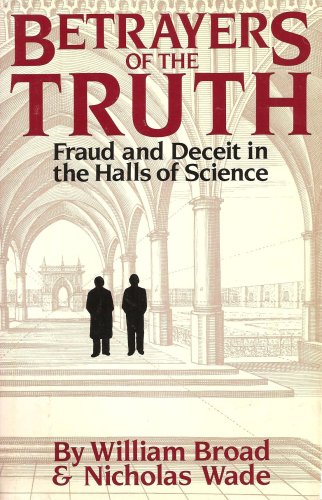
Ebook Info
- Published: 1983
- Number of pages: 256 pages
- Format: PDF
- File Size: 26.94 MB
- Authors: William Broad
Description
User’s Reviews
Reviews from Amazon users which were colected at the time this book was published on the website:
⭐In the course of researching scientific retractions I have taken to reading much literature about the hows and whys of scientific deception. Last week I posted a review of False Prophets by Alexander Kohn. That book was written about five years after Broad and Wade’s that is the subject of this book review. It is with curious irony that I report that Kohn’s book relied so heavily on this current book that it must have taken the author about two hours to write. He did cite these two authors and this book regularly so it is not plagiarism. Essentially they did his leg work for him.I have been familiar with Wade for many years by reading books and articles most often in the New York Times. He has been controversial on several topics which suggest that he may prefer the status of iconoclast, one which sticks in my craw for its hubris. That does not suggest that he is anything but a good writer and I selectively read his articles and learn from them. Broad is new to me except as being referenced in other literature.So this is a better book than Kohn’s because it sets up precedents for its assault on science. While the author’s state often that scientific fraud is rare, they sensationalize what they have found. The title of the book in itself is hyperbole. They also tell the reader that much of what is found in the precedents mentioned above are myths suggesting that in the broad world of science notions such as the scientific method and peer review are fraudulent in themselves. The self-policing of science is nonexistent which is in contradiction to much of the ideas in this book.The precedents include a broad description of how scientific research is conducted. They call them “attractive ideals” and then define them as ideology. They include:A “Cognitive Structure” which is the scientific method; the verifiability of scientific claims; the peer review process. They also discuss the sociological norms of science as defined by Robert Merton. Merton also described science as utilizing “universalism” whereby true science does not know boundaries as to who can participate. Merton perhaps was an ideologue since there is plenty of evidence that gainsays the scientific world as universalist. Anyone who has read about the lives of EE Just or Leithe Misner would have to agree.So in the world of science there are the superstars or as John Passmore, the philosopher of science would suggest-the “aristoscientists” and they certainly hold positions and make decisions that affect the direction of researches. When they determine that it is in their best interest to point scholarship in a direction that gilds their own path they may take it. But they do not all do that. There are those that do but I think the authors on this book paint with a broad brush.It is true and has been borne out by much research has verified that the aristocientist suffers much more from scientific infidelities than their underlings. They are forgiven more readily than their post-docs who become farm laborers rather than chemists should their fraudulent behavior become uncovered.So Broad and Wade outline what is wrong with the scientific culture and offer little to suggest how it could change for the better. There are comments that are snarky about the myths of peer review for example but the actual tone suggests to the reader that these are not really solutions.The largest part of the book describes egregious scientific fraud that has existed up to its printing. You can read the book for the stories many oft told. But they are sensational and do not describe what someone like Erich Jarvis is doing with birdsong at Duke and how it relates to human speech. They do not render Noam Chomsky (aristoscientist)’s disagreement with Jarvis’ findings. Instead they dwell on the spectacular fraud.The authors agree with me that science fraud is tiny compared with all of the work that is going on across the world. Their efforts in this book are to sensationalize that fraud and to become iconoclastic about the general notion of the scientific method. Of course anyone who is interested knows the method is a broad approach to realizing the results of experimentation. There is not one Decalogue that is the scientific method. It is an approach to discern results of hypothesis study. Attacking it and the norms of science riles me because it loans fodder to the vast anti-science population in America. Now is when we need more scientific thinking because metaphysics and back to the earth improbabilities are not going to feed a child in a refugee camp. Nor will the notions that science cannot answer questions about morality for instance.Science is not perfect-actually maybe it is. Science knows its limits and individual practioners may not. So there is the verity of lab results which upon reproducibility have their say. There are scientists who are seeking fame and glory for the short term (knowing that their fraud will be uncovered at some time). In the end the self-policing of science will prevail. For big studies with lots of importance discovery will be sooner. For those studies that do not make the New York Times Tuesday issue and are important only in their leading to other research it will take longer.Scientific fraud is real and as (retraction watch) informs us it is nearly a daily event. Is it as exaggerated as the authors say? Is the fraud being done in areas critical to human and animal welfare? A cursory examination of the current literature suggests that it is not. Fraud is more current in studiesthat are peripheral for the most part. They are uncovered quickly in others.They do waste money in terms of government expenses both from NIH grants but also in time spent scrutinizing them for veritablity or specific fraud. The problem as I see it is that in the sum total, the number of researches that advance science as opposed to the number of fraudulent cases, has the concept of science as a fraudulent business been proven? Not as far as my own research has gone.The problem with iconoclastic gainsayers of science and its minions is that it provides fuel to the anti-science flamethrowers who come from three (perhaps more) armies. Fundamentalist Americans who are mostly Christian in their beliefs are concerned that science abrogates their knowledge from authority be it the Bible, Koran or some other holy book. Politicians in the pockets of big business who want to ensure their various stipends of campaign goodies so as to promote their political concerns relish in antiscience diatribes. New age-Postmodern hippies want to negate science for its reductionism. Broad and Wade’s book is fuel for all of these sentiments.Science does inform us of the changes in flu dynamics so that a better preparation of a vaccine comes out every year to combat the effects of the virus countering last year’s success. Science cannot effectively tell us how we fall in love or like almonds better than pecans-at least not yet. It does though, make lives better by trying to resolve environmental, disease or communication issues. There are crooks out there to be sure but if we increase our distrust of science due to hysterical cases of vast fraud and ignore the day to day work of scientists are we doing ourselves a favor? Are we improving anything’s life?
⭐I purchased Betrayers of the Truth based solely on a recommendation by Russell Blaylock, MD, who mentioned it in one of his books. Betrayers provides a detailed history of fraudulent scientific practices. It starts with very early science — we’re talking Newton, Galileo and more. Then it quickly progresses to comprehensive stories of the biggest most badass frauds occurring from 1960-1980. Who dun it? How and why did they do it? Why did the hoax last so long? How did it finally get outed?Along the way, authors Broad and Wade ask the reader to consider deep philosophical questions like the acceptance or rejection of truth, the myth of logic and others. While somewhat interesting, much of this material was too dated and the key players were too long gone for my taste. It must have been very juicy stuff in its hayday, but i found myself not caring all that much. One of the big contributing problems during this time period had to do with limited access to paper-based reports and data. Surely scientists today have immediate, worldwide online access to every kind of information. Does this increase the probability of fraud, or does it lower it? I’d be curious to know.In any case, I found Gary Taubes book, Good Calories Bad Calories, to have more relevant and lively information about fraud and suppression of scientific information, especially as it relates to the overreaching “fat is bad” message that’s been perpetuated by multiple agencies and sources of health expertise for the last 50 or 60 years.I would only recommend Betrayers of Truth to those who have a personal or professional interest in scientific research.
⭐Full disclosure: I am a topic for one of the chapters in this book. To be sure, I was a young postdoctoral student at the Massachusetts General Hospital when I began to suspect that my boss, a rising star in the Harvard Medical circles, was fudging his research. I won’t spoil the outcome by telling you the results but the book is a good story. So why did I buy the book almost 35 years after it was published and how does it read at this point in history (between the contemporary ‘it’s happening now’ phase and the historical phase, when all of the principals are long gone and this is the only record of their time on earth). Answer one: I bought it because after all this time I had the chance to meet one of the authors for the first time. My portion was created by a series of telephone interviews over many hours between my office as a new professor at Stanford Medical School and the author’s New York City office. And I re-read it in anticipation of our meeting. Answer two: it reads surprisingly well, providing the sense of drama and tension of a good novel and a glimpse at the issue of scientific fraud when it was just beginning to become a media discussion. And with the massive increase in money in modern science leading to even bigger temptations I am afraid the authors should be pressed to write the modern sequel to bring this important topic up to date.
⭐It was a very old book but still not so bad condition
⭐A fascinating story of intellect seduced by the temptation of fame. The author recounts the studies of scientific historians bringing to light the deception of famous scientists: – Ptolemy who took the credit from another Greek astronomer, Hipparchus; – Galileo, father of empiricism, who’s experiments defied replication; – Newton who, from his lofty seat as president of the Royal Society, accused Leibniz of plagiary while doctoring supporting measurements to make his own Principia more persuasive.From there the author describes more modern plagiarism and outright deceit within the scientific community.This is a great read for those seeking a career in the sciences or in engineering.If this review was helpful, please add your vote.
⭐A factual book about bad practice in science, deceit and fraud. The second hand book is actually in very good condition and the price I got it is excellent value for money.
⭐Fascinating mixture of self-deception, fudge and outright fraud. It’s a very readable book, though by now a little dated.
⭐Excellent book, abouty the first in its genre. Has many followers, thanks to recent discoveries of scientific misconduct.Unfortunately no longer (easily) available, or reprinted.
Keywords
Free Download Betrayers of the Truth: Fraud and Deceit in the Halls of Science in PDF format
Betrayers of the Truth: Fraud and Deceit in the Halls of Science PDF Free Download
Download Betrayers of the Truth: Fraud and Deceit in the Halls of Science 1983 PDF Free
Betrayers of the Truth: Fraud and Deceit in the Halls of Science 1983 PDF Free Download
Download Betrayers of the Truth: Fraud and Deceit in the Halls of Science PDF
Free Download Ebook Betrayers of the Truth: Fraud and Deceit in the Halls of Science