Ebook Info
- Published: 1996
- Number of pages: 210 pages
- Format: PDF
- File Size: 16.17 MB
- Authors: Thomas F. Banchoff
Description
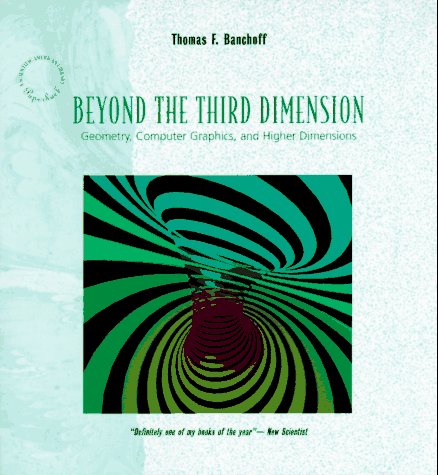
This work investigates ways of picturing and understanding dimensions below and above our own. What would a two-dimensional universe be like? How can we even attempt to picture objects of four, five or six dimensions? Such are the questions examined in this text.
User’s Reviews
Reviews from Amazon users which were colected at the time this book was published on the website:
⭐I haven’t finished yet. But it’s really well written. A great book to read as an introduction to hyper-dimensional geometry.
⭐This is an excellent introduction to the 4th dimension (and the 5th). It’s a little difficult to follow in places, but in general readable and interesting. I will definitely use this as a resource when I teach college-level geometry courses.
⭐Mathematical ideas, when first learned, tend to undergo a curious inner transformation. At the outset, some tangible representation is necessary to effectively latch onto the concept. Thereafter, the symbolic elaboration using the language of mathematics is sufficient to encompass not only that particular figure, but limitless others like it as well. The underlying geometry is still there, but there are simply too many possibilities to illustrate in any amount of time.The first step of illustrating must be manifest, using ink or chalk or sand or digital pixels. In this way, even the finest geometric illustrations can be considered extremely crude and innacurate in comparison to rigorous mathematical precision. Consider, however, how extraordinarily difficult it would be to grasp trigonometric functions, vector spaces, or even the basic Cartesian coordinate system, without first observing supporting representative illustrations. Even if later forgotten, those initial images are crucial for understanding.This work provides a wide range of richly color-illustrated examples of the abstract geometric structures dealt with regularly in mathematics and the sciences. It is unique in its quality and affordability, and is supported with excellent prose, briefly describing the developmental history, and frequently how to reconstruct the figures from a sparse handful of assumptions. From an introductory description of dimension, this book then branches into numerous and diverse major topics: scaling, slices, regular polytopes, perspective, coordinate geometry, and non-euclidean geometry. While sparing in its level of mathematical description and precision, it never diverges into a fully artistic exposition on the subjects either. There is a careful balance, to guide the reader into better understanding the particular system under discussion.Certainly reading this book is merely the first step of a far longer term process. Symbolic computing programs, such as Mathematica, Maple or MatLab, will assist in visualization, as well as in understanding the pragmatic relation between the graphical and set-theoretic descriptions of the figures. Other books will also assist in this. Many of Rucker’s works provide further descriptions of certain topics, specifically Geometry Relativity & The Fourth Dimension is admirable in its brevity and profundity. Abbott’s classic Flatland is the foundational book on non-technical description of dimensions. The venerable What Is Mathematics? by Courant and Robbins combines illustration and mathematics as well as any work written since. Design science touches on these topics frequently as well, Kappraff’s Connections is an extraordinary example of this. Deeper mathematical topics include set theory, algebraic groups, vector analysis, and too many others to list.However abstract the concepts diagrams and illustrations in this book may seem initially, most if not all have been utilized for practical application in recent times. You may very well be using devices on a daily basis, which have these concepts as a basis for their functionality. Keep this in mind while reveling in what the individual imagination can conjure.
⭐After reading this book, no doubt Thomas Banchoff is a deeply experienced geometry enthusiast.Unlike many schoolbooks, his book shows the main ideas underlying a multi-faceted geometry with minimal technical complication nonsense, using simple concepts and a bright argumentation, almost without losing insight! He never misses an opportunity to connect geometry to other sciences like algebra, relativity, optics, mechanics and to arts. It is not only the ‘Everything you desired to know about the 4th dimensions’ but also a bunch of 2D and 3D geometry ‘master tricks’ as well as a historical narration (including recent discoveries).Examples: – how to find yourself the polytopes (4D ‘polyhedra’) with 3D representations – how to easily calculate vertex coordinates of the 5 polyhedra – how to draw a torus on a hypersphère! -.. and many othersNo way you could escape this reading with the same vision of geometry!
⭐This book is a jewel! It contains a wide collection of visual geometry. Professor Banchoff is able to link geometry to many aspects of life. It’s a treasure trove for anybody teaching geometry at any level. It’s a book that can be read at many levels. If you’re willing to skip a bit here and there, you can get a very good general idea. But if you want to really understand all the details, it can make for hours of challenging reading. I’m still reading it! 🙂
⭐Living in a world of three dimensional space makes it hard for us to conceive fourth dimension and it gets even harder to visualize the fifth and higher dimension. Superstring theorists predict the existence of 10th and 26th dimensions in universe; hence it seems reasonable for many of us to understand how it would be like to be living in fourth dimension. Thomas Banchoff is one of the leaders in the study of higher dimension using computer graphics; he has illustrated fourth dimension using basic geometrical approach such as slicing the spatial dimension, observing the shadows of structures, comparing the folded and foldout versions of polytops and description of configuration of spaces. This book is useful for someone who appreciates geometry, but for a reader who likes to visualize the fourth dimension he/she may read Clifford Pickover’s Surfing through Hyperspace, which does a better job in illustrating fourth dimension.
⭐A comfortable introduction to modern geometry for the general reader, with emphasis on the concept of the dimension. This reference concludes with an introduction to non-euclidean geometry.
⭐Good introduction to the concept of the 4th dimension using plenty of illustrations. I have not detected any errors.
Keywords
Free Download Beyond the Third Dimension: Geometry, Computer Graphics, and Higher Dimensions (Scientific American Library Series) in PDF format
Beyond the Third Dimension: Geometry, Computer Graphics, and Higher Dimensions (Scientific American Library Series) PDF Free Download
Download Beyond the Third Dimension: Geometry, Computer Graphics, and Higher Dimensions (Scientific American Library Series) 1996 PDF Free
Beyond the Third Dimension: Geometry, Computer Graphics, and Higher Dimensions (Scientific American Library Series) 1996 PDF Free Download
Download Beyond the Third Dimension: Geometry, Computer Graphics, and Higher Dimensions (Scientific American Library Series) PDF
Free Download Ebook Beyond the Third Dimension: Geometry, Computer Graphics, and Higher Dimensions (Scientific American Library Series)