Ebook Info
- Published: 2019
- Number of pages: 304 pages
- Format: Epub
- File Size: 1.06 MB
- Authors: Trevor Noah
Description
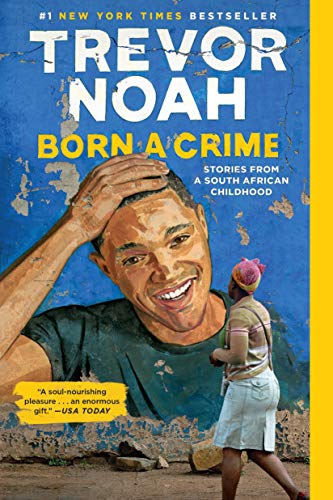
Trevor Noah’s unlikely path from apartheid South Africa to the desk of The Daily Show began with a criminal act: his birth. Trevor was born to a white Swiss father and a black Xhosa mother at a time when such a union was punishable by five years in prison. Living proof of his parents’ indiscretion, Trevor was kept mostly indoors for the earliest years of his life, bound by the extreme and often absurd measures his mother took to hide him from a government that could, at any moment, steal him away. Finally liberated by the end of South Africa’s tyrannical white rule, Trevor and his mother set forth on a grand adventure, living openly and freely and embracing the opportunities won by a centuries-long struggle.
Born a Crime is the story of a mischievous young boy who grows into a restless young man as he struggles to find himself in a world where he was never supposed to exist. It is also the story of that young man’s relationship with his fearless, rebellious, and fervently religious mother—his teammate, a woman determined to save her son from the cycle of poverty, violence, and abuse that would ultimately threaten her own life.
The stories collected here are by turns hilarious, dramatic, and deeply affecting. Whether subsisting on caterpillars for dinner during hard times, being thrown from a moving car during an attempted kidnapping, or just trying to survive the life-and-death pitfalls of dating in high school, Trevor illuminates his curious world with an incisive wit and unflinching honesty. His stories weave together to form a moving and searingly funny portrait of a boy making his way through a damaged world in a dangerous time, armed only with a keen sense of humor and a mother’s unconventional, unconditional love.
User’s Reviews
“A soul-nourishing pleasure . . . an enormous gift.”—USA Today “By turns alarming, sad and funny . . . not just an unnerving account of growing up in South Africa under apartheid, but a love letter to the author’s remarkable mother.”—Michiko Kakutani, The New York Times“You’d be hard-pressed to find a comic’s origin story better than the one Trevor Noah serves up in Born a Crime. . . . Witty truth-telling . . . brilliant comedy.”—O: The Oprah Magazine“Remarkable . . . smart . . . extraordinary . . . essential reading on every level.”—The Seattle Times“[Noah] thrives with the help of his astonishingly fearless mother. . . . Their fierce bond makes this story soar.”—People “When I think of Trevor Noah, the first image I see is from his brilliant memoir, Born a Crime, of Trevor’s mother throwing him out of a moving vehicle while he’s asleep in order to save his life. Through other eyes this could be remembered as traumatic and harrowing. Through Trevor’s it is bonding and hilarious, a testament to the love of someone who truly had to think on their feet. That is how Trevor sees the world. A fantastic storyteller, he has always been a defier of rules, which he broke simply by being born in his native country.”—Lupita Nyong’o, Time “Noah’s not the main character in his own story—his mother is the constant . . . and by the end, Noah lovingly makes clear that the book belongs to her. . . . Noah proves to be a gifted storyteller, able to deftly lace his poignant tales with amusing irony.”—Entertainment Weekly“[An] unforgettable memoir.”—Parade“This isn’t your average comic-writes-a-memoir: It’s a unique look at a man who is a product of his culture—and a nuanced look at a part of the world whose people have known dark times easily pushed aside.”—Refinery29“[Noah’s] electrifying memoir sparkles with funny stories . . . and his candid and compassionate essays deepen our perception of the complexities of race, gender, and class.”—Booklist (starred review)“Powerful prose . . . told through stories and vignettes that are sharply observed, deftly conveyed and consistently candid. Growing organically from them is an affecting investigation of identity, ethnicity, language, masculinity, nationality and, most of all, humanity.”—Mail & Guardian (South Africa) “[Noah’s] story of surviving—and thriving—is mind-blowing.”—Cosmopolitan “Noah has a real tale to tell, and he tells it well. . . . Among the many virtues of Born a Crime is a frank and telling portrait of life in South Africa during the 1980s and ’90s.”—Newsday “An affecting memoir, Born a Crime [is] a love letter to his mother.”—The Washington Post“Witty and revealing . . . Noah’s story is the story of modern South Africa.”—Publishers Weekly (starred review) About the Author Trevor Noah is a comedian from South Africa. Excerpt. © Reprinted by permission. All rights reserved. 1RunSometimes in big Hollywood movies they’ll have these crazy chase scenes where somebody jumps or gets thrown from a moving car. The person hits the ground and rolls for a bit. Then they come to a stop and pop up and dust themselves off, like it was no big deal. Whenever I see that I think, That’s rubbish. Getting thrown out of a moving car hurts way worse than that.I was nine years old when my mother threw me out of a moving car. It happened on a Sunday. I know it was on a Sunday because we were coming home from church, and every Sunday in my childhood meant church. We never missed church. My mother was—and still is— a deeply religious woman. Very Christian. Like indigenous peoples around the world, black South Africans adopted the religion of our colonizers. By “adopt” I mean it was forced on us. The white man was quite stern with the native. “You need to pray to Jesus,” he said. “Jesus will save you.” To which the native replied, “Well, we do need to be saved—saved from you, but that’s beside the point. So let’s give this Jesus thing a shot.”My whole family is religious, but where my mother was Team Jesus all the way, my grandmother balanced her Christian faith with the traditional Xhosa beliefs she’d grown up with, communicating with the spirits of our ancestors. For a long time I didn’t understand why so many black people had abandoned their indigenous faith for Christianity. But the more we went to church and the longer I sat in those pews the more I learned about how Christianity works: If you’re Native American and you pray to the wolves, you’re a savage. If you’re African and you pray to your ancestors, you’re a primitive. But when white people pray to a guy who turns water into wine, well, that’s just common sense.My childhood involved church, or some form of church, at least four nights a week. Tuesday night was the prayer meeting. Wednesday night was Bible study. Thursday night was Youth church. Friday and Saturday we had off. (Time to sin!) Then on Sunday we went to church. Three churches, to be precise. The reason we went to three churches was because my mom said each church gave her something different. The first church offered jubilant praise of the Lord. The second church offered deep analysis of the scripture, which my mom loved. The third church offered passion and catharsis; it was a place where you truly felt the presence of the Holy Spirit inside you. Completely by coincidence, as we moved back and forth among these churches, I noticed that each one had its own distinct racial makeup: Jubilant church was mixed church. Analytical church was white church. And passionate, cathartic church, that was black church.Mixed church was Rhema Bible Church. Rhema was one of those huge, supermodern, suburban megachurches. The pastor, Ray McCauley, was an ex-bodybuilder with a big smile and the personality of a cheerleader. Pastor Ray had competed in the 1974 Mr. Universe competition. He placed third. The winner that year was Arnold Schwarzenegger. Every week, Ray would be up onstage working really hard to make Jesus cool. There was arena-style seating and a rock band jamming out with the latest Christian contemporary pop. Everyone sang along, and if you didn’t know the words that was okay because they were all right up there on the Jumbotron for you. It was Christian karaoke, basically. I always had a blast at mixed church.White church was Rosebank Union in Sandton, a very white and wealthy part of Johannesburg. I loved white church because I didn’t actually have to go to the main service. My mom would go to that, and I would go to the youth side, to Sunday school. In Sunday school we got to read cool stories. Noah and the flood was obviously a favorite; I had a personal stake there. But I also loved the stories about Moses parting the Red Sea, David slaying Goliath, Jesus whipping the money changers in the temple.I grew up in a home with very little exposure to popular culture. Boyz II Men were not allowed in my mother’s house. Songs about some guy grinding on a girl all night long? No, no, no. That was forbidden. I’d hear the other kids at school singing “End of the Road,” and I’d have no clue what was going on. I knew of these Boyz II Men, but I didn’t really know who they were. The only music I knew was from church: soaring, uplifting songs praising Jesus. It was the same with movies. My mom didn’t want my mind polluted by movies with sex and violence. So the Bible was my action movie. Samson was my superhero. He was my He-Man. A guy beating a thousand people to death with the jawbone of a donkey? That’s pretty badass. Eventually you get to Paul writing letters to the Ephesians and it loses the plot, but the Old Testament and the Gospels? I could quote you anything from those pages, chapter and verse. There were Bible games and quizzes every week at white church, and I kicked everyone’s ass.Then there was black church. There was always some kind of black church service going on somewhere, and we tried them all. In the township, that typically meant an outdoor, tent-revival-style church. We usually went to my grandmother’s church, an old-school Methodist congregation, five hundred African grannies in blue-and-white blouses, clutching their Bibles and patiently burning in the hot African sun. Black church was rough, I won’t lie. No air-conditioning. No lyrics up on Jumbotrons. And it lasted forever, three or four hours at least, which confused me because white church was only like an hour—in and out, thanks for coming. But at black church I would sit there for what felt like an eternity, trying to figure out why time moved so slowly. Is it possible for time to actually stop? If so, why does it stop at black church and not at white church? I eventually decided black people needed more time with Jesus because we suffered more. “I’m here to fill up on my blessings for the week,” my mother used to say. The more time we spent at church, she reckoned, the more blessings we accrued, like a Starbucks Rewards Card.Black church had one saving grace. If I could make it to the third or fourth hour I’d get to watch the pastor cast demons out of people. People possessed by demons would start running up and down the aisles like madmen, screaming in tongues. The ushers would tackle them, like bouncers at a club, and hold them down for the pastor. The pastor would grab their heads and violently shake them back and forth, shouting, “I cast out this spirit in the name of Jesus!” Some pastors were more violent than others, but what they all shared in common was that they wouldn’t stop until the demon was gone and the congregant had gone limp and collapsed on the stage. The person had to fall. Because if he didn’t fall that meant the demon was powerful and the pastor needed to come at him even harder. You could be a linebacker in the NFL. Didn’t matter. That pastor was taking you down. Good Lord, that was fun.Christian karaoke, badass action stories, and violent faith healers—man, I loved church. The thing I didn’t love was the lengths we had to go to in order to get to church. It was an epic slog. We lived in Eden Park, a tiny suburb way outside Johannesburg. It took us an hour to get to white church, another forty-five minutes to get to mixed church, and another forty-five minutes to drive out to Soweto for black church. Then, if that weren’t bad enough, some Sundays we’d double back to white church for a special evening service. By the time we finally got home at night, I’d collapse into bed.This particular Sunday, the Sunday I was hurled from a moving car, started out like any other Sunday. My mother woke me up, made me porridge for breakfast. I took my bath while she dressed my baby brother Andrew, who was nine months old. Then we went out to the driveway, but once we were finally all strapped in and ready to go, the car wouldn’t start. My mom had this ancient, broken-down, bright-tangerine Volkswagen Beetle that she picked up for next to nothing. The reason she got it for next to nothing was because it was always breaking down. To this day I hate secondhand cars. Almost everything that’s ever gone wrong in my life I can trace back to a secondhand car. Secondhand cars made me get detention for being late for school. Secondhand cars left us hitchhiking on the side of the freeway. A secondhand car was also the reason my mom got married. If it hadn’t been for the Volkswagen that didn’t work, we never would have looked for the mechanic who became the husband who became the stepfather who became the man who tortured us for years and put a bullet in the back of my mother’s head—I’ll take the new car with the warranty every time.As much as I loved church, the idea of a nine-hour slog, from mixed church to white church to black church then doubling back to white church again, was just too much to contemplate. It was bad enough in a car, but taking public transport would be twice as long and twice as hard. When the Volkswagen refused to start, inside my head I was praying, Please say we’ll just stay home. Please say we’ll just stay home. Then I glanced over to see the determined look on my mother’s face, her jaw set, and I knew I had a long day ahead of me.“Come,” she said. “We’re going to catch minibuses.”My mother is as stubborn as she is religious. Once her mind’s made up, that’s it. Indeed, obstacles that would normally lead a person to change their plans, like a car breaking down, only made her more determined to forge ahead.“It’s the Devil,” she said about the stalled car. “The Devil doesn’t want us to go to church. That’s why we’ve got to catch minibuses.”Whenever I found myself up against my mother’s faith-based obstinacy, I would try, as respectfully as possible, to counter with an opposing point of view.“Or,” I said, “the Lord knows that today we shouldn’t go to church, which is why he made sure the car wouldn’t start, so that we stay at home as a family and take a day of rest, because even the Lord rested.”“Ah, that’s the Devil talking, Trevor.”“No, because Jesus is in control, and if Jesus is in control and we pray to Jesus, he would let the car start, but he hasn’t, therefore—”“No, Trevor! Sometimes Jesus puts obstacles in your way to see if you overcome them. Like Job. This could be a test.”“Ah! Yes, Mom. But the test could be to see if we’re willing to accept what has happened and stay at home and praise Jesus for his wisdom.”“No. That’s the Devil talking. Now go change your clothes.”“But Mom!”“Trevor! Sun’qhela!”Sun’qhela is a phrase with many shades of meaning. It says “don’t undermine me,” “don’t underestimate me,” and “just try me.” It’s a command and a threat, all at once. It’s a common thing for Xhosa parents to say to their kids. Any time I heard it I knew it meant the conversation was over, and if I uttered another word I was in for a hiding—what we call a spanking.At the time I attended a private Catholic school known as Maryvale College. I was the champion of the Maryvale sports day every single year, and my mother won the moms’ trophy every single year. Why? Because she was always chasing me to kick my ass, and I was always running not to get my ass kicked. Nobody ran like me and my mom. She wasn’t one of those “Come over here and get your hiding” type moms. She’d deliver it to you free of charge. She was a thrower, too. Whatever was next to her was coming at you. If it was something breakable, I had to catch it and put it down. If it broke, that would be my fault, too, and the ass-kicking would be that much worse. If she threw a vase at me, I’d have to catch it, put it down, and then run. In a split second, I’d have to think, Is it valuable? Yes. Is it breakable? Yes. Catch it, put it down, now run.We had a very Tom and Jerry relationship, me and my mom. She was the strict disciplinarian; I was naughty as shit. She would send me out to buy groceries, and I wouldn’t come right home because I’d be using the change from the milk and bread to play arcade games at the supermarket. I loved videogames. I was a master at Street Fighter. I could go forever on a single play. I’d drop a coin in, time would fly, and the next thing I knew there’d be a woman behind me with a belt. It was a race. I’d take off out the door and through the dusty streets of Eden Park, clambering over walls, ducking through backyards. It was a normal thing in our neighborhood. Everybody knew: that Trevor child would come through like a bat out of hell, and his mom would be right there behind him. She could go at a full sprint in high heels, but if she really wanted to come after me she had this thing where she’d kick her shoes off while still going at top speed. She’d do this weird move with her ankles and the heels would go flying and she wouldn’t even miss a step. That’s when I knew, Okay, she’s in turbo mode now.When I was little she always caught me, but as I got older I got faster, and when speed failed her she’d use her wits. If I was about to get away she’d yell, “Stop! Thief!” She’d do this to her own child. In South Africa, nobody gets involved in other people’s business—unless it’s mob justice, and then everybody wants in. So she’d yell “Thief!” knowing it would bring the whole neighborhood out against me, and then I’d have strangers trying to grab me and tackle me, and I’d have to duck and dive and dodge them as well, all the while screaming, “I’m not a thief! I’m her son!”The last thing I wanted to do that Sunday morning was climb into some crowded minibus, but the second I heard my mom say sun’qhela I knew my fate was sealed. She gathered up Andrew and we climbed out of the Volkswagen and went out to try to catch a ride. Read more
Reviews from Amazon users, collected at the time the book is getting published on UniedVRG. It can be related to shiping or paper quality instead of the book content:
⭐ I didn’t look at the reviews until after I bought Born a Crime and read it for myself. While reading the 1 star reviews, out of curiosity, I was shocked at some of the negative reviews. Life in third world countries is different than what you would experience in America or other developed countries. Culturally they have beliefs, behaviors, and/or customs that may be considered weird or ugly to those who are not familiar. In my opinion, I believe Trevor Noah wrote wonderfully. He was completely transparent with his feelings, thoughts and experiences as a child growing up in an abusive third world country under apartheid and the aftermath. One reviewer spoke of a horrific animal situation (it was terrible and I do not support animal cruelty of any sort) but you have to remove yourself from it. If you are mad because he didn’t respond the way YOU wanted, obviously there is a lack of understanding of his situation in life (I am not in anyway saying it was ok but it is a product of his environment). He was writing about his thoughts (he had at that moment), as a child growing up in a culture/society with ugly thoughts about that particular animal (I’m attempting to not give away any part of the plot while writing this). He was a product of his in environment and if he was taught something else maybe he would of had a different reaction at that time. I thought about giving the book a 5 star but I noticed all the existing reviews so I decided to reach those who would read the negative reviews, like myself, before purchasing a book. I thoroughly enjoyed Born a Crime. There were times I laughed. Times where I was utterly shocked. And a time when I got a bit emotional. Trevor Noah did a great job explaining the horrors of domestic violence and the lack of protection for women and children that still exists all over the world today. The nonexistent opportunities for children of poverty in third world countries especially regarding education. Being in an interracial marriage in America, I CANNOT fully understand what it must of been like for Trevor Noah’s parents or as a mixed child growing up in such a hateful yet separated society. This is just my opinion. Take it for what it is.
⭐ I don’t review a lot of books anymore, but this one got to me. There are lots of books written by people — including me — who had a hard time growing up. Abusive parents, poverty, oppression. War. There is a lot of awful stuff children endure.Trevor Noah endured all of it. Name something bad that a kid can experience and it probably happened to him. Born under apartheid, his existence was illegal. His birth was, as the title of his book suggests, a crime.As the child of a white father and a black mother under South Africa during apartheid, if he had been noticed by the authorities, they would have taken him from his family and put him … somewhere. So merely surviving until the end of apartheid was no mean feat. Add to that extreme poverty, violence and life under the most oppressive, racist regime you can imagine. Actually, you may not be able to imagine it. I knew it was bad, but South Africa refined oppression into an art form.One of the other noteworthy things about this book was that I learned great deal about things I thought I already knew. I don’t know if Noah intended it as a cautionary tale, but it is. Chilling.I didn’t read the book. I listened to the audiobook because Noah reads it himself. He has a beautiful, melodic voice and a lovely cadence. It was a treat for my ears and my brain.You might think with all of this terrible stuff — and some of it is really horrific — that this would be an angry, possibly embittered man. But he isn’t.He’s funny when humor is possible. Even when he’s serious, there is grace and wit — plus a sweetness and generosity of spirit that’s rather uplifting. I don’t think I’ve ever said that about a book. It’s not a word I use lightly. Trevor Noah is a rare person, able to appreciate the good stuff in his life and not obsess over the considerable amount of injustice he has experienced.I’m not usually a big fan of celebrity memoirs or autobiographies, but this is exceptional. If you have the patience, listen to it as an audiobook. Otherwise, consider reading it. He’s a smart guy, a good writer, and an astute observer of humanity, government, politics, and relationships. Insightful, witty, and entertaining, I highly recommend it.
⭐ I was born in South Africa, though I did most of my growing up in the U.S., Trevor immediately submerged me into township life with his reading of these amazing childhood stories.I know Trevor is a big deal is South Africa, and he’s quickly becoming a big deal here. Listen to him describe the landscape of South Africa, her politics and her struggles. Take a look through his eyes and see what abject poverty and adversity can do to two strong and insightful souls like Trevor and his mother, and you will get a glimpse into the very best of humanity.Very inspirational and emotive. I cannot recommend it enough!
⭐ This book is a collection of different stories as opposed to a regular novel, which wouldn’t be so bad, but the stories are boring and meaningless…I was looking for a meaningful point to his tale but there never was one…he is also hypocritical in that he states how whites had all privilege and were treated better but then he tells a story of how he stole something from a store with his black friend and the friend gets caught but he gets away…the police view the video camera to try to identify the second person (which is him) but the person looks white on the video camera. The police continue to question people and try to find this “white” person to arrest him which is shocking and contradictory since he tells us throughout the book how whites are allowed to do whatever they want. Meanwhile the police don’t think it’s him. Instead of owning up to his crime, when questioned if he knows the “white” kid in the video, he says no! Plus this may make it possible for another person, to get blamed for a crime he committed…I can’t believe someone published this nonsense!
⭐ I thoroughly, thoroughly, thoroughly enjoyed this book. I don’t even watch the Daily Show. I’ve seen clips of Noah on the show and I thought yeah he’s funny enough to replace Jon Stewart but it still didn’t make me an avid watcher. I chose to read this book because I saw that Bill Gates had it on his summer reading list and being a computer person myself I decided to read it. :-)I know it’s crazy but I’m glad I did. I learned a lot from this book about apartheid in South Africa. I knew about it but not in detail (they don’t really teach it in school). This book gave me some more insight into that system of racial discrimination before and after it ended from someone who experienced it.I went through a range of emotions reading Noah’s stories of growing up in poverty in racist South Africa and still being able to work himself into the career he has now. I laughed, I cried, I was angry, I was sad, I was happy, everything…and when I had to stop reading at times, I was right back into it when I started reading it again. Honestly, that doesn’t happen with every book I read. Reading about each character made you feel like you knew them. His Mom seemed like a strong, smart and religious woman who imparted a lot of her wisdom on Noah. She was a beautiful person. I know she’s proud of her son.I can’t say more than has already been said about this book (mostly rave reviews) except buy it and read. I love, love, loved it!!I wish Trevor Noah continued success and if there is another book in the works I will definitely be reading it.
⭐ My decision to request Born a Crime has nothing to do with star power or fandom. I have to admit I have never seen Trevor Noah on the Daily Show. I requested this book when I learned it was about Trevor Noah’s childhood in Apartheid South Africa.I started reading my ebook galley as soon as I was approved.I have to love a guy who finds comedy in tragedy and who gleefully spins yarns about experiences that would keep most of us in therapy for a lifetime. There is a genius in comedy that allows us to encounter devastating truths through the protective lens of laughter.The heroine of the book is Noah’s mother, a feisty lady with a solid rock faith, a gal who snubs her nose at things that don’t make sense. She makes mistakes, but always out of love. She takes huge risks but somehow Jesus is always there to catch her mid-fall.Noah was “naughty as s***” and a challenge to raise, but never hateful or mean. He learned to navigate Apartheid society’s complex system that divided people in to three groups: black, white, and colored. How one was categorized was senseless. Japanese were put into the white’ slot but Chinese into the ‘colored’.”The genius of Apartheid was convincing people who were the overwhelming majority to turn on each other. Apart hate, is what is was.”Noah was ‘colored’ with a ‘black’ Xhosa African mother and a ‘white’ Swiss father, his very existence implicating his parent’s crime. Had the police discovered them, his parents would be sent to jail and Noah sent to an orphanage. He spent much of his life hidden away, indoors. His parents could not be seen together with him, and his mother had to even pretend he was not her child.Noah was “colored by complexion but not by culture.” He spoke multiple languages, Xhosa and Zulu and Afrikaans, and English, could fit into most groups, but felt affiliated to black culture.The book is a series of episodic tales, thoughtfully constructed, saving the climax of his family history until the end of the book, after we have come to know and understand them.”I saw the futility of violence, the cycle that just repeats itself, the damage that’s inflicted on people that they in turn inflict on others. I saw, more than anything, that relationships are not sustained by violence, but by love.”The book is funny but is more than a diversive read, it enlarges our understanding of the world. Noah offers an understanding of South African history, colonialism, and Apartheid that is engaging and relevant. He shares the important things he learned and offers them to us. We should listen. We should learn.
⭐ It’s January 2018 but I know this book is going to be a contender for my favorite of the year. I loved it. Born a Crime reminded me of the importance of reading and the power of books. When you read about another’s history and challenges, in a tiny way you walk in their shoes.I was aware of Apartheid in the abstract, but details are what build empathy. South Africa categorized Trevor Noah at birth as someone less than others. The book is a clear reminder why we should celebrate Apartheid’s demise. Born a Crime was a perfect title.As an American, I shared the frustration of another country’s struggle with racism. Apartheid reminded me of “separate but equal,” expanded to greater cruelties.Incredibly, the book isn’t a downer. Somehow Noah tells his tales with humor and a relaxed attitude. I wasn’t a Trevor Noah fan before reading this, but I am now.Larry NocellaAuthor of the novel, Razor Wire Karma, available on Amazon.
⭐ I received the book today. It’s a great book but I feel as though I somehow got a bootleg version of it. The printing of the book is off and the back cover is a bit blurry, which is completely different from the copy I looked at in the bookstore. I’m disappointed. But it’s way too much of a hassle to send it back just to wait for a refund. So I’m stuck.Update. I read up until chapter 14, because chapter 15 is missing. They just repeated chapter 13 and 14. It goes from page 166 to 199. I’m mad. Only order from Amazon at least you can return it. I knew this was a counterfeit.
⭐ I purchased a book written by a comedian, thinking it would be funny. The sample made me laugh out loud! I wish I were exaggerating when I say that the sample provided is the only funny part in the book.We begin with Noah being very clear that even though he is half-white, he firmly identifies as Black. He feels that racism, which has been so prevalent in his life, must be the backbone of his bio. So, every story in the book finds him judged by others based on his skin color. Every. Single. Story.Now I can hear the protests in response to that last paragraph. But, I’d like to reveal that, in Every.Single.Story., you’ll read that that those who judged Noah based on his skin color – and made assumptions as to his character and behavior – are OTHER Blacks and “Coloreds”(who are described as mixed-race peoples, like Noah). And yet in another twisty-turn, every encounter he has with Whites are pleasant! “He can’t go anywhere after this revelation!” you cry, but Noah proves he’s smarter than the rest of us. He told us these things because they’re a nice set up for his real message, which is this:The White Man is keeping everyone down. *yawn*Noah lectures to us (ad nauseam) that race is a social construct invented to keep the majority occupied with fighting each other (Blacks, Natives, Coloreds, Chinese) while the privileged minority (Whites, Whites and maybe the Japanese-please don’t ask) rules. Noah presents this as if he’s bestowing some kind of new enlightenment upon us, the unwashed masses. All it did for me is make me wonder if he’d read a world history book…ever.I would hope that most people know Whites didn’t invent “ye olde divide and conquer” strategy to subjugate black people. I just assumed most everyone knows this has been a tried and true strategy since the beginning of time. Of course, these facts don’t fit his narrative. But Noah tries…and tries…and tries.Noah also wants you to believe he has solved the problem of the (non-white) disenfranchised. Using “ye old fishing analogy”, he claims that teaching a man to fish is fine, but it means nothing unless you GIVE him a rod. Hell… If you’re going through all that trouble for a person who does not have the wherewithal to ask and learn in order to EAT, you might as well keep fishing FOR them. Or concede that Nature’s Rule of Order #1 (survival of the fittest) may have something to it after all.Noah is clear people must be given what they need to succeed. To prove his point, he tells the story of being given a CD writer and how this gift allowed him to pirate music and movies (but he’s sorry!) and sell them to earn money. My favorite passage has Noah and his friends making money via high-interest loans to woman needing to buy food. I’m guessing Noah forgot that he should have bought them that fishing rod instead.When thinking of free things that can be given to people to help them help themselves, you may be tempted to think “education”. Noah is quick to point out how that isn’t enough because many people must support their families and can’t get an education. But jobs aren’t the answer either because, from a social standpoint, the DE’s (disenfranchised) will be ridiculed by their (same-colored) peers and end up quitting those jobs.So, in summary, this is a book written by a comedian that isn’t funny. It’s a dissertation on the history of racism, who caused it and why, by someone who doesn’t know the first thing about it. It triples as a lecture on sociology, psychology and the human condition, by a person with no credentials other than presenting “fake news”. Literally.But, if Noah’s purpose was to give us glimpses into his life as a hoodlum, who flirted with a little danger and almost lost a loved one, (but somehow became internationally famous at the end of it with no real hard work on his part, by his own admission), then Mission Accomplished.Sent from my iPad
⭐ Before he replaced Jon Stewart as the host of The Daily Show, Trevor Noah had a difficult childhood in both Apartheid and post-Apartheid South Africa. Having a white father and a black mother, Trevor was already the product of racist laws that could have kept him and his parents imprisoned for several years. He spent most of his childhood in hiding to evade the police, which included not being around his white father as often as he wanted in order to keep the subterfuge alive. With poverty, an abusive stepfather, and life in general working against him, Trevor still managed to keep his sense of humor intact with the help of his jovial, yet strict mother, who he credits as his number one fan.This glimpse into Trevor Noah’s life is as educational as it is entertaining. It’s a firsthand look into how structural racism worked in Apartheid-ruled South Africa and how it’s still alive in the world today. Racism isn’t just about calling somebody the N-word or beating black and colored people to death. It’s psychological torture as well. The whites in charge purposefully divided their non-white peers into separate groups and treated them as less than human. The education was watered down, the living conditions were crappy, poverty was by design, and violence became a social norm. None of that changed after Apartheid was over, in the same way that structural racism never ended after slavery in America. You can change the laws all you want, but the damage has already been done. The damage continues to be dealt in subtle ways behind the scenes of politics. The one thing we learn from history is that we learn nothing from history.Because Trevor grew up with an abusive stepfather named Abel, his memoir also gives us a glimpse into how psychologically torturous domestic violence is. Abel was regarded as a nice guy around town who would always help out those in need. That was the disguise he needed in order to secretly beat Trevor and his mother and get away with it every time. Trevor’s mother was met with skepticism from the police every time she tried to file a report. Abel would always be apologetic and life would go on happily for a while until the next beating. The scary thing about him was that he was always calm and collected when he struck his family. He wasn’t as psychotic as The Joker or dramatic as Darth Vader. He was just a regular guy with a good reputation outside of home. Even when he would drink himself into stupidity, he always came across as a cool guy. Those are the worst kinds of villains that are too realistic for superhero movies. Trevor Noah was haunted by this man’s evil deeds for many years to come. Abel is still walking around South Africa today as a free man. How sick is that?Through all of the racism, violence, and troubled times, Trevor Noah never let any of those things strip away his individuality, morals, or sense of humor, all of which he got from his loving disciplinarian mother. She always taught him how to question everything and never lose sight of who he was. And that’s the thing with Apartheid: the education quality for blacks and colored people is significantly reduced for the sake of maintaining the status quo. Without an educational mother who bought him books and allowed him to explore the world beyond his impoverished home, Trevor wouldn’t be the well-informed man he is today. There are none so blind as those who will not see, and Trevor Noah’s eyes were wide open. He had a rough childhood, but without it, his worldview would have been watered down to where he could never fill Jon Stewart’s shoes, let alone live his own way. Trevor lives life with no regrets and that’s something we all need to learn if we’re to move forward.The eye-opening educational aspects as well as the humorous writing style make Born a Crime a must-read for anybody who wants to explore the world without actually being in the crossfire of South African racism. Trevor Noah went through hell so that he could nourish the world with love and thoughtfulness. His story is genuine and his emotions are passionate. He could never be bitter, because bitterness would strip away everything he worked so hard to become. An extra credit grade is what this book deserves, nothing less, maybe more.
Keywords
Free Download Born a Crime: Stories from a South African Childhood in Epub format
Born a Crime: Stories from a South African Childhood Epub Free Download
Download Born a Crime: Stories from a South African Childhood 2019 Epub Free
Born a Crime: Stories from a South African Childhood 2019 Epub Free Download
Download Born a Crime: Stories from a South African Childhood Epub
Free Download Ebook Born a Crime: Stories from a South African Childhood