

Ebook Info
- Published: 2016
- Number of pages: 440 pages
- Format: PDF
- File Size: 3.50 MB
- Authors: William Mellor
Description
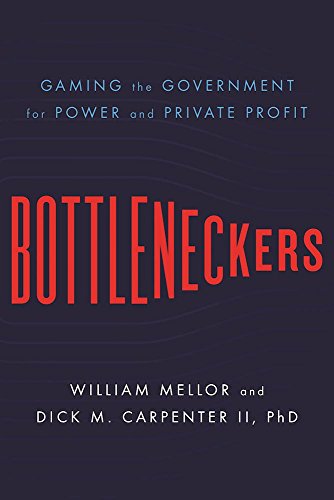
Bottlenecker (n): a person who advocates for the creation or perpetuation of government regulation, particularly an occupational license, to restrict entry into his or her occupation, thereby accruing an economic advantage without providing a benefit to consumers. The Left, Right, and Center all hate them: powerful special interests that use government power for their own private benefit. In an era when the Left hates “fat cats” and the Right despises “crony capitalists,” now there is an artful and memorable one-word pejorative they can both get behind: bottleneckers. A “bottlenecker” is anyone who uses government power to limit competition and thereby reap monopoly profits and other benefits. Bottleneckers work with politicians to constrict competition, entrepreneurial innovation, and opportunity. They thereby limit consumer choice; drive up consumer prices; and they support politicians who willingly overstep the constitutional limits of their powers to create, maintain, and expand these anticompetitive bottlenecks. The Institute for Justice’s new book Bottleneckers coins a new word in the American lexicon, and provides a rich history and well-researched examples of bottleneckers in one occupation after another—from alcohol distributors to taxicab cartels—pointing the way to positive reforms.
User’s Reviews
Editorial Reviews: About the Author William H. (Chip) Mellor serves as chairman and founding general counsel of the Institute for Justice. He cofounded IJ in 1991 and served as president and general counsel until 2015. He has litigated cutting-edge constitutional cases, notably achieving the first federal appellate court victory for economic liberty under the Fourteenth Amendment since the New Deal. While Mellor was president, IJ litigated five US Supreme Court cases, winning four. Under Mellor’s leadership, IJ has grown from a five-person start-up into a law firm with a nearly hundred-member staff, including over forty attorneys and an annual budget of $20 million. Dick Carpenter is a director of strategic research at the Institute for Justice and a professor at the University of Colorado Colorado Springs.
Reviews from Amazon users which were colected at the time this book was published on the website:
⭐If you want to be blown away by an exposé of how the government can stop people from working, achieving their dreams, hiring others, and improving the economy, race out and read Mellor and Carpenter’s “Bottleneckers.” From local to state to Federal Government rules, it can be nearly impossible to get started as an entrepreneur.I got interested in the book when I heard John Stossel interview the author. I was shocked by what I heard and I wanted to see if the claims could be substantiated. Luckily, “Bottleneckers” is packed with stories and their associated footnotes so that the academically inclined reader can confirm the veracity of the author’s claims.In the book, Mellor and Carpenter go through a serious of professions wherein the embedded players work with the government to lock out new players or to grab money from the entrepreneurs who just want to earn an honest living with their own two hands. They analyze industries including funeral homes, taxis, interior design, food trucks, hair braiders, and more. Each chapter tells stories of real people who have had to fight heroically, not always succeeding, just to work. It reminded me of a real-life story of a good friend of mine who could not pursue her dream of helping people laugh. As a humorist, she had the uncanny ability to talk to people, help them dig deep into their souls to find their passions and fears, and then find the funny. By talking with her, a person could uncork his frustration through the use of joke-telling in order to be happier himself. I suggested that she become a humor therapist. “I couldn’t do that,” she explained, “because I’m not a licensed therapist.” Really? By talking with someone and making him laugh at the foibles in his life, does she really need government oversight? As the authors of “Bottleneckers” point out, there will always be people who can imagine how much damage therapists could do and then explain why the government needs to regulate them: “What if a suicidal person approaches the therapist and she just laughs at him?” Come on, bottleneckers, let’s FIRST find some evidence that unlicensed therapists are really doing some harm. And then top that off with evidence that licensed therapists stop all the suicides, and then we can talk about how important government regulation is. But until that point, let millions or consumers decide for themselves whether they want to talk with someone who can put a smile on their face. Sadly, my friend doesn’t have the financial means to start suing the government to allow her to practice as a humor therapist, and she doesn’t have the money or desire to go to medical school to become a psychiatrist, so she’ll continue along her current path of not being a humor therapist. It’s such a tragic loss for the hundreds of people who she would probably be able to help during her career if she were just free to work.
⭐The book mostly details specific cases of bottlenecking by following a few people represented in a few different industries. I had assumed the book would cover more the historical aspect of bottlenecking. It does provide some brief information about certain laws, probably the most expansive being in the first chapter about the 3 tier system used in the liquor industry. The rest of the chapters become very redundant, and there is too much time spent on giving some background about the people used as examples of the effects of bottlenecking. In short, this book read more like a series of articles in a newspaper rather then a coherent and comprehensive academic book on the subject, or historical accounting.
⭐I cannot recommend this book enough. This is the story of the painful, life-destroying results of occupational restrictions that predominately affect people struggling to get by and crush their dreams of independence. It has a really clear style, with personal, immediate stories and statistics.People who aren’t free to make a living, aren’t free. It’s time to arm ourselves with these facts and fight back against the intrusive government regulations that only exist to protect entrenched interests from competition.
⭐Links in Table of Contents don’t work. No Endnotes. So that destroys a good bit of the value of the book. Needs to be fixed. Once fixed, I would give the book four stars. Citations are often week. No citations to specific state statutes. Just citations to other works. This is insufficient in my opinion.
⭐A very good read. I wish he got into the many other avenues of the Bottleneckers, such as programmatic accrediting bodies that operates like as trade associations
⭐a little dry but good info
⭐Commentary on the sad state of free enterprise in a declining capitalist state.
⭐The examples are good, but the writing is quite poor and very repetitive.
Keywords
Free Download Bottleneckers: Gaming the Government for Power and Private Profit in PDF format
Bottleneckers: Gaming the Government for Power and Private Profit PDF Free Download
Download Bottleneckers: Gaming the Government for Power and Private Profit 2016 PDF Free
Bottleneckers: Gaming the Government for Power and Private Profit 2016 PDF Free Download
Download Bottleneckers: Gaming the Government for Power and Private Profit PDF
Free Download Ebook Bottleneckers: Gaming the Government for Power and Private Profit