

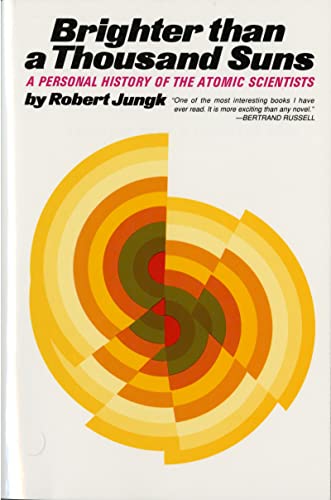
Ebook Info
- Published: 1970
- Number of pages: 384 pages
- Format: PDF
- File Size: 28.13 MB
- Authors: Robert Jungk
Description
An account of the remarkable scientists who discovered that nuclear fission was possible and then became concerned about its implications. Index. Translated by James Cleugh.
User’s Reviews
Editorial Reviews: About the Author No Bio
Reviews from Amazon users which were colected at the time this book was published on the website:
⭐I first read “Brighter than a Thousand Suns” at the end of 1970. While remembering that I thought highly of the book then, I no longer have much recollection of its contents. Recently, after finishing a couple of books on the history of Maxwell equations, hydrodynamics and thermodynamics, it occurred to me that I would enjoy reading “Brighter than a Thousand Suns” again.The year 1970 was at the height of the cold war between superpowers with nuclear weapons that can wipe out civilization in seconds. The doomsday clock in 1971 was set by the Editors of the publication “Bulletin of Atomic Scientists” to 23.50, or 10 minutes to midnight. Now in 2021, although the nuclear threat is still there, one would think that the world should be much further from midnight than in 1970, since, after all, it has been 36 years ago that the cold war was declared to have ended. To my great surprise, when I look it up, the doomsday clock in 2021 is only 100 seconds from midnight! This time, humankind faces not only nuclear bombs but also the devastating threat of climate change. At the beginning of 2021, The Bulletin stated that the current issues are “the most dangerous situation that humanity has ever faced.”The book told the events before, during and after the second World War, covering not only the building of the atomic bomb but also the hydrogen bomb, which for a while was known as the Super. Most of the book is heavy reading, as it is filled with serious matters, as well as conflicts of various kinds. The exception is Chapter 2, with the exquisite title “The Beautiful Years 1923-32”. Here it described the time when scientists, students, and professors were free from politics, with stories which were amusing and nostalgic. Every reader who is not a physicist will smile at mathematician David Hilbert’s remark that “Physics is obviously too difficult for physicists.” Among the many heart-warming stories was the one about a young student in University of Gottingen in Germany. He was walking along in a dream, stumbled and fell flat on his face. When a fellow student rushed up and tried to help him to his feet, the fallen student, still on the ground, vigorously repulsed his helper’s efforts, shouting “Leave me alone will you? I’m busy!” Apparently. a new brilliant solution had just occurred to him.Unfortunately, the beautiful years soon came to an end. The Nazis took over Germany in 1933 and was poised to invade countries in Europe. When Einstein moved to the U.S. in the autumn of 1933, taking up the position in the Institute of Advanced Studies in Princeton, the French Physicist Paul Langevin said that “The Pope of Physics has moved and the United States will now become the center of the natural sciences.”The main story was about why and how the American Government decided to build the atomic bomb, how the effort, designated as the Manhattan Project, was organized, and what life and work at Los Alamos and at Oak Ridge were like for the scientists. Particularly interesting were the episodes depicting the personalities of some famous scientists and mathematicians, including Oppenheimer, Feynman, Dirac, Bethe, Teller, Einstein, Hilbert, von Neumann, among others. The decision processes regarding whether to use the atomic bomb against Japan, whether to proceed with the hydrogen bomb etc. were documented in detail. It is somber to read “The widespread underestimation in the West, during the first four years after the war, of Russia’s capacity to construct atom bombs within a foreseeable time is almost more astonishing than the earlier overestimation of Germany’s atomic potential.“.There were brief descriptions of the state of atomic physics research in the late 1930’s and early 1940’s, particularly the work of Hahn, Joliet-Curie, Frank, Frisch, Rutherford, and Szilard. The later part of the book detailed the origin, the debate, and the production and testing of the hydrogen bomb, Oppenheimer’s role in the tragedy of his friend Haakon Chevalier, and the hearing to take away the security clearance of Oppenheimer.In the chapter concerning Oppenheimer, the author made the following observation about the modern-day scientist: “His remarkable admission perhaps explains why the twentieth-century Faust allows himself, in his obsession with success and despite occasional twinges of conscience, to be persuaded into signing the pact with the Devil that confronts him: What is ‘technically sweet’ he finds nothing less than irresistible”.I found the above observation eerily similar to a recent remark a former comedian made on the show of a current comedian:“I love scientists and they do good work. But they are going to kill us all. Here’s how I believe the world ends, and I say this to you in sincerity…….The world ends, the last words man utters are somewhere in a lab, a guy goes, huh huh, it worked.”Comedians aside, “Brighter than a thousand suns” vividly described a unique and bitter/sweet page of human history. It should be a must read for anyone seeking to gain some understanding of the complicated modern world.
⭐Werner Heisenberg I believe to be the biggest hero of the last century. No one could have helped humanity anymore that the act of saving us from a nuclear holocaust. The real shame is that he is not generally recognized for the heroic deed that he had accomplished. . The report done by Dr. Samuel Gaudsmit was biased. Dr. Gaudsmit had a built in hatred for anything that was German. His own parents were both killed by Nazi’s. . He pointed to the math calculations of Dr. Heisenberg’s as being “faulty” Of course, to pull off and misdirect the German bomb program, it has to be assumed that these numbers would be erroneous. How could they be anything else? the real question then becomes “did Dr. Werner Heisenberg make the errors on purpose? This subject is more fully covered in the the misdirection that Werner Heisenberg intended they would have to be faulty.Robert Jungk tells a revealing story of the atmosphere that had existed in GottingenGermany among the best physics minds in the world. .The books by Robert Jungk and Thomas Powers should both be read to gain an understanding into the thoughts both scientific and moral that had gone into the actual making of the bomb.We failed to give due credit to some of the finest heroes of the entire nuclear development. Hitler, could have made a bomb without the misdirection of Werner Heisenberg.
⭐Perhaps my favored book ever. Just read the first two paragraphs, and you will be hooked.Not just a history of atomic physics and the bomb (though it is that and damned well done), but a philosophical bomb as well.How did these scientists, physicists, and mathematicians, from all over the world: most of them pacifists, come together to make a weapon so terrible it was only used nearly 100 years ago and never since?
⭐A non-partisan view of the development of the A bomb. Much in depth description of the project.
⭐While an easy to read book, Jungk presents some false information that depreciates the value of the book.The first is the impression that Von Weisacker and other German scientists attempted to give to the post war world, that they were not really trying to build a bomb, but were merely interested in nuclear power. This is refuted by Jeremy Bernstein, in his book “Hitler’s Uranium Club.” The historical record shows that there were many memorandums sent to the German Military, by the scientists, about the possibility of producing an atomic bomb.The more serious misstatement however, is about Klaus Fuchs’ espionage on the Manhattan Project which was the most damaging espionage committed by any of the atomic spies of that era. Jungk claims that Fuchs decided to spy for the Soviet Union when he learned about plans to bomb Hiroshima. This is so off base that one has to question Jungk’s scholarship or motives. Here is why: Fuchs began spying for the Soviets in 1941 in Britain, before Pearl Harbor and before there was even a Manhattan Project. The decision to acutally bomb Hiroshima was made in 1945. None of the scientists know what the targets were.This is such a huge distortion of the facts that it should be mentioned in any review of this book. The book has lots of details but if you buy it, beware of some of the downright distortions of history. A better choice is Richard Rhodes’s book, “The Making of the Atomic Bomb”.
⭐340 page with epilogue, plus two appendices discussing the politics of the atomic bomb (written before a bomb was dropped on Hiroshima.) Penned in a pleasant style, slightly political but not offensive.
⭐Even more interesting now than when it was a prescribed text for Matriculation class in 1966
⭐This is actually the full version, not the censored one I used to read back in Eastern Europe…
⭐This book is absolutely fascinating .It gives data that puts into context a lot of the mystery of the 1950s anxiety about Nurclear War.To one who as a small bay remembers the newspaper furore over the Execution of the Roseberges in the USA .This book sheds light on such matter.In the light of a resurgence of Nuclear Arms Racing. It is worth the careful reading.
⭐I first read this on publication years ago – on rereading it I was impressed with the soundness of the research and the clarity of the writing. It captures the emotional uncertainty of the participants and the world view of the bomb at the time. A “must read” for anyone with an interest in physics and human nature.
⭐An excellent, detailed history of the numerous scientists involved with early nuclear research
⭐as described
⭐essential reading
Keywords
Free Download Brighter Than a Thousand Suns: A Personal History of the Atomic Scientists in PDF format
Brighter Than a Thousand Suns: A Personal History of the Atomic Scientists PDF Free Download
Download Brighter Than a Thousand Suns: A Personal History of the Atomic Scientists 1970 PDF Free
Brighter Than a Thousand Suns: A Personal History of the Atomic Scientists 1970 PDF Free Download
Download Brighter Than a Thousand Suns: A Personal History of the Atomic Scientists PDF
Free Download Ebook Brighter Than a Thousand Suns: A Personal History of the Atomic Scientists