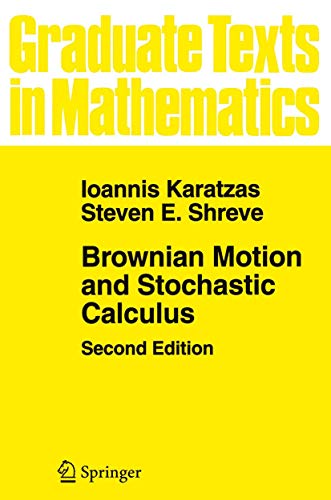
Ebook Info
- Published: 1991
- Number of pages: 493 pages
- Format: PDF
- File Size: 3.53 MB
- Authors: Ioannis Karatzas
Description
A graduate-course text, written for readers familiar with measure-theoretic probability and discrete-time processes, wishing to explore stochastic processes in continuous time. The vehicle chosen for this exposition is Brownian motion, which is presented as the canonical example of both a martingale and a Markov process with continuous paths. In this context, the theory of stochastic integration and stochastic calculus is developed, illustrated by results concerning representations of martingales and change of measure on Wiener space, which in turn permit a presentation of recent advances in financial economics. The book contains a detailed discussion of weak and strong solutions of stochastic differential equations and a study of local time for semimartingales, with special emphasis on the theory of Brownian local time. The whole is backed by a large number of problems and exercises.
User’s Reviews
Editorial Reviews: Review Second EditionI. Karatzas and S.E. ShreveBrownian Motion and Stochastic Calculus”A valuable book for every graduate student studying stochastic process, and for those who are interested in pure and applied probability. The authors have done a good job.”―MATHEMATICAL REVIEWS
Reviews from Amazon users which were colected at the time this book was published on the website:
⭐This book isn’t really the place to start learning about stochastic calculus. Get Oskendal’s
⭐for this.Even to the prepared reader, this book is exasperating. It is as if the authors came up with an excellent outline for an advanced treatment of this topic. Then they realized that to do all of the material justice, they’d need to have not one, but two 400 page volumes. Their publisher must have balked at that idea, so their solution was to leave out half the detail, forcing each of our poor readers to re-generate the missing 400 pages of needed detail on his/her own. In the opinion of this reviewer, that is exactly what they have done with this text.Fortunately for us all, there exists a nice two volume (800 page total pages) treatment of this material. Rogers & Williams
⭐and
⭐provide a thorough, accessible exposition with all the needed rigor, generality and detail.Karatzas & Shreve’s treatment of early foundational material is less than helpful to the student. Consider a pair of key results on martingales early on in the text: the optional sampling theorem and the optional stopping theorem. The authors “prove” the optional sampling theorem by appealing to the discrete time results in Chung’s
⭐and then applying limiting arguments to bootstrap to the continuous time case. Since all of the real “ideas” are in the discrete time case, it’s not clear how much of a service the authors’ treatment really is. Worse yet, the optional stopping theorem isn’t even called out as a theorem, but instead buried as problem.It is curious to see which topics inspire the authors to spill ink. For example in Chapter 2, we get not one, but 3, yes three different constructions of Brownian motion: convolved heat kernels, Haar interpolation and random walks/Wiener measure. Of course, only the last construction is used going forward and the first two constructions are not brimming over with detail. This is a curious indulgence in a text that is purposefully being stingy with detail. Our poor reader has to pay the price for this indulgence with an extremely terse treatment of the strong Markov property and reflection principle, the Blumenthal Zero-One Law, and other foundational properties of Brownian motion.Chapter 3 represents the core of the text and develops all the of “greatest hits” including the Ito Integral, Ito’s rule, Levy’s characterization of Brownian motion, the martingale representation theorem, the Girsanov Theorem and an introduction of Brownian local time. (Brownian local time is further developed in Chapter 6). The development of the Ito Integral is shamelessly sketchy. All the theorems are correctly stated, but the “proofs” offered aren’t detailed enough to explain why all of the stated assumptions are needed. When the reader gets to the development of Ito’s rule, he/she finds a rude 3 sentence introduction to semi-martingales, a topic which hadn’t been explored and never gets more than a passing mention in the authors’ text.Assuming that you’ve understood everything going on in the text up to this point, Chapter 4 is quite nice. It gives a very intuitive introduction in the role of the Mean Value Theorem as a hook connecting stochastic integrals with classical PDE’s. The section on Harmonic functions and the Dirichlet problem is quite nice. The material on the heat equation requires properties of Brownian motion most easily derived from the convolved heat kernels construction. The chapter winds up with a nice treatment of the Feynman-Kac formulas.After the PDE’s material, the reader might develop a sense of hope that the remainder of the exposition will be readily accessible. This is not the case and with the SDE’s in Chapter 5, the authors return to their now too familiar terse style as they study strong and weak solutions to stochastic differential equations. At one point, the authors decide to approach the problem by generalizing from functions to functionals without even so much as defining their notion of a functional.Really, the only good role for this text is as base material for a do-it-yourself “Moore Method” class on stochastic calculus, like they used to do for general topology at the University of Texas. If you completed a Moore-style class this way and wrote up all of your work, you’d have a very fine text covering
⭐This book is an excellent text on stochastic calculus. As is commonly done, the text focuses on integration with respect to a Brownian motion.However, there are several important pre-requisites: the reader must be intimately familiar with measure theory, probability theory and stochastic processes. For those new to stochastic calculus it is generally recommended to read Oksendal’s book on stochastic differential equations and then come back to Karatzas and Shreve.Please be warned that even with reasonable background to probability theory and stochastic calculus, this text is very difficult to understand mathematically- it requires a certain level of dedication from the reader if the book is to be read back to back rather than act as a reference
⭐This is the “Springer Study Edition”, apparently a one-time imprint for cheap print-on-demand copies of otherwise out-of-print books. Had I known this (and it does not seem to be mentioned anywhere in the item description), I probably would have sprung for a used copy of the hardcover at a similar price.As a study copy it should suffice — the inner margins are a bit tight, but nowhere near as bad as some PoD knockoffs. It just would have been nice to know what I was paying for.
⭐the book met my expectations, but the rating comes from the condition in which i received the book, which is poor to say it nicely.2 corners of the book were damaged, and the only reasons i didn’t try to give it back were because: 1. it’s not that big of a problem and 2. it wasnt severely damaged.but i will seriously consider these types of problems next time i order another book.
⭐Nice texts for graduate students.
⭐The theory of Brownian motion is ubiquitous in physics and mathematics, and has recently become very important in mathematical finance and network modeling. The observation of the irregular movement of pollen suspended in water by Robert Brown in 1828 led Albert Einstein to formulate a theory for Brownian motion. In this book the authors outline rigorously the theory of Browian motion. Their logic is impeccable, and the content is fascinating reading, even to those very experienced in the subject. The authors begin in chapter 1 with the task of defining martingales and filtrations, with the notion of a stochastic process being adapted to a filtration taking on particular importance. They omit the proof that a process is progressively measurable if and only if it is measurable and adapted, because of the difficulty of the proof, but give a reference where the proof can be found. Continuous-time martingales are defined, with (compensated) Poisson processes given as an example. The Doob-Meyer decomposition and square-integrable martingales are discussed, and the chapter if full of exercises, with solutions provided to some of these at the end of the chapter. Brownian motion is formally defined in the next chapter, with its existence proven using Wiener measure on the space of continuous functions on the positive half line. The discussion in this chapter has to rank as one of the best in print, due to the meticulous and precise manner in which the material is presented. The Markov property of Brownian motion is proven, along with a good presentation of the Levi modulus of continuity. Readers working in constructive quantum field theory will see their usual construction of Wiener measure in the second exercise of the chapter. Those working in that area are used to seeing (conditional) Wiener measure defined on a collection of cylinder sets, which is then extended to the Borel subsets . Such a construction is done in this book, but the approach is somewhat different than what physicists normally see in quantum field theory. The theory of stochastic integration is presented in Chapter 3, and it is superbly written. The authors are careful to distinguish the theory of integration for stochastic processes from the ordinary one with emphasis on the actual computation of stochastic integrals. The reader is first asked to explore the Stratonovitch and Ito integrals in an exercise., and then a thorough treatment is given by the authors later in the chapter. The authors point out the differences between the Ito and Stratonovich integrals, with the latter being defined for a smaller class of functions than the former. The important Ito rule for changing variables is discussed, and then used to give the Kunita-Watanabe martingale characterization of Brownian motion. Physicists involved in constructive quantum field theory will appreciate the discussion of the Trotter existence theorem in this chapter. The connection of Brownian motion with partial differential equations, so familiar to physicists via the heat equation, is the subject of the next chapter. These equations give the transition probabilities of the stochastic process, and are studied here first in the context of harmonic analysis, namely the classical Dirichlet problem. This is followed by a beautiful treatment of the one-dimensional heat equation and the Feynman-Kac formulas. Those readers working in constructive quantum field theory will see the Green’s function lurking in the background. The very important topic of stochastic differential equations is outlined in chapter 5, with emphasis placed on the study of diffusive processes. The solutions of these equations have an immense literature, and the authors do not of course overview all of it, but do give a useful introduction. Both strong and weak solutions are discussed, with the Girsanov and Yamada-Watanabe techniques used throughout. Explicit solutions are given for linear stochastic differential equations, such as the Ornstein-Uhlenbeck process governing the Brownian motion of a particle with friction. Financial engineers will appreciate the discussion of the applications of this formalism to option pricing and the Merton consumption theory in this chapter. Options pricing is cast in martingale terms, and then the usual Black-Scholes equation is derived from this. The notorious Hamilton-Jacobi-Bellman equation is discussed in the consumption/investment problem, and the authors show how to employ techniques for solving this problem instead of solving this difficult nonlinear equation. The authors give a hint of the important Malliavin calculus in the Appendix and give references for the reader. The last chapter of the book is more specialized than the rest and deals with the Levy theory of Brownian local time. This theory does have a connection with the theory of jump processes, which are currently very important in financial and network modeling. The authors do a fine job of explaining how Poisson random measures permit the event bookkeeping in these jump processes. Their discussion is applied to the computing of the transition probabilities for a Brownian motion with two-valued drift.
⭐Absolute classics. Very comprehensive and rigorous treatment of the subject.
⭐The content of this book is perfect . However, the quality of this book is not that good, when I compared the book I purchased with the same book I borrowed from my university’s library. It is easily to see that the printing on the cover is little bit blurred. I am not sure this issue is due to the different version of printing or I was ‘lucky” to buy an illegal-copy. I need your reply and meanwhile I need to go somewhere to double check my intuition is right or wrong.
⭐One of the best books ever written on stochastic calculus. Easy to read, many exercises with some contained solutions to engage the reader and the book has a clear structure, ending with Paul Levy’s theory of local time.
⭐Can’t believe that I got this nearly brand new book with such a low price. It’s really worth the money.
⭐I do not like that the authors state so many involved facts as problems and exercises. Since they later use many of these results in the main text, they should work them out themselves. Sometimes hints might be given, but since the topic is technically and conceptually difficult, it will often not be possible for the reader to write it down correctly.Problems are of paramount importance in mathematics and that is why the student deserves handpicked exercises. In this case I have the feeling that whenever the authors do not want to elaborate on cumbersome facts, they state an exercise or a problem. This also makes looking up facts a frustrating experience, since it is cumbersome to check how they proved a certain theorem, only to be referred to some exercises or problems earlier in the book.The book is best suited for the already advanced reader, who takes this topic very seriously and wants to challenge himself.Besides the mentioned flaw the authors try hard to communicate the major ideas and also address applications e.g. in mathematical finance.
Keywords
Free Download Brownian Motion and Stochastic Calculus (Graduate Texts in Mathematics, 113) 2nd Edition in PDF format
Brownian Motion and Stochastic Calculus (Graduate Texts in Mathematics, 113) 2nd Edition PDF Free Download
Download Brownian Motion and Stochastic Calculus (Graduate Texts in Mathematics, 113) 2nd Edition 1991 PDF Free
Brownian Motion and Stochastic Calculus (Graduate Texts in Mathematics, 113) 2nd Edition 1991 PDF Free Download
Download Brownian Motion and Stochastic Calculus (Graduate Texts in Mathematics, 113) 2nd Edition PDF
Free Download Ebook Brownian Motion and Stochastic Calculus (Graduate Texts in Mathematics, 113) 2nd Edition