

Ebook Info
- Published: 2009
- Number of pages: 272 pages
- Format: PDF
- File Size: 0.80 MB
- Authors: Steve Hagen
Description
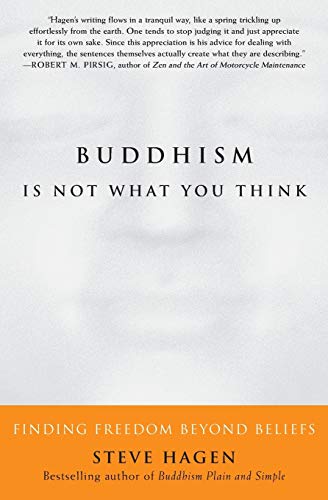
“[Hagan’s] book will appeal to readers interested in what true Zen practice is supposed to be about beyond all the popular images and colorful stories.”—Robert M. Pirsig, New York Times bestselling author of Zen and the Art of Motorcycle Maintenance Buddhism is Not What You Think is a clear, direct, and engaging guide to the most essential elements of spiritual inquiry: attention, intention, honesty with oneself, compassion, and the desire to awaken. A renowned Zen teacher, Steve Hagen offers a valuable hands-on guidebook in which examples from everyday life are presented alongside stories from Buddhist teachers past and present to banish misconceptions and inspire the newcomer and the knowledgeable practitioner alike. Buddhism is Not What You Think—it is both more…and less.
User’s Reviews
Editorial Reviews: Review “This is not just another nice book about Buddhism, one telling us what we like to hear and are used to hearing. No–it is a clear and challenging showing of the fundamental truth of our lives. This is an exceptional book. Make good use of it.” — Charlotte Joko Beck author of Everyday Zen“Hagen (Buddhism Plain and Simple) here presents 43 short chapters dealing with various aspects of Buddhist practice in a way that cuts to the heart of the matter. Hagen reminds us that whenever we’re grasping, aspiring, analyzing, judging, or in any way adding to the simple experience of the present moment, we are missing the point. The book will appeal to readers interested in what true Zen practice is supposed to be about beyond all the popular images and colorful stories. For practitioners it is also a book that will reward multiple readings over time.” — Robert M. Pirsig, author of Zen and the Art of Motorcycle Maintenance From the Back Cover Bestselling author and renowned Zen teacher Steve Hagen penetrates the most essential and enduring questions at the heart of the Buddha’s teachings: How can we see the world in each moment, rather than merely as what we think, hope, or fear it is? How can we base our actions on reality, rather than on the longing and loathing of our hearts and minds? How can we live lives that are wise, compassionate, and in tune with reality? And how can we separate the wisdom of Buddhism from the cultural trappings and misconceptions that have come to be associated with it?Drawing on down-to-earth examples from everyday life and stories from Buddhist teachers past and present, Hagen tackles these fundamental inquiries with his trademark lucid, straightforward prose. The newcomer to Buddhism will be inspired by this accessible and provocative introduction, and those more familiar with Buddhism will welcome this much needed hands-on guide to understanding what it truly means to be awake. By being challenged to question what we take for granted, we come to see the world as it truly is. Buddhism Is Not What You Think offers a profound and clear path to a life of joy and freedom. About the Author Steve Hagen is a Zen priest, a longtime teacher of Buddhism, and the author of the bestselling Buddhism Plain and Simple and Buddhism Is Not What You Think. Hagen began studying Buddhism in 1967. In 1975 he became a student of Dainin Katagiri Roshi, and in 1979 he was ordained a Zen priest. Steve lives in Minneapolis, where he lectures, teaches meditation, and writes. He is currently head teacher at Dharma Field Meditation and Learning Center in Minneapolis. Excerpt. © Reprinted by permission. All rights reserved. Buddhism Is Not What You ThinkFinding Freedom Beyond BeliefsBy Hagen, SteveHarperSanFranciscoISBN: 0060730579Chapter OneParadox and ConfusionIf you visit a Buddhist temple in Japan, you’ll likely encounter two gigantic, fierce, demonlike figures standing ateither side of the entrance. These are called the guardians ofTruth, and their names are Paradox and Confusion.When I first encountered these figures, it had never occurredto me that Truth had guards — or, indeed, that it needed guarding.But if the notion had arisen in my mind, I suspect I wouldhave pictured very pleasing, angelic figures.Why were these creatures so terrifying and menacing? Andwhy were the guardians of Truth represented rather than Truthitself?Gradually, I began to see the implication. There can be noimage of Truth. Truth can’t be captured in an image or aphrase or a word. It can’t be laid out in a theory, a diagram, ora book. Whatever notions we might have about Truth are incapableof bringing us to it. Thus, in trying to take hold ofTruth, we naturally encounter paradox and confusion.It works like this: though we experience Reality directly, weignore it. Instead, we try to explain it or take hold of it throughideas, models, beliefs, and stories. But precisely because thesethings aren’t Reality, our explanations naturally never matchactual experience. In the disjoint between Reality and our explanationsof it, paradox and confusion naturally arise.Furthermore, any accurate statement we would make aboutTruth must contain within itself its own demise. Thus such astatement inevitably will appear paradoxical and contradictory.In other words, statements about Truth and Reality arenot like ordinary statements.Usually we make a statement to single something out, to pinsomething down and make it unambiguous. Not so if our businessis Truth. In this case we must be willing to encounter,rather than try to evade, paradox and confusion.Our problem with paradox and confusion is that we insiston putting our direct experience into a conceptual box. We tryto encapsulate our experience in frozen, changeless form: “thismeans that.”Ordinary statements don’t permit paradox. Rather, they tryto pin down their subjects and make them appear as real andsolid as possible. Ordinary statements are presented in thespirit of “This is the Truth; believe it.” Then we ‘re handedsomething, often in the form of a book or a pamphlet.But all statements that present themselves in this way — whether they’re about politics, morality, economics, psychology,religion, science, philosophy, mathematics, or auto mechanics — are just ordinary stuff. They’re not Truth; they’re merely theattempt to preserve what necessarily passes away.When we claim to describe what’s Really going on by ourwords, no matter how beautiful, such words are already in error.Truth simply can’t be represented.We want Truth badly. We want to hold it tightly in ourhand. We want to give it to others in a word or a phrase. Wewant something we can jot down. Something we can impressupon others — and impress others with.We act as though Truth were something we could stuff inour pockets, something we could take out every once in awhile to show people, saying, “Here, this is it!” We forget thatthey will show us their slips of paper, with other ostensibleTruths written upon them.But Truth is not like this. Indeed, how could it be?We need only see that it’s beyond the spin of paradox thatTruth and Reality are glimpsed. If we would simply not try topin Reality down, confusion would no longer turn us away.What we can do is carefully attend to what’s actually goingon around us — and notice that our formulated beliefs, concepts,and stories never fully explain what’s going on.Our eyes must remain open long enough that we may besuddenly overwhelmed by a new experience — a new awareness — that shatters our habitual thought and our old familiarstories.We can free ourselves from paradox and confusion onlywhen we set ourselves in an open and inquiring frame of mind while ever on guard that we do not insist upon some particularbelief, no matter how seemingly well justified.If it ‘s Truth we’re after, we ‘ll find that we cannot start withany assumptions or concepts whatsoever. Instead, we must approachthe world with bare, naked attention, seeing it withoutany mental bias — without concepts, beliefs, preconceptions,presumptions, or expectations.Doing this is the subject of this book.Continues…Excerpted from Buddhism Is Not What You Thinkby Hagen, Steve Excerpted by permission. All rights reserved. No part of this excerpt may be reproduced or reprinted without permission in writing from the publisher.Excerpts are provided by Dial-A-Book Inc. solely for the personal use of visitors to this web site. Read more
Reviews from Amazon users which were colected at the time this book was published on the website:
⭐Steve Hagen does it again. Naturally, I first read the best seller, “Buddhism Plain and Simple” which in my opinion might be a better book; either way it’s worth reading both. What’s beautiful about Steve Hagen is that his writing style is so clear and lucid; it just flows. Buddhism may be difficult for some and easy for others. In any event – Hagen’s writing style is one that isn’t triumphed by many. I definitely recommend Derek Lin, and Ming Dao Deng in this category as well. These two scholars are extremely understandable and entertaining.Moving on, there are many wonderful points in this book – too many to mention; however I would like to list a few key notes in my own words as I often do:If everything is indeed a part of the whole and cannot be removed – then there’s only one thing to do… That is to be aware of it – recognize it for what it is and work with it till it becomes a part of you. Subsequently, there’s no reason to run or flee. Just be present and accept what comes and goes as nature itself. Much easier said than done, but recognition is the first step…We live and die in each moment because we only have this moment, and this moment is forever fleeting. All we have is this moment and when it’s gone – it’s gone. So, live in the moment to your fullest extent. This is the only moment you have, so you must live fully – full to the point that nothing remains – no reservations, no thoughts, no trace, nothing… To be alive in every breath, no regrets, no sorrow, no guilt – just the experience / the interaction…To truly interact with any/every activity you’re involved in… to become one with whatever you do means to immerse yourself fully in the moment. This is where you can’t tell where you start and the activity begins. This is peace of mind as well for there is nothing else but this moment which you are totally and completely immersed… This is Truth, Reality and Peace of Mind….To be like animals in the wild – to be self-contained and realize you don’t need anything. Just do what need to be done… We, as human beings, indeed we complicate our issues and beyond; instead, we must simplify all things. Realize we are one with our world, and we already have all we need- truly we are already complete…
⭐”Buddhism Is Not What You Think” has become one of my most beloved books and I found it coincidentally while googling a story I had heard about two statues that often sit outside Buddhist temples in Japan that are called the the Guardians of Truth. Steve Hagen begins Chapter One with that very story. These figures represent the paradox in our search for truth – so often we want to say THIS is the truth. Then immediately we limit our experience and put it in a box. Additionally we search for truth outside ourselves – as if someone or something else has our answers.Hagen’s instructions and guidance on working with our humanity are simple yet powerful. After twenty years on my own very eclectic spiritual path, I appreciate Hagen’s approach. It is both inspiring and practical. One of my favorite quotes from the book is: “There’s nothing to prove, nothing to figure out, nothing to get, nothing to understand. When we finally stop explaining everything to ourselves, we may discover that in silence, complete understanding was here all along.” Ahhhh, freedom. Thank you Steve!
⭐I’ve read many books on Buddhism, Zen and enlightenment. Many are obscure or too complicated to understand in practical terms. This book was simple in its presentation of what one needs to try to understand what really can’t be explained in words. The message is clear. Stop thinking. Just continue to come back to what’s happening right now. That’s the only place to be. That’s what’s happening. We call it reality.
⭐Great book on waking up and paying attention to thoughts without attachment to said thoughts. A great resource. Highly recommend
⭐Great read. Great explanations. It is just super-duper great! Please, do not male me write more! Read the book. Very good book. Some say it is the best book.
⭐This was my first time reading a book by Steve Hagen and I was fascinated , sometime I will start to lose interest in books that I read however this book had my interest all the way through and now I can’t wait to read more from this author and maybe even someday meet him in person where he teaches .
⭐This is an easily understood explanation about Buddhism that is not oversimplified, so it is a book I like to re-read occasionally, and that I often share with people curious about Buddhism.
⭐This book is incredible. It is often difficult to get an accurate description of what Buddhism is in the Western world due to Western bias, and once one has moved through that, the next hurdle is Eastern bias. Steve Hagen shows the barest, most basic tenants of Buddhism without the cloud of confusion and mystery that accompanies most religious traditions, ex. prayer. If you think you know what Buddhism teaches because it was explained to you buy a non-Buddhist, you’re probably mistaken. Thanks to Steve, now I can recognize what is and is not “Buddhism.”
⭐I thought that Steve Hagen’s previous book, ‘Buddhism Plain and Simple’ was a wonderful book, in fact one of the best books on Buddhism I’ve read. Having been practising as a Buddhist some years ago once I read it I realised that I’d finally understood what Buddha’s teachings truly are about. ‘Buddhism is not what you think’ is almost as good; clear in its exposition of Buddhist practice and it cuts through all of the nonsense that Buddha’s teachings accumulated over the centuries as the teachings moved from being a beautiful philosophy of awakening to a religion with all of the negative connotations and practices that that implies. Each chapter is a brilliant reminder to become present and to live in mindfulness.
⭐Re-reading this I realised how many of the ideas that I first encountered on first reading it all those years ago had become part of how I see the world. This is Steve Hagan’s great gift, helping us to see things with greater clarity in a way that sticks.
⭐Extremely well written, highly recommended to those seeking to appreciate this gift of life. Thank you for the wise words.
⭐I found the author’s earlier book an interesting read and bought this one as a follow up It cuts through a lot of the monastic traditions and treats the teachings as a 20th Century philosophy
⭐This interesting book is about reality and how to wake up in order to start living life in the real world rather than the unreal constructs of our own minds. Thought provoking and soaks into your consciousness like soft rain.
Keywords
Free Download Buddhism Is Not What You Think: Finding Freedom Beyond Beliefs in PDF format
Buddhism Is Not What You Think: Finding Freedom Beyond Beliefs PDF Free Download
Download Buddhism Is Not What You Think: Finding Freedom Beyond Beliefs 2009 PDF Free
Buddhism Is Not What You Think: Finding Freedom Beyond Beliefs 2009 PDF Free Download
Download Buddhism Is Not What You Think: Finding Freedom Beyond Beliefs PDF
Free Download Ebook Buddhism Is Not What You Think: Finding Freedom Beyond Beliefs