

Ebook Info
- Published: 2006
- Number of pages: 270 pages
- Format: PDF
- File Size: 1.65 MB
- Authors: Maria C. Galavotti
Description
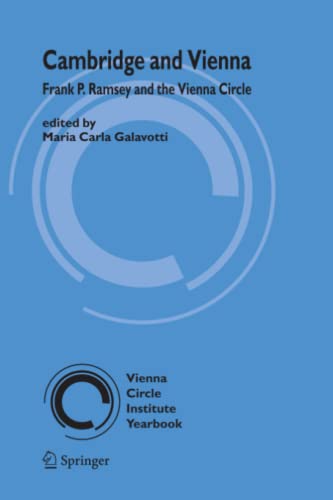
The Institute Vienna Circle held a conference in Vienna in 2003, Cambridge and Vienna – Frank P. Ramsey and the Vienna Circle, to commemorate the philosophical and scientific work of Frank Plumpton Ramsey (1903–1930). This Ramsey conference provided not only historical and biographical perspectives on one of the most gifted thinkers of the Twentieth Century, but also new impulses for further research on at least some of the topics pioneered by Ramsey, whose interest and potential are greater than ever.Ramsey did pioneering work in several fields, practitioners of which rarely know of his important work in other fields: philosophy of logic and theory of language, foundations of mathematics, mathematics, probability theory, methodology of science, philosophy of psychology, and economics. There was a focus on the one topic which was of strongest mutual concern to Ramsey and the Vienna Circle, namely the question of foundations of mathematics, in particular the status of logicism.Although the major scientific connection linking Ramsey with Austria is his work on logic, to which the Vienna Circle dedicated several meetings, certainly the connection which is of greater general interest concerns Ramsey’s visits and discussions with Wittgenstein. Ramsey was the only important thinker to actually visit Wittgenstein during his school-teaching career in Puchberg and Ottertal in the 1920s, in Lower Austria; and later, Ramsey was instrumental in getting Wittgenstein positions at Cambridge.
User’s Reviews
Editorial Reviews: From the Back Cover The Institute Vienna Circle held a conference in Vienna in 2003, Cambridge and Vienna – Frank P. Ramsey and the Vienna Circle, to commemorate the philosophical and scientific work of Frank Plumpton Ramsey (1903–1930). This Ramsey conference provided not only historical and biographical perspectives on one of the most gifted thinkers of the Twentieth Century, but also new impulses for further research on at least some of the topics pioneered by Ramsey, whose interest and potential are greater than ever.Ramsey did pioneering work in several fields, practitioners of which rarely know of his important work in other fields: philosophy of logic and theory of language, foundations of mathematics, mathematics, probability theory, methodology of science, philosophy of psychology, and economics. There was a focus on the one topic which was of strongest mutual concern to Ramsey and the Vienna Circle, namely the question of foundations of mathematics, in particular the status of logicism.Although the major scientific connection linking Ramsey with Austria is his work on logic, to which the Vienna Circle dedicated several meetings, certainly the connection which is of greater general interest concerns Ramsey’s visits and discussions with Wittgenstein. Ramsey was the only important thinker to actually visit Wittgenstein during his school-teaching career in Puchberg and Ottertal in the 1920s, in Lower Austria; and later, Ramsey was instrumental in getting Wittgenstein positions at Cambridge.
Reviews from Amazon users which were colected at the time this book was published on the website:
⭐Galavotti has turned out her usual assessment of Ramsey as the boy genius who was the greatest philosopher of the 20th century.This reviewer teaches discrete math courses so he certainly agrees that,in certain areas not related to probability,Ramsey made contributions that qualify him for genius status.His subjective theory of probabilty was not one of those areas,especially when he critiques Keynes’s theory based on a reading of only two chapters of Keynes’s 1921 A Treatise on Probability,chapters 3 and 4.How Ramsey has been able to get away with his gross misrepresentation of Keynes’s theory,as well as what are many appeals to ignorance,authority,and ad hominem attacks on Keynes,is a mystery tothis reviewer . Two of the contributors to this volume ,B Skyms and P Suppes,simply continue Ramsey’s misrepresentation of Keynes’s contribution.Keynes,a university tournament chess player,understood the extreme importance of the role of intuition in decision making.Practically any modern day study of the role played by intuition in decision making,such as those written by Gary Klein and D G Myers,concludes,based on large amounts of experimental evidence,that the use of intuition, knowing without knowing precisely how you know,is overwhelmingly supported .Keynes’s position is that decision makers are able to use their intuition to establish a connection or degree of partial entailment or similarity between two propositions,one representing the existing partial evidence and the other a conclusion based on this partial evidence.Keynes called these degrees logical or inductive probabilities.Ramsey simply denies that they exist,as do Suppes and Skyms.No experimental evidence is cited by Ramsey or deductive proof provided to show that inductive probabilities do not exist.The following inductive probabilities are intuited by this reviewer based on the partial evidence provided in these essays-(a)neither Ramsey,Skyms,or Suppes has ever played, or would ever have played,any tournament chess games in their lives,(b)none of them ,if they had attempted to play,would ever rise above a class E rating because they are deductivists who would attemt to analyze every move they made.Suppes arrives at what can only be described as a nonsense conclusion:”It is hard to think of another book in the history of probability,as badly thought out as Keynes’,which has had so much attention”.(Suppes,p.36). Suppes essay is followed by another essay written by Skyms,titled “Discovering “Weight”,or the value of knowledge”.Skyms claims that a two page essay written by Ramsey,a version of the EVPI(the expected value of perfect information)rule used to calculate expected values in the EMV(expected monetary value)rule,solves Keynes’ weight of the evidence problem.It does nothing of the sort.Ramsey simply assumes that the weight of the evidence already equals 1 so that he can use either a specific probability distribution or a set of numerical probabilities that are additive and sum to one.This is the very point that Keynes would challenge.Skyms appears to be completely ignorant of the very similar work done by Ellsberg,Einhorn and Hogarth,Gardenfors and Sahlin,or Tversky’s support theory,which all present indices to measure weight like concepts that are very similar to Keynes’s specification of an index to measure the weight of the evidence,w,on the unit interval between 0 and 1.w measures the completeness of the relevant actual and potential evidence upon which a decision maker would base his estimates of probability.If w<1,Ramsey's calculations become worthless nonsense. It appears that Suppes and Skyms never learned from the 20 year old confrontation between Kahneman and Tversky versus L Jonathon Cohen over the blue-green taxi cab problem that abruptly ended with Tversky implicitly conceding practically every point to Cohen and putting forth his support theory, a theory closely related to Keynes's weight of the evidence approach A final error committed by both Suppes and Skyms is their claim that Keynes did not understand Bayesian conditionalization.On the contrary,Keynes understood only too well.Bayesian Conditionalization only works if w=1,which means that a timeless probability distribution has been defined to be applicable.Again,if w<1,this approach falls apart. ⭐
Keywords
Free Download Cambridge and Vienna: Frank P. Ramsey and the Vienna Circle (Vienna Circle Institute Yearbook, 12) in PDF format
Cambridge and Vienna: Frank P. Ramsey and the Vienna Circle (Vienna Circle Institute Yearbook, 12) PDF Free Download
Download Cambridge and Vienna: Frank P. Ramsey and the Vienna Circle (Vienna Circle Institute Yearbook, 12) 2006 PDF Free
Cambridge and Vienna: Frank P. Ramsey and the Vienna Circle (Vienna Circle Institute Yearbook, 12) 2006 PDF Free Download
Download Cambridge and Vienna: Frank P. Ramsey and the Vienna Circle (Vienna Circle Institute Yearbook, 12) PDF
Free Download Ebook Cambridge and Vienna: Frank P. Ramsey and the Vienna Circle (Vienna Circle Institute Yearbook, 12)