

Ebook Info
- Published: 2007
- Number of pages: 180 pages
- Format: PDF
- File Size: 4.38 MB
- Authors: Lenny Smith
Description
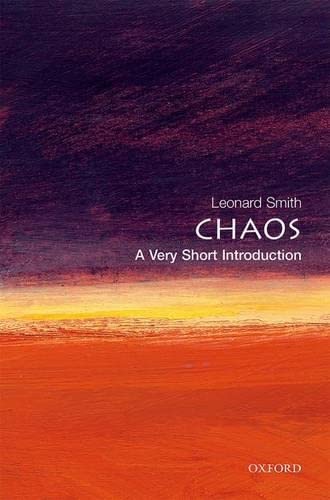
Chaos exists in systems all around us. Even the simplest system can be subject to chaos, denying us accurate predictions of its behavior, and sometimes giving rise to astonishing structures of large-scale order. Here, Leonard Smith shows that we all have an intuitive understanding of chaotic systems. He uses accessible math and physics to explain Chaos Theory, and points to numerous examples in philosophy and literature that illuminate the problems. This book provides a complete understanding of chaotic dynamics, using examples from mathematics, physics, philosophy, and the real world, with an explanation of why chaos is important and how it differs from the idea of randomness. The author’s real life applications include the weather forecast, a pendulum, a coin toss, mass transit, politics, and the role of chaos in gambling and the stock market. Chaos represents a prime opportunity for mathematical lay people to finally get a clear understanding of this fascinating concept.About the Series: Combining authority with wit, accessibility, and style, Very Short Introductions offer an introduction to some of life’s most interesting topics. Written by experts for the newcomer, they demonstrate the finest contemporary thinking about the central problems and issues in hundreds of key topics, from philosophy to Freud, quantum theory to Islam.
User’s Reviews
Editorial Reviews: Review “Leonard Smith’s Chaos (part of the Oxford Very Short Introduction series) will give you the clearest (but not too painful idea) of the maths involved… There’s a lot packed into this little book, and for such a technical exploration it’s surprisingly readable and enjoyable.”– popularscience.co.uk About the Author Leonard Smith is a member of the Mathematics Faculty in Oxford and lectues on nonlinear dynamical systems and chaos.
Reviews from Amazon users which were colected at the time this book was published on the website:
⭐I read the book twice. The first time I read it in bits and pieces and, frankly, didn’t get a lot out of it. The second time I sat down, focused and read it as a whole; the second approach was much more valuable. So, I recommend that you take the time to read the book in a focused matter; otherwise, if you’re like me, you may not get the book’s import.Next, you need to understand that the book has a number of mathematical concepts that for a non-mathematician like me, takes some effort to grasp. There are mathematical concepts that I believe that I only dimly understand even after some effort to do so. However, I concluded that this probably more on my shortcomings rather than the author’s.So, if you’re going to read the book, commit to do so, and, unless you’ve got a broader mathematical background than I have (one college calculus course), prepare to be challenged. The more I considered the book after my second reading, the more that I felt the challenges merited my effort. I think that it will reward your effort as well.What are the rewards? Most are familiar with the “butterfly effect;” the idea that a butterfly flapping its wings in Argentina, for instance, can cause a tornado in Kansas. The book discusses, among many things, “sensitive dependence,” the reality that sometimes small changes can have exponentially large effects across time, and maybe a fairly short time. But there’s much more.To my surprise, the book challenges the belief that mathematics can adequately, and always, describe reality. In doing so the book compares the realities faced by physicists and mathematicians. Chaos has defined the mathematical dynamical qualities, of being (1) recurrent, (2) deterministic and (3) sensitive dependence in its initial state. A physical system may be described as chaotic, but it may be difficult, or impossible, to be assured that it possesses all three of these qualities. The author describes why computers can’t model chaos systems.Another surprising observation of the book is that we probably can’t determine the initial physical state of a table, a garden filled with rabbits, etc., with as much precision as we think. This inability is due to the concept of “noise.” Read the book to see what “noise” is and why it affects our ability to make predictions.Chaotic systems are non-linear. The book considers scientific inquiry prior to, and during much of, the 20th century, which dealt with linear systems, and how that experience, and some of the mathematical concepts developed for that experience, was upended by chaos as it developed during the 20th century. So, the book has a history of science component, which I found interesting.Models, such as the ones used for weather forecasting, are examined in detail. The strengths, weaknesses, and evolution of modeling receive careful examination. Can a model, even one with 10,000,000 variables ever truly permit accurate forecasting? Read to find out.Lastly, the author occasionally considers the concept of “truth.” If the model and/or the math is bad or inadequate, can one get truth from any effort to model reality. He tells the story of three baseball umpires who explain their views of the game. One says: “I calls ’em as I sees ‘me.” The second says: “I calls ’em as they are.” The third says: “They ain’t, until I calls ’em.” The author says that chaos pushes us towards the philosophical position of the third umpire. Focus and I think you’ll find your efforts rewarded.
⭐I enjoy this short introduction series. I have read several books from this series and have found that it is a good way to learn about topics I have always wanted to learn about but never found the time to study in depth. Nevertheless, I was a little disappointed with this book.I have heard about chaos theory for years and ‘the butterfly effect,’ that chaos theory invokes has almost become cliché. Yet, I didn’t understand what chaos theory was. That is why I picked up this book. Now, after reading it, if I understand rightly, it seems like chaos is an apparent lack of order within a system and chaos theory is an attempt to measure and model uncertainty within particular systems. Even though there is apparent disorder there is an underlying order in which small events can lead to complex results, thus the famous ‘butterfly effect.’ of chaos theory. The theory actually arose from attempts to understand and model weather patterns, and to predict future weather. It was out of the need to understand uncertainty in weather that the science grew.That was about as far as I got in my understanding of the ideas contained within. The author claimed readers didn’t need to be mathematicians to understand what he was saying about chaos. Sure, he never threw any formulas at me. Yet, much of the concepts and jargon was derived from math. I feel to really appreciate what he was saying about chaos theory one needs a solid background in math. I found some of the jargon and math ideas intimidating and didn’t feel like I was comprehending all of the concepts that the author was trying to communicate.Again, could have the author communicated the concepts better, or does the reader need the background to understand what the author was saying?I will leave that up to other readers to decide. Maybe they will appreciate the thoughts contained within better than I did. Yet, regardless, I recommend books from this series. It is a good way to quickly get up to speed on intellectual topics in vogue. I hope that the editors continue to produce new books in this series.
⭐I found this in an interesting, but difficult read. That is not to say it was not a very helpful introduction, but this is a very complex and potentially daunting subject. This 176 page read serves as a very good springboard to a whole lot more reading! Unfortunately, I can see myself doing a lot more studying in this area; but that’s the fun of it! I must admit that I enjoy learning about math, science, and philosophy; and this has plenty of all those things! Pardon me, but my “geek” is showing! How embarrassing!I would recommend this book to those who enjoy science or math, but beware, this can easily lead to much heavier reading. Consider yourself warned!
⭐I once attended a lecture by the author and, despite his lively manner, wild hair, and all-over denim styling I was absolutely baffled within a few minutes.However, this book turned out to be a pleasant surprise, being easy to read (considering the subject matter) as well as packed with interesting ideas and insights.Since the format is compact I’ve found it a perfect book for reading while travelling.
⭐Sort but very clear.
⭐Lucid and exciting,
⭐I was left with the sense that Mr Smith needs to get out of his office a little bit more often so he may appreciate better what lay people do or do not already know. I’m a graduate engineer with a strong mathematical back ground who has already studied chaos for a while and I struggled to understand the concepts he was trying to convey, even ones that I am already familiar with, from his text. As well as his explanations being unnecessarily hard to understand and rather abstract, I was left with the feeling that he had originally written a much longer text that someone else has badly edited leaving large holes in the logic and explanation just so as to make this a small enough book to fit with the short introduction requirement. As a result, what is left is confusing and off putting. In essence, Chaos is not hard to grasp and is fundamentally the study of nature. Unfortunately Mr Smith seems to have managed to achieve otherwise.If you want a book that covers the subject in both more depth as well as gets across the concepts in a way that is understandable, and that will encourage an interest in the subject then consider
⭐Chaos: Making a New Science
⭐. If on the other hand you want to be confused and put off, this book will be just fine.
⭐”Very short introductions”-don’t confuse it with easy-going literature! Concise and efficient would be a much better description. You definitely have to work your way through the whole matter, which is not that short, thanks to the small letter printing and fine paper. I doubt, though, that it would be possible to keep it any shorter without being inaccurate-a person like Einstein would say it is just right for people with short time but the ambition to get as full and deep a picture of the whole matter as possible. It is a borderline journey for hard matter like “chaos theory”, but still a successfull one.
Keywords
Free Download Chaos: A Very Short Introduction 1st Edition in PDF format
Chaos: A Very Short Introduction 1st Edition PDF Free Download
Download Chaos: A Very Short Introduction 1st Edition 2007 PDF Free
Chaos: A Very Short Introduction 1st Edition 2007 PDF Free Download
Download Chaos: A Very Short Introduction 1st Edition PDF
Free Download Ebook Chaos: A Very Short Introduction 1st Edition