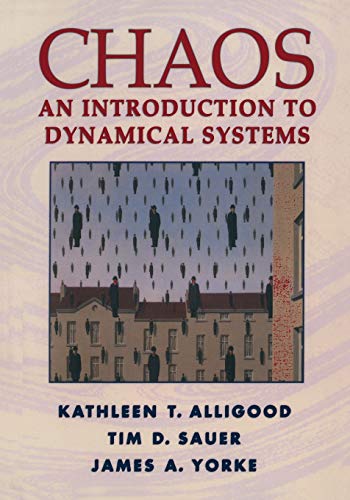
Ebook Info
- Published: 1996
- Number of pages: 620 pages
- Format: PDF
- File Size: 13.35 MB
- Authors: Kathleen T. Alligood
Description
Developed and class-tested by a distinguished team of authors at two universities, this text is intended for courses in nonlinear dynamics in either mathematics or physics. The only prerequisites are calculus, differential equations, and linear algebra. Along with discussions of the major topics, including discrete dynamical systems, chaos, fractals, nonlinear differential equations and bifurcations, the text also includes Lab Visits — short reports that illustrate relevant concepts from the physical, chemical and biological sciences. There are Computer Experiments throughout the text that present opportunities to explore dynamics through computer simulations, designed for use with any software package. And each chapter ends with a Challenge, guiding students through an advanced topic in the form of an extended exercise.
User’s Reviews
Editorial Reviews: Review From the reviews:”… Written by some prominent contributors to the development of the field … With regard to both style and content, the authors succeed in introducing junior/senior undergraduate students to the dynamics and analytical techniques associated with nonlinear systems, especially those related to chaos … There are several aspects of the book that distinguish it from some other recent contributions in this area … The treatment of discrete systems here maintains a balanced emphasis between one- and two- (or higher-) dimensional problems. This is an important feature since the dynamics for the two cases and methods employed for their analyses may differ significantly. Also, while most other introductory texts concentrate almost exclusively upon discrete mappings, here at least three of the thirteen chapters are devoted to differential equations, including the Poincare-Bendixson theorem. Add to this a discussion of $omega$-limit sets, including periodic and strange attractors, as well as a chapter on fractals, and the result is one of the most comprehensive texts on the topic that has yet appeared.” Mathematical Reviews About the Author
Reviews from Amazon users which were colected at the time this book was published on the website:
⭐It was about the mid 1990’s, still assimilating the big hype caused by the eventual and much-publicized proof by Andrew Wiles of Fermat’s Last Theorem, when my curiosity (bolstered more by having seen a movie such as The Jurassic Park!) finally led me to taking a first college course on Chaos and Fractals at a California State school. At that time, the funny, surcastic, and somewhat sloppy foreign professor (who happened to be a country-mate of mine, for better or worse), had chosen the brand-new text “Fractals Everywhere” by Michael F. Barnsely for teaching our mid-size class consisting mainly of senior and first-year graduate students in math and sciences. I recall the discussion starting out by covering the basics about the metric spaces and sequences, and I having a head-start over many others coming fresh on the heels of a heavy-duty general topology course just in the previous semester (so for example I could show off to others on the first instruction day what it meant for two metrics to be equivalent). Still, I admit the semester went by without many of us really absorbing the nuts and bolts of the subject, for example why exactly topological transitivity was needed for chaos in an Iterated Function System, and why exactly some known fractals had the given fractional dimensions (eventhough we could compute them). However the students were generally happy to have scratched the surface of this vast, engaging subject, and for the time being it seemed about enough exposure for most of us. Consequently for me, during the several ensuing years in the late 90’s the subject leapt mostly into the background, but nearly a decade later since I first took the college course, somehow it came back to the foreground in the company of several other applied subjects such as control, game theory, and information/coding theory.Now looking back, I find Barnsley’s text a very good choice having gone through at the time, but the title by Alligood, Sauer, and Yorke (as a recommendation by a college professor at a different school who had taught his students from it) seemed like a more well-balanced introduction to the area of dynamical systems. In fact I also recall at the time there was a discussion as to whether yet another text by Robert Devaney would have made for a better first course. The aforementioned professor duely noted that Devaney only dealt with the discrete dynamical systems, while A/S/Y treated both the discrete and continuous, hence making the choice of the latter a more suitable one. In any event, the rundown of the topics discussed in the 13 chapters of A/S/Y include: one and two dimensional maps, fixed points, iterations, sinks, sources, saddles, Lyapunov exponents, chaotic orbits, conjugacy, fractals and their dimension, chaotic attractors, measure, Lotka-Volterra models, Poincare-Bendixson theorem, Lorentz and Roessler attractors, stable manifolds and crises, homoclinic and heteroclinic points, bifurcations, and cascades. There are answers and solutions to the selected exercises, as well as extensive references at the back, making up an ideal setting for self-study. The level and style of exposition is targeted towards an advanced undergraduate student who is into applied math or engineering fields. Therefore the authors emphasize concepts and applications instead of getting bogged down in too much mathematical rigor or heavy use of the abstract machinery (which is of course needed for a thorough treatment of the subject at an advanced level; there are in fact several newer titles which all occupy this niche). Notationally and stylistically also, A/S/Y is very accessible and attractive. All in all, an excellent first excursion/introduction to one of the most fascinating areas of applied math, whether for classroom use, or for self-study.[Review updated and reposted on 08/08/08]
⭐I think this book is really strong on discrete index dynamical systems (Chapters 1-4) but could use a rewrite on the continuous index portion (Chapter 7,8). I haven’t read the later portion. Summary: Read this for difference equations, Strogatz for differential equations.
⭐I needed the book for class. It certainly isn’t the best textbook I’ve used (as a math major) but it gets the job done. It could probably use better examples and more clear directives to illustrate points more clearly.
⭐The product came very dirty, but was otherwise in “very good” condition.
⭐Very nice introduction to an increasingly important subject.
⭐This introduce the dynamical systems together with chaos from map and ordinary differentials equations clearly! It also talks about manifold! I likes it !
⭐This book is both simple enough to understand, and sophisticated enough to provide further understanding. If you are an second or third year undergraduate planning on graduate work, this book is a great way to catch up on advanced mathematics.
⭐Yorke and his collaborators produced what is probably the best available textbook on chaos. It is meant for both the beginer and the advanced student.
Keywords
Free Download Chaos: An Introduction to Dynamical Systems (Textbooks in Mathematical Sciences) in PDF format
Chaos: An Introduction to Dynamical Systems (Textbooks in Mathematical Sciences) PDF Free Download
Download Chaos: An Introduction to Dynamical Systems (Textbooks in Mathematical Sciences) 1996 PDF Free
Chaos: An Introduction to Dynamical Systems (Textbooks in Mathematical Sciences) 1996 PDF Free Download
Download Chaos: An Introduction to Dynamical Systems (Textbooks in Mathematical Sciences) PDF
Free Download Ebook Chaos: An Introduction to Dynamical Systems (Textbooks in Mathematical Sciences)