Ebook Info
- Published: 2006
- Number of pages: 392 pages
- Format: PDF
- File Size: 1.45 MB
- Authors: John W. Garver
Description
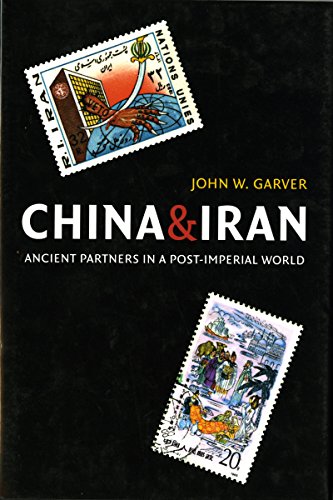
Iran’s nuclear aspirations increasingly dominate its relations with the United States and Europe. China remains one of Iran’s strongest allies on the Security Council, and also its most likely supplier of technology and assistance, built on decades of close economic and military relations. Iran is enjoying strong new influence in the Middle East and Asia following record oil profits and Shi’i victories in Iraqi parliamentary elections. Like Iran, China fought for decades to increase its self-reliance and geopolitical influence after painful experiences under European colonialism, which spurred nationalist revolutions.With China and Iran: Ancient Partners in a Post-Imperial World, John Garver breaks new ground on the relationship between the People’s Republic of China and the Islamic Republic of Iran. Grounding his survey in the twin concepts of civilization and power, Garver explores the relationship between these two ancient and proud peoples, each of which consider the other a peer and a partner in their mutual determination to build a post-Western-dominated Asia. Successive governments of both China and Iran have recognized substantial national capabilities in each other, capabilities that allow the countries to achieve their own national interests through cooperation. These interests have varied – from countering Soviet expansionism to resisting U.S. unilateralism – but the cooperative relationship between the two nations has remained constant.In his compelling analysis, Garver explores the evolution of Sino-Iranian relations through several phases, including Iran under the shah and before the 1979 revolution; from the 1979 revolution to 1989, a year marked both by the end of the Iran-Iraq war and the beginning of conflict in Sino-U.S. relations; and from 1989 to 2004. China and Iran includes discussion of the current debates at the International Atomic Energy Agency over Iran’s nuclear programs and China’s role in assisting these programs and in supporting Iran in international debates. Garver examines China’s involvement in Iran’s efforts to modernize its military, including China’s offer of weapons, capital goods, and engineering services in exchange for Iranian oil, suggesting links between this energy exchange and China’s support for Iran in political arenas.In today’s political climate, where China is recognized as a rising and increasingly influential global power and Iran as one of the most powerful nations in the Middle East, this book presents a crucial analysis of a topic of utmost importance to scholars and the general public today.
User’s Reviews
Editorial Reviews: Review “With this study, the author has written on a rarely discussed topic: Chinese-Iranian relations. He has done us a great service in doing so, not only by taking on an unusual topic, but also in doing it with gratifying length. . . . Garver has succeeded in capturing both the current context of the Sino-Iranian relationship and the much deeper historical context of their goals and attitudes. . . . The book deserves a wide audience.”―The Historian”This thoughtful exploration of the important but little-understood relationship between the Islamic Republic of Iran and the People’s Republic of China could not be timelier. . . . [Garver] provides precisely what policy makers need: historical perspective on Chinese-Iranian contact going back to imperial times, but concentrating on the late 20th century.”―Choice”Garver’s analysis of the past and future of the relationship is thoroughly researched, analytically astute, and lucidly presented.. Garver sees the relationship he is studying from the inside― what it means to be participants in their own mental worlds, from the outside― how it works geostrategically, and from all around, in historical, cultural, diplomatic, strategic, and economic dimensions.”―Political Science Quarterly”A great contribution to our knowledge of Chinese foreign policy and its achievements with an important partner at a time of US preeminence. This work will appeal to the policymaker and professor alike, and would be suitable for both upper undergraduate and especially graduate courses. Whether readers are concerned with China’s rise, the emergence of a more powerful Iran or interests and constraints for the United States in engaging these regional powers, China and Iran makes for an exacting, insightful and valuable read.”―The China Journal”A comprehensive examination of the drivers, content, and possible implications of the relationship between China and Iran.”―Middle East Journal”Interesting and timely.”―IIAS Newsletter”Garver’s work presents valuable insights into this relationship built on centuries of economic relations.”―Open Spaces”An incisive and remarkably lucid historical overview. Garver’s China and Iran is likely to recast our thinking on the dynamics and study of bilateral relations.”―Dawn”Could not be timelier..At a time when Washington is trying to cajole China into helping to halt Iranian efforts to build nuclear weapons and long―range missiles, diplomats and scholars ought to put this solid, sober, well―researched, reasonably priced book near the top of their reading lists.”―Choice Magazine”An excellent study of complex and understudied issues. It is absolutely seminal in the sense that there is no book at all on this topic, and precious few articles. China and Iran is a major contribution to the field.”―Kamran Aghaie, University of Texas at Austin”Garver has again proven himself to be the nation’s leading scholar of China’s foreign relations. This pathbreaking scholarship provides a much―needed corrective to media caricatures and fills a void of reliable information.”―David Shambaugh, George Washington University”Garver’s painstaking research shows how China and Iran try consistently to resist perceived American hegemony and invoke their ancient relations to legitimize the convergence of their national interests. Garver empathetically probes these relations from the perspectives of their leaders, rather than his own American lenses.”―R. K. Ramazani, University of Virginia”Garver’s incisive and lucid work draws attention to the range and depth of China―Iran cultural interactions and how these shape their perceptions and projection of power…. These rigorous, refreshing, innovative insights on the intricacies of regional politics are likely to recast our thinking on power relationships in Asia and the Middle East.”―Saaed Shafqat, Columbia University”A tour de force of the highest importance to U.S. policymakers and scholars alike.”―Ambassador Thomas Graham Jr.”The first of its kind, Garver’s timely book combines exciting insights on politics, ideology, Islam, and energy, as well as military and nuclear policy. This will be the standard work for some time to come.”―Yitzhak Shichor, University of Haifa From the Publisher “An excellent study of complex and understudied issues. It is absolutely seminal in the sense that there is no book at all on this topic, and precious few articles. China and Iran is a major contribution to the field.” Kamran Aghaie, University of Texas at Austin From the Back Cover John W. Garver charts the evolution of Sino-Iranian relations through several phases and explores the contentious debates over Iran’s nuclear programs and China’s role in assisting these programs and supporting Iran’s efforts to modernize its military and oil industry infrastructure. About the Author John W. Garver is professor of international affairs at the Georgia Institute of Technology. Among his previous books are Protracted Contest: Sino-Soviet Rivalry in the Twentieth Century and Face Off: China, the United States, and Taiwan’s Democratization. Read more
Reviews from Amazon users which were colected at the time this book was published on the website:
⭐The Kingdom of Iran and the People’s Republic of China established diplomatic relations in 1971. Of course, relations between these two great ancient civilizations vastly predates the twentieth century, with the silk road a testimony to the strength and duration of their bonding. Both China and Iran are inspired by a sense that their outstanding civilizational achievements over long stretches of history entitle them to an esteemed rank in the community of states, and a feeling that the current international order, dominated as it is by the Western power that stripped them of their earlier high status, is profoundly unjust.This sense of grievance and victimization with the course of modern history has led to various discourses on the desired international order. In the 1970s and 1980s Beijing extolled unity of the developing, Third World countries seeking liberation from superpower interference, domination, and exploitation. During the immediate post-Cold War period, Beijing framed world trends in terms of trends toward multipolarity and against U.S. attempts to uphold unipolar domination. By the late 1990s Beijing downplayed the theme of incipient multipolarity, but condemned U.S. unilateralism, power politics, bullying, double standards, and interference. In all these periods Iran provided a valued card in China’s strategic game. Relations between the two countries were underpinned by concrete interests: containing the Soviet Union in the 1970s, countering U.S. hegemonism in the 1990s, developing the economies and military forces in their own countries, supplying and consuming energy, etc.Opposition to U.S. unipolar domination and aspiration to a more balanced international order therefore creates considerable common interest between the two powers. In the wording of communiques, “Iran and China share common views on many major international issues, although they pursue independent foreign policies”. The last qualification should however be emphasized. China’s cooperation with Iran has frequently come into conflict with the imperative of maintaining a broadly cooperative relation with the United States in the sake of China’s economic development. When the chips are down, the requirements of China’s “peaceful rise” trump all other considerations, and Iran’s wild card is simply too dangerous to play.Developments in the nuclear arena illustrate the trade-offs between China’s cooperation with Iran and maintenance of Sino-American comity. Support for Iranian nuclear programs was a key element of Beijing’s effort to forge a partnership with Iran in the 1980s and 1990s. While China was not Iran’s only partner during that period (Pakistan’s Abdul Qadir Khan provided key technologies for uranium enrichment), it was by far the most important. During these years, Beijing turned a blind eye as Iran’s nuclear program large and covert military dimensions came into public view. In 1997 however, China abandoned its nuclear cooperation with Iran under intense U.S. pressure to do so.Safeguarding China’s vital relation with the United States was not the sole motivation. The desire to be recognized as a sober, responsible leading nation of the world gradually led China to support the nonproliferation regime. Although an Iranian bomb did not directly threaten China, Beijing recognized that as an NPT nuclear weapon state China’s interests were best served by limiting the number of states that possess nuclear weapons. The desire to access U.S. and Europe’s advanced nuclear power technology to ease the country’s energy bottlenecks also provided a strong incentive. The terms the U.S. set for accessing that technology were China’s compliance with global nonproliferation norms and, in the case of Iran, severance of all nuclear ties, including cooperation permitted under international law.Developments in the Middle East also illustrate this basic trade-off. Although Chinese diplomats have consistently held that “the affairs of a given region must be managed by the countries and peoples of that region”, China has decided not to antagonize the United States in the Middle East. China depends on the Persian Gulf for the greater part of its oil imports, and therefore indirectly benefits from the security guarantee provided by the U.S. The only scenario that would balance this dependence on the U.S. securing the Gulf would be in the advent of a conflict over Taiwan. Should a conflict in the Taiwan straits become protracted, the United States would be likely to cut off China’s oil imports one way or another. The willingness of a major petroleum power like Iran to continue supplying China could be highly important under these circumstances.The Sino-Iranian relation can therefore be best described as a second-order relationship in the sense that both parties have periodically subordinated that relationship to other objectives. In the 1970s Iran insisted on subordinating its relation with China to Iran’s relation with the Soviet Union, and used the rivalry between the two powers to its own advantage. Similarly, in the 2000s Beijing insists on subordinating its relation with Iran to China’s far more important relation with the United States, and uses the Iranian card both as a leverage and as a hedge.In the long run however, the author sees much potential for cooperation between the two powers. There has been no incident of armed conflict in the long history of interaction between Chinese and Persian states, but rather lots of mutually beneficial exchanges, including occasional convergence of strategic interests. Among all regional powers having to cope with China’s “peaceful rise”, Iran promises to be more comfortable with greater Chinese power than does any other major Asian state. China and Iran are ancient partners that may be drawn ever closer together in a post-imperial world.
⭐Between 2005 and 2007, Iranian trade with China doubled to US$20 billion. On September 30, 2007, the Chinese ambassador to Tehran said, “China will never do anything against Iran’s interests.” (1) With the increase of relations between Beijing and Tehran, so, too, have U.S. policy concerns grown. Despite that, the literature on Sino-Iranian relations has been sparse until now.To fill the gap, Garver, a China scholar at the Georgia Institute of Technology, puts together an impressive exploration of Sino-Iranian relations in China and Iran. Unfortunately, he breezes through twenty centuries of pre-modern Sino-Iranian relations in just eight pages, depriving the reader of context for the recent flourishing. Garver may be too cynical when he suggests that Chinese and Iranian emphasis on their earlier ties is convenient revisionism for there does exist a rich Persian literature–yet to be translated into any Western language–discussing earlier generations of ties with China. (2)Garver’s focus begins in 1971 when the Peoples’ Republic of China established relations with Iran. He then traces the ebb and flow of contacts through China’s liberalization and Iran’s Islamic revolution. Throughout much of the 1990s, Tehran and Beijing found common ground in an “anti-[U.S.] hegemony partnership.” Separate chapters examine the Iranian approach to China’s Muslim Uighur population; Chinese assistance to Iran’s nuclear program; and Sino-Iranian energy cooperation.China and Iran is straightforward, well-indexed, and well-sourced, if a bit dry. Garver does not offer earthshaking analysis, but for any policy practitioner wishing to understand the context of the current Sino-Iranian embrace, China and Iran offers a handy, reliable resource.Michael RubinMiddle East QuarterlySpring 2008(1) Fars News Agency, Oct. 1, 2007.(2) Ali Akbar Khata`i, Khataynameh [The Book of China], Iraj Afshar, ed. (Tehran: Center for Documents of Asian Culture, 1993).
⭐
Keywords
Free Download China and Iran: Ancient Partners in a Post-Imperial World in PDF format
China and Iran: Ancient Partners in a Post-Imperial World PDF Free Download
Download China and Iran: Ancient Partners in a Post-Imperial World 2006 PDF Free
China and Iran: Ancient Partners in a Post-Imperial World 2006 PDF Free Download
Download China and Iran: Ancient Partners in a Post-Imperial World PDF
Free Download Ebook China and Iran: Ancient Partners in a Post-Imperial World