

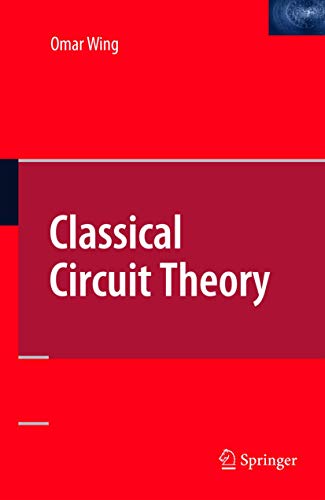
Ebook Info
- Published: 2009
- Number of pages: 310 pages
- Format: PDF
- File Size: 2.02 MB
- Authors: Omar Wing
Description
Classical circuit theory is a mathematical theory of linear, passive circuits, namely, circuits composed of resistors, capacitors and inductors. Like many a thing classical, it is old and enduring, structured and precise, simple and elegant. It is simple in that everything in it can be deduced from ?rst principles based on a few physical laws. It is enduring in that the things we can say about linear, passive circuits are universally true, unchanging. No matter how complex a circuit may be, as long as it consists of these three kinds of elements, its behavior must be as prescribed by the theory. The theory tells us what circuits can and cannot do. As expected of any good theory, classical circuit theory is also useful. Its ulti mate application is circuit design. The theory leads us to a design methodology that is systematic and precise. It is based on just two fundamental theorems: that the impedance function of a linear, passive circuit is a positive real function, and that the transfer function is a bounded real function, of a complex variable.
User’s Reviews
Editorial Reviews: Review From the reviews:”Classical Circuit Theory is a relatively short book that restricts content to linear circuits composed of passive elements. The approach to this traditional subject is modern. … This well-written volume should be valuable to students taking a sophisticated approach toward circuit theory. Summing Up: Recommended. Upper-division undergraduates and graduate students.” (M. S. Roden, Choice, Vol. 46 (9), May, 2009) From the Back Cover Classical Circuit Theory provides readers with the fundamental, analytic properties of linear circuits that are important to the design of conventional and non-conventional circuits in modern communication systems. These properties include the relations between phase and gain, between the real and imaginary parts, and between phase and group delay. They also include the fundamental limitations on gain and bandwidth, which are important in broadband matching in amplifier design. The idea that an impedance function is a positive real function and that a transfer function is bounded-real, forms the basis for analytic design of all conventional filters. At the same time, mathematical programming tools are now widely available so that design of non-conventional circuits by optimization is but a few mouse clicks away. Every new concept within the material is illustrated with one or more examples. There are exercises and problems at the end of the chapters. Some may be suitable for term projects. The design techniques presented are also illustrated step by step with easy-to-follow examples.
Reviews from Amazon users which were colected at the time this book was published on the website:
⭐I like this book, it may be considered a compilation of the work by the great authors of network synthesis such as Guillemin, Cauer, Foster, Darlington and such.I personally disagree with the other reviewer, why does a book should be considered good or bad, based only on its practicallity? I believe this is a good book to learn advanced circuit theory. Its main focus point is network analysis and synthesis of passive networks, both of which are very complex topics, requiring a good grasp of theory and mathematical concepts. The author’s writting style is clear and concise.I would definitely recommend this book to anyone involved in network synthesis,
⭐I am writing as a one time student of Professor Wing, who taught both circuit theory and partial differential equations when I was a junior in the electrical engineering at Columbia University. The text used then by Friedland, Wing and Ash I have referred to ever since in my career as it encapsulated what was then known from over a hundred years of practioners’ experience with electrical circuits. This text provides what the one I was taught did not – an excellent history of the development of many minds in analyzing electrical circuits. However, this present treatment is almost completely analytical and devoted to filter synthesis. It is not a volume welcome to practicing engineers, almost a complete departure from what I studied which, even then, threatened analysis over practicality. The treatment of transmission lines is cursive and completely without attachment to their physical reality. No Heaviside in this one, although he is credited with the original analysis in the introduction. Such a colossal disappointment. Reading this well written text one might as well be on Mars, where living is harder and the air thin.
Keywords
Free Download Classical Circuit Theory 2009th Edition in PDF format
Classical Circuit Theory 2009th Edition PDF Free Download
Download Classical Circuit Theory 2009th Edition 2009 PDF Free
Classical Circuit Theory 2009th Edition 2009 PDF Free Download
Download Classical Circuit Theory 2009th Edition PDF
Free Download Ebook Classical Circuit Theory 2009th Edition