

Ebook Info
- Published: 2015
- Number of pages: 612 pages
- Format: PDF
- File Size: 25.09 MB
- Authors: E C George Sudarshan
Description
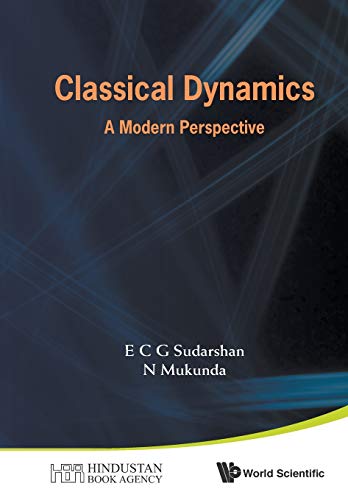
Classical dynamics is traditionally treated as an early stage in the development of physics, a stage that has long been superseded by more ambitious theories. Here, in this book, classical dynamics is treated as a subject on its own as well as a research frontier. Incorporating insights gained over the past several decades, the essential principles of classical dynamics are presented, while demonstrating that a number of key results originally considered only in the context of quantum theory and particle physics, have their foundations in classical dynamics.Graduate students in physics and practicing physicists will welcome the present approach to classical dynamics that encompasses systems of particles, free and interacting fields, and coupled systems. Lie groups and Lie algebras are incorporated at a basic level and are used in describing space-time symmetry groups. There is an extensive discussion on constrained systems, Dirac brackets and their geometrical interpretation. The Lie-algebraic description of dynamical systems is discussed in detail, and Poisson brackets are developed as a realization of Lie brackets. Other topics include treatments of classical spin, elementary relativistic systems in the classical context, irreducible realizations of the Galileo and Poincaré groups, and hydrodynamics as a Galilean field theory. Students will also find that this approach that deals with problems of manifest covariance, the no-interaction theorem in Hamiltonian mechanics and the structure of action-at-a-distance theories provides all the essential preparatory groundwork for a passage to quantum field theory.This reprinting of the original text published in 1974 is a testimony to the vitality of the contents that has remained relevant over nearly half a century.
User’s Reviews
Editorial Reviews: From the Back Cover Classical dynamics is traditionally treated as an early stage in the development of physics, a stage that has long been superseded by more ambitious theories. Here, in this book, classical dynamics is treated as a subject on its own as well as a research frontier. Incorporating insights gained over the past several decades, the essential principles of classical dynamics are presented, while demonstrating that a number of key results originally considered only in the context of quantum theory and particle physics, have their foundations in classical dynamics. Graduate students in physics and practicing physicists will welcome the present approach to classical dynamics that encompasses systems of particles, free and interacting fields, and coupled systems. Lie groups and Lie algebras are incorporated at a basic level and are used in describing space-time symmetry groups. There is an extensive discussion on constrained systems, Dirac brackets and their geometrical interpretation. The Lie-algebraic description of dynamical systems is discussed in detail, and Poisson brackets are developed as a realization of Lie brackets. Other topics include treatments of classical spin, elementary relativistic systems in the classical context, irreducible realizations of the Galileo and Poincar groups, and hydrodynamics as a Galilean field theory. Students will also find that this approach that deals with problems of manifest covariance, the no-interaction theorem in Hamiltonian mechanics and the structure of action-at-a-distance theories provides all the essential preparatory groundwork for a passage to quantum field theory. This reprinting of the original text published in 1974 is a testimony to the vitality of the contents that has remained relevant over nearly half a century.
Reviews from Amazon users which were colected at the time this book was published on the website:
⭐This text never quite took off as a primary first year graduate text or advanced undergraduate text. It assumes familiarity with graduate level analytical mechanics like Goldstein. For example you’re shown that the action functional satisfies the Hamilton-Jacobi equation without telling you it’s the Hamilton-Jacobi equation early in the text. The Legendre transformation also makes its way early and you’re assumed to know how it converts the Lagrangian to the Hamiltonian form. So much of the material you’d encounter in a graduate text like Goldstein is presented by way of review. Classical mechanics is presented in the spirit of quantum mechanics in their treatment according to the authors and indeed it’s a different viewpoint. It’s primarily a research monograph. The emphasis is classical mechanics via group theory. Essentially elements from about every graduate course that would lead to a masters in physics in most American universities find their way in this presentation (quantum mechanics, statistical mechanics, classical electrodynamics, analytical mechanics). Be prepared as it may involve a learning curve. In fact when it was widely available in its hardcover edition, it was popular among practicing physicists who wanted to learn Lie groups in the familiar context of classical mechanics. In addition to the mathematics you would encounter in the above mentioned courses, the authors assume familiarity with rigorous analysis. It’s needed to understand the one mathematics reference given: L.P.Eisenhart’s “Continuous Groups of Transformations,” available as a free PDF or cheaply on Amazon. For example the Jacobian’s use in the change of variables formula for integrals leads to conservation of volume in phase space if the Jaccobian is nonsingular (determinant is nonzero) as well as the role it plays in function independence as exemplified in the inverse and implicit function theorems. Also familiarity with the theory of group representations is assumed (proof of Schur’s lemma, invariant subspaces, irreducible representations, etc.). Tinkham’s group theory text will do here. Judging from qualifying exams released online it’s possible to escape group representations-even with a Ph.D. !When Dirac sought a different derivation or proof of the fundamental quantum commutators via Heisenberg’s ideas he stumbled on the Poisson Brackets-likely because the relations they obeyed might be amenable to a matrix form as in Heisenberg’s theory-I say stumbled because later he confessed he was unfamiliar with them. With faith in the laws of classical mechanics and taking order into account because of possible non-commutativity as shown by Heisenberg, he succeeded. You can find this proof around p. 86 in his Principles. This discovery brought this neglected and somewhat obscure concept back into mainstream physics. The Poisson Bracket relations are actually defining relations for a Lie algebra. The Lie algebra approach had continued and developed for some time within the quantum context before it was explored in its classical context via its Poisson Bracket realization. In particular the quantum theory of angular momentum with its ladder operators and Casimir operators was known and used for several decades before its classical P.B. theory. In short this text contains much hard to find material. There’s even a proof of the no-interaction theorem of relativistic mechanics, though some steps are presented in outline which the reader must complete (you should be able when you get there), This disallows useful concepts such as center of mass and center of mass frame. They show how the introduction of the field evades this theorem. In fact you’ll find that much of what we know of classical fields emerged only after exploration in the quantum realm.You will realize as you read this that classical mechanics is physics. It is very much alive and active in our most advanced theories as action principles or their concomitant groups. The group theory and representations developed within this book form necessary groundwork for field theory texts beyond an introduction such as Cheng and Li.
⭐Excellent book about classical mechanics, with emphasis in applications of group theory.
⭐Everything OK !
⭐If you want to know more about gauge invariance in classical mechanics, this is the book.
⭐In Memoriam:E.C.G. Sudarshan16 September 1931 – 13 May 2018This book almost certainly deserves a five-star rating. However, read: “the book could form the basis of a one-year course on classical dynamics” and yet “it is not meant to be a classroom text.” (preface). Pause to consider that dichotomy ! Even so, this monograph is fascinating and challenging. It is not a competitor to the venerable Herbert Goldstein text, nor was it intended to be (my copy, apparently ‘checked-out’ from the university library only one time between 1974 and 1977 ! The text was first published 1974 by Wiley). My observations:(1) The initial four chapters will flow easily if one possesses requisite background By the way, that is thirty-pages of text ! Learn of Weiss (Action Principle) and review Lagrange (function). Read: “This is a generalization of Newton’s second law of motion and specifies a general pattern for the equations of dynamics.” (page 17). Chapter Four is succinct: Lagrange and Hamilton plus relationships between the two. The terms constraint and invariance introduced.(2) Fifth chapter: this is where the fun begins. Poisson bracket and Lagrange bracket–these will be your lifeline. An interesting discussion of tensor notation (page 37) precedes discussion of canonical transformation. Challenging part:(3) Groups. Pay attention to notation, linear differential operators (page 55). Read: “the Hamiltonian acts as the generator of this canonical transformation.” (page 63). A nice discussion of differential (Hamilton) versus global (Lagrange) then, Feynman. (page 65). Read: “this reciprocal relationship has an analogy in quantum mechanics as well, and is most clearly seen in the formulation due to Feynman.”(4) Chapter seven: Integrals. Invariant measures and phase space discussed. Analogies with quantum mechanics, front and center when discussing the various representations: Heisenberg ( ‘time-independent’ ), Schrodinger( ‘statistical mechanics’ ), Dirac (‘two-part’, see page 71). These ten pages make for some of the most interesting reading encountered thus far (pages 67-77).(5) Now, Constraints. Dirac’s influence is apparent on every page of this exposition. Collateral reading: Dirac’s Lectures On Quantum Mechanics. Read: “the point of departure for the Hamiltonian theory is, as always, the definition of the momentum variables.” (page 91). Chapter Eight and Nine are to be read as a set. Here, again, contact is made with groups (page 130). Chapters one through nine, extending from finite to…(6) Infinitely many-degrees-of-freedom (chapter ten). Classical field theory, concluding with sound-waves in an ideal gas. (pages 148-152).(7) Linear and Angular Momentum. These topics viewed from a ‘group-theoretic’ viewpoint. This discussion precedes a mathematical interlude detailing:(8) Sets, topological spaces and groups. The interlude will consist of three chapters. It is here where we get details of Lie group theory. The discussion here (three chapters) will span 70 pages. We read: “the invariance properties prevent us from finding a unique solution, unless we impose from outside some extra relations that amount to selecting one special coordinate system.” (page 198). Assimilation of these three chapters will be necessary in all else to follow.(9) Now, the real fun begins. Galilean, Lorentzian, Poincare groups. The topics of chapter fifteen. A lucid discussion of fundamentals. Reading: “if either, or both, of these operations (space reflection and time reversal) are added on to the earlier groups, we get new groups consisting of two or more disjoint components.” (pages 275-281). From there to:(10) “The structures of Poincare and Galilei Groups abstracted from the transformation laws for the space and time coordinates of ‘events’.” Two chapters (nineteen and twenty) fill in the details. Fluid dynamics presented as an example of Galilei invariance (pages 420-428). Regards Poincare invariance, we read: “there is no arbitrariness in the zero-point of the energy.” (page 442). Spin, extolled in fascinating manner (page 462). Three-dimensional rotation received its explication earlier (spinors, chapter seventeen). Electromagnetism presented as example of Poincare invariance (pages 502-509). That example, electromagnetism, is continued in following chapter: manifest covariance.(11) Final chapter, relativistic action-at-a-distance. Read: “under suitable circumstances the key equations describing a relativistic action at a distance theory of particles alone–can be reinterpreted as those of a canonical Hamiltonian system of particles and fields with local interactions.”(12) The conclusion to this monograph: “In classical mechanics there is a fundamental distinction between the two kinds of dynamical entities, particles and fields…the situation is quite different in quantum mechanics, fields have quanta that are particles, particles can be exchanged between quanta…the synthesis of the notion of particles and fields has been achieved.” (page 599).(13) Concluding my review: There is much more to learn in this fascinating publication, referred to (by the authors)as “an affair of the heart.” If you have studied the easier text by Saletan and Cromer (Theoretical Mechanics), then Mukunda and Sudarshan should be within grasp. A fascinating, advanced, treatise worthy of your attention.
⭐The book is beautifully written. Read this book after having had a course in graduate-level classical mechanics. it’s difficult not because of writing style but because of the advanced nature of topics.Also, the book deals with many advanced topics that are hard to find in other books. Must have for theoretical physicists!
⭐This is a masterpiece on the foundations of classical dynamics, every physicist should study such a book.
⭐One of the best books; pretty advanced but worth reading
⭐One of the best books on Classical Dynamics written by leading physicists. A must read for all physicists.
Keywords
Free Download Classical Dynamics: A Modern Perspective in PDF format
Classical Dynamics: A Modern Perspective PDF Free Download
Download Classical Dynamics: A Modern Perspective 2015 PDF Free
Classical Dynamics: A Modern Perspective 2015 PDF Free Download
Download Classical Dynamics: A Modern Perspective PDF
Free Download Ebook Classical Dynamics: A Modern Perspective