

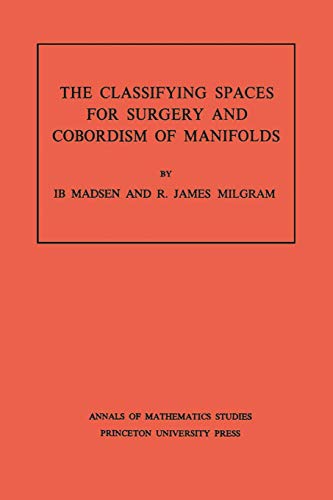
Ebook Info
- Published: 2016
- Number of pages: 284 pages
- Format: PDF
- File Size: 11.95 MB
- Authors: Ib Madsen
Description
Beginning with a general discussion of bordism, Professors Madsen and Milgram present the homotopy theory of the surgery classifying spaces and the classifying spaces for the various required bundle theories. The next part covers more recent work on the maps between these spaces and the properties of the PL and Top characteristic classes, and includes integrality theorems for topological and PL manifolds. Later chapters treat the integral cohomology of BPL and Btop. The authors conclude with a discussion of the PL and topological cobordism rings and a construction of the torsion-free generators.
User’s Reviews
Reviews from Amazon users which were colected at the time this book was published on the website:
⭐One of the most interesting of all results in the theory of vector bundles is the famous classification theorem, which says that the set of isomorphism classes of k-dimensional vector bundles over a paracompact space is in a natural bijective correspondence with the set of homotopy classes of mappings of this space into the Grassman manifold of k-dimensional subspaces in infinite-dimensional space. This book is a summary of what was known at the time of publication for classifying spaces in a more general context, namely in the piecewise-linear and topological categories. The basic theme underlying the use of classifying spaces in all of these categories is that the classifying of geometric objects is viewed as a homotopy classification of maps into a classifying space. I only read the first seven chapters of this book, so my review will be confined to these. The authors review the role of classifying spaces for (principal) bundles in Chapter 1, and this is one of the few books that actually gives an explicit construction of the classifying space for the case of finite dimensional CW complexes. The classifying spaces for the classical Lie groups are then reviewed very quickly. In addition, the authors review what the reader will need to know about the cobordism ring for differentiable, topological, and piecewise-linear manifolds. For brevity, the authors refer to all of these manifolds as “(H)-manifolds.” For (H)-manifolds satisfying the property of “transversality”, such as differentiable, piecewise-linear, and topological (for n not equal to 4) manifolds, the authors show that the cobordism ring gives rise to a generalized homology theory, and that such a theory can be represented by a spectrum, the famous “Thom spectrum”.Chapter 2 reviews the Browder-Novikov-Sullivan theory of surgery classification of (simply-connected) manifolds. The strategy here, as the authors explain, is to find an obstruction to a homotopy type actually being the homotopy type of a manifold. The notion of a Poincare-duality space is an elementary example of this, since a simply connected closed manifold is one and hence a manifold determines a unique homotopy type of a Poincare-duality space. The authors give an explicit example of a 5-dimensional simply connected Poincare-duality space that does not have the homotopy type of a smooth, piecewise-linear, or topological manifold. The obstruction to a Poincare-duality space containing a differentiable or piecewise-linear manifold in its homotopy type is the existence of a reduction of its Spivak normal bundle.In chapter 3, the authors concentrate their attention on the homotopy type and cohomology modulo 2 of the space of homotopy equivalences G and oriented homotopy equivalences of the n-sphere SG. This involves the consideration of the infinite loop space of the 0-sphere and the classifying space of the symmetric group on n letters. The cohomology of the latter is shown to lead to a calculation of the cohomology of the classifying space of SG.The Sullivan theory of the homotopy types of G/PL and G/TOP is considered in chapter 4. This involves the interpretation of the Kervaire invariant in terms of characteristic classes in cohomology or K-theory. For G/PL, one then obtains maps from G/PL into Eilenberg-Maclane spaces or the classifying space BO. The authors then discuss how Sullivan obtained homotopy equivalences by using localization. The situation for G/TOP is similar as the authors show briefly.The authors continue with the Sullivan theory of the classifying spaces of TOP and PL localized away from 2, along with their associated Thom spectra. To do this this, use is made of the J-homomorphism in the stable homotopy groups of spheres. This leads to a consideration of the classifying space of the cokernel of J, and they discuss the work of Sullivan who has shown the existence of a splitting at each odd prime for BSPL in terms of BSO and cokerJ. The validity of the Adams’ conjecture allows a similar analysis for the Thom spectra of the classifying spaces of TOP and PL localized away from 2.Chapter 6 considers the structure of infinite loop spaces and the “Q-operations” between the i-th and (i+a)-th homology groups (modulo 2) of these spaces. These operations measure the how far the H-space multiplication is from being commutative. Since the H-space multiplications are homotopy operations, these homology operations are a measure of the non-triviality of the infinite sequence of higher homotopies associated with the infinite loop space.In chapter 7, the authors consider the infinite loop space structure of G/TOP localized at 2, and show that “first delooping” B(G/TOP), and the “second delooping” B^2(G/TOP) localized at 2 can be written as a product of Eilenberg-Maclane spaces, in analogy with the case of G/TOP localized at 2. They mention but do not show in detail that the “third delooping” B^3(G/TOP) cannot be written as the product of Eilenberg-Maclane spaces.
⭐very satisfied
⭐
Keywords
Free Download Classifying Spaces for Surgery and Corbordism of Manifolds. (AM-92), Volume 92 (Annals of Mathematics Studies) in PDF format
Classifying Spaces for Surgery and Corbordism of Manifolds. (AM-92), Volume 92 (Annals of Mathematics Studies) PDF Free Download
Download Classifying Spaces for Surgery and Corbordism of Manifolds. (AM-92), Volume 92 (Annals of Mathematics Studies) 2016 PDF Free
Classifying Spaces for Surgery and Corbordism of Manifolds. (AM-92), Volume 92 (Annals of Mathematics Studies) 2016 PDF Free Download
Download Classifying Spaces for Surgery and Corbordism of Manifolds. (AM-92), Volume 92 (Annals of Mathematics Studies) PDF
Free Download Ebook Classifying Spaces for Surgery and Corbordism of Manifolds. (AM-92), Volume 92 (Annals of Mathematics Studies)