Ebook Info
- Published: 1989
- Number of pages: 432 pages
- Format: PDF
- File Size: 23.84 MB
- Authors: Kurt Gödel
Description
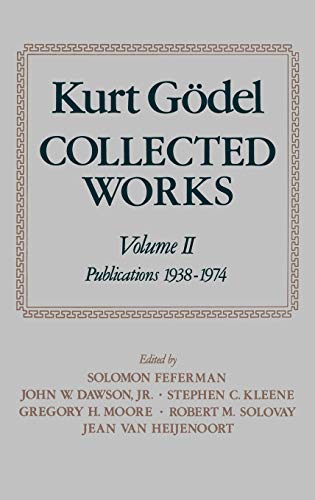
Kurt Gödel was the most outstanding logician of the twentieth century, famous for his work on the completeness of logic, the incompleteness of number theory, and the consistency of the axiom of choice and the continuum hypothesis. He is also noted for his work on constructivity, the decision problem, and the foundations of computation theory, as well as for the strong individuality of his writings on the philosophy of mathematics. Less well-known is his discovery of unusual cosmological models for Einstein’s equations, permitting “time-travel” into the past. This second volume of a comprehensive edition of Gödel’s works collects together all his publications from 1938 to 1974. Together with Volume I (Publications 1929-1936), it makes available for the first time in a single source all of his previously published work. Continuing the format established in the earlier volume, the present text includes introductory notes that provide extensive explanatory and historical commentary on each of the papers, a facing English translation of the one German original, and a complete bibliography. Succeeding volumes are to contain unpublished manuscripts, lectures, correspondence, and extracts from the notebooks. Collected Works is designed to be accessible and useful to as wide an audience as possible without sacrificing scientific or historical accuracy. The only complete edition available in English, it will be an essential part of the working library of professionals and students in logic, mathematics, philosophy, history of science, and computer science. These volumes will also interest scientists and all others who wish to be acquainted with one of the great minds of the twentieth century.
User’s Reviews
Editorial Reviews: Review “I was initially inspired for this review when I happened to pick up Volume 2 of Kurt Godel’s Collected Works: anyone with a serious interest in the intellectual history of the 20th century should do the same. Godel’s famous proof of the incompleteness of arithmetic is arguably the most famous theorem of our century . . . . These volumes are intended for the mainstream and they succeed admirably; Solomon Feferman and his distinguished board of editors have produced a collected works that is a model for all such endeavors. The collection is beautifully designed; I congratulate Oxford University Press on the high quality with which every detail is executed. Papers originally written in German are translated on facing pages, and it really is “complete” . . . . The introductory material is profuse and worth the price on its own . . . . Godel was a meticulous writer, and with some excellent editorial handling, the proof is a pleasure to read.” –A.I. Expert”The volumes are meticulously edited and are a pleasure to consult. Original page numbers are clearly shown; papers written in German are printed with facing translations; there is a comprehensive bibliography …and there are good indexes; and there are some revealing photographs.” –Bulletin of the London Mathematical Society”The publication of this book is a significant scientific event ….a splendid text ….excellent English translation. The introductory notes add much to the reader’s understanding of the primary material, and the list of editors and contributors reads like a Who’s Who of modern Logic.” –Theory of Computation”A comprehensive edition of the 20th-century logician’s work, in facing pages of German and English. Volume two covers published writings in the period 1938-1974, including newly typeset versions of papers on his continuum hypothesis, Russell’s mathematical logic, Cantor’s continuum problem, the relationship between relativity and idealistic philosophy, and rotating universes in general relativity theory. Each selection or group of selections is introduced, and extensive notes and references are included.”–SciTech Book News About the Author The Editor-in-ChiefSolomon Feferman is Professor of Mathematics and Philosophy, and Chairman of the Department of Mathematics at Stanford University. He is past president of the Association of Symbolic Logic.The EditorsJohn W. Dawson, Jr., is Professor of Mathematics at Pennsylvania State University, York. Steven C. Kleene is Emeritus Dean of Letters and Science, and Emeritus Professor of Mathematics and Computer Science at the University of Wisconsin, Madison. Gregory H. Moore is Associate Professor of Mathematics at McMaster University, Hamilton, Ontario, Canada. Robert M. Solovay is Professor of Mathematics at the University of California, Berkeley. The late Jean van Heijenoort was Emeritus Professor of Philosophy at Brandeis University until his death in 1986.
Reviews from Amazon users which were colected at the time this book was published on the website:
⭐A summary of his statement on p. 125 on “Russell’s Mathematical Logic” describes the “vicious circle principle: forbids a certain kind of circularity which is made responsible for the paradoxes. The fallacy in these, so it is contended, consists in the circumstance that one defines (or tacitly assumes) totalities, whose existence would entail the existence of certain new elements of the same totality, namely elements definable only in terms of the whole totality.” This led to the formulation of a principle which says that “no totality can contain members definable only in terms of this totality, or members involving or presupposing this totality.” (The vicious circle principle). (Also a “not applying to itself principle to keep the vicious circle principle from applying to itself p. 126In describing Russell’s theory of types he says, “The paradoxes are avoided by the theory of simple types which is combined with the theory of simple orders – a “ramified hierarchy””Godel argues that the vicious circle principle is false rather than that classical mathematics is false.p. 202 “A remark about the relationship between relativity theory and idealistic philosophy (1949a) (Note that this view supports my usual presentations in class on this!)”The argument runs as follows: Change becomes possible only through the lapse of time. The existence of an objective lapse of time 4, however, means (or, at least, is equivalent to the fact) that reality consists of an infinity of layers of “now”p. 203 which come into existence successively. But, if simultaneity is something relative in the sense just explained, reality cannot be split up into such layers in an objectively determined way. Each observer has his own set of “nows”, and none of these various systems of layers can claim the prerogative of representing the objective lapse of time. 5″
⭐
⭐
⭐
⭐
⭐
Keywords
Free Download Collected Works: Volume II: Publications 1938-1974 (Kurt Godel Collected Works) 1st Edition in PDF format
Collected Works: Volume II: Publications 1938-1974 (Kurt Godel Collected Works) 1st Edition PDF Free Download
Download Collected Works: Volume II: Publications 1938-1974 (Kurt Godel Collected Works) 1st Edition 1989 PDF Free
Collected Works: Volume II: Publications 1938-1974 (Kurt Godel Collected Works) 1st Edition 1989 PDF Free Download
Download Collected Works: Volume II: Publications 1938-1974 (Kurt Godel Collected Works) 1st Edition PDF
Free Download Ebook Collected Works: Volume II: Publications 1938-1974 (Kurt Godel Collected Works) 1st Edition