Ebook Info
- Published: 1990
- Number of pages: 308 pages
- Format: PDF
- File Size: 9.38 MB
- Authors: Barry R. Parker
Description
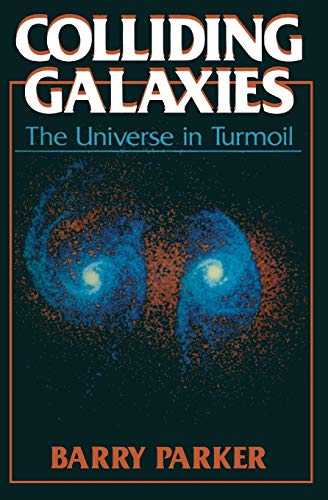
I remember sitting spellbound, watching the movie When Worlds Collide. Two planets hurled through space toward Earth while scientists and engineers frantically raced to complete a rocket ship that would take them to safety. In the final moments the spaceship lifted off as the occupants watched the Earth bulge, crack, then literally explode as one of the planets struck it. As I left the theater I wondered if it was really possible for another world to collide with Earth. Later I learned that while many catastrophic collisions no doubt occurred early in the his tory of the solar system, today they are exceedingly rare. I was relieved, but in another sense I was disappointed (not that I hoped a collision of this type would actually occur). A collision of two objects in space, say, two stars, I was sure would be a spectacular event. It is quite unlikely, however, that we will ever witness the collision of two stars. The event is just too rare. But collisions of systems of stars-galaxies-oddly enough, are relatively com mon. In fact, we see evidence of several in the sky right now.
User’s Reviews
Reviews from Amazon users which were colected at the time this book was published on the website:
⭐Colliding Galaxies, as the title suggests is about colliding galaxies.As you may imagine this is a pretty obscure subject and you may be wondering how much interesting material can there really be on it? Well, at least I have this question, so when I got book in 1990 as a gift, I let it sit on my bookshelf for 20 years before I decided it was time to read it in an attempt to cleanup my old books.I was right, there isn’t much interesting material in the book. Although the book is 300 pages long, Parker uses pretty uncreative ways to take up space by adding material that is either irrelevant or confusing for the reader.For example, thing that Parker does repeatedly is directly quote from people he interviewed. Parker is a scientist interviewing other scientists so it’s probably not a great idea to be quoting a scientist’s use of jargon. And it’s not just a few sentences, it’s paragraph after paragraph. To make matters worse, Parker quotes questions that are irrelevant to the reader. For example, ‘How did you get interested in astronomy.’ Ok, great ice breaker question. But, probably not something you want to include in you book, let alone quote directly. By the time you get to the 10th scientist, the reader is ready to scream. Enough!At other times, the use of quotes completely detracts the reader. For example, on page 226, Parker quotes Josh Barnes in a paragraph goes on for half a page before, Barnes states, ‘You’ve got things that are not disk galaxies… and they’re making stars like crazy. So this idea is probably out.’ So Parker that thought it was important to spend half a page quoting a scientist relate a theory that he admits doesn’t work. Stupid!With these quotes, Parker comes across as too lazy to do his own research. Throughout the book, Parker offers competing theories, but he never offers his point of view. Parker’s a scientist. He’s capable enough. Instead Parker’s conclusions are very bland, like stating that collisions between galaxies do occur, even though this wasn’t a point of contention.Another problem, where this book suffers is contradictions. For example, on page 251 Parker states that the Virgo cluster contains about 20% of the galaxies in our supercluster and is 60 million light years from us. In all there millions of galaxies in the supercluster.Now go back to page 244 where Parker states that the Virgo cluster is 40,000 light years from us and contains about 1500 galaxies.Here’s a list of the chapters in the book:1. Introduction2. Galaxies3. The Discovery of Radio Sources4. Exploding and Peculiar Galaxies5. Cosmic Jets and Galactic Dynamos6. Quasars7. Is our galaxy exploding?8. A detailed look at a nearby exploding galaxy Centaurus A.9. Colliding Galaxies: The discovery10. Merging galaxies.11. Collision and computers.12. Clusters and Superclusters.13. To the ends of the universe.14. EpilogueOverall, the book fails on a number of fronts. The chapters do not transition well. The material is dry and poorly organized. There are a lot pictures, but they’re not explained well. The captions are a few words without really giving the reader insight.I was really upset, because this could have been a very good book, but Parker just didn’t put his heart into it.
⭐I loved this book for all the reasons that Dan Shaffer hated it!
Keywords
Free Download Colliding Galaxies: The Universe in Turmoil in PDF format
Colliding Galaxies: The Universe in Turmoil PDF Free Download
Download Colliding Galaxies: The Universe in Turmoil 1990 PDF Free
Colliding Galaxies: The Universe in Turmoil 1990 PDF Free Download
Download Colliding Galaxies: The Universe in Turmoil PDF
Free Download Ebook Colliding Galaxies: The Universe in Turmoil