

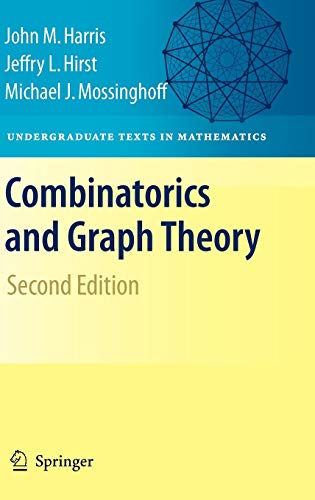
Ebook Info
- Published: 2008
- Number of pages: 396 pages
- Format: PDF
- File Size: 3.34 MB
- Authors: John Harris
Description
These notes were first used in an introductory course team taught by the authors at Appalachian State University to advanced undergraduates and beginning graduates. The text was written with four pedagogical goals in mind: offer a variety of topics in one course, get to the main themes and tools as efficiently as possible, show the relationships between the different topics, and include recent results to convince students that mathematics is a living discipline.
User’s Reviews
Editorial Reviews: Review From the reviews:SIAM REVIEW”The narrative and proofs are well written, and the authors are given to frequent uses of humor. Students should find this book as easy to read as any other good-quality text written with them in mind. Each of the three chapters concludes with several paragraphs describing an excellent selection of more advanced texts or papers to consider for further study”From the reviews of the second edition: “Any undergraduate work in combinatorics or graph theory, whether a course or independent study, would likely be well served by this textbook … . The authors offer a wide selection of topics, often in more depth than other undergraduate texts, in an engaging and clear style. … Each chapter concludes with extensive notes on further reading.” (Brian Hopkins, Mathematical Reviews, Issue 2010 b) “Combinatorics and Graph Theory is a popular pair of topics to choose for an undergraduate course. … The book is written in a reader-friendly style and there are enough exercises. … It is certainly good that someone took the effort to write … in a form that is appropriate for undergraduates. … the book will most often be used for a reading class by a student who already has a background in combinatorics and who wants to learn about the set theoretical aspect of it.” (Miklós Bóna, SIGACT News, Vol. 40 (3), 2009)“This undergraduate textbook contains three chapters: Graph Theory, Combinatorics and Infinite Combinatorics and Graphs. … There is a short section on References in each chapter introducing briefly other books dealing with the topics covered in the respective chapter. A full list of 293 references, about 550 exercises and an index with 13 pages are also provided.” (Dalibor Froncek, Zentralblatt MATH, Vol. 1170, 2009) From the Back Cover This book covers a wide variety of topics in combinatorics and graph theory. It includes results and problems that cross subdisciplines, emphasizing relationships between different areas of mathematics. In addition, recent results appear in the text, illustrating the fact that mathematics is a living discipline.The second edition includes many new topics and features:• New sections in graph theory on distance, Eulerian trails, and Hamiltonian paths.• New material on partitions, multinomial coefficients, and the pigeonhole principle.• Expanded coverage of Pólya Theory to include de Bruijn’s method for counting arrangements when a second symmetry group acts on the set of allowed colors.• Topics in combinatorial geometry, including Erdos and Szekeres’ development of Ramsey Theory in a problem about convex polygons determined by sets of points.• Expanded coverage of stable marriage problems, and new sections on marriage problems for infinite sets, both countable and uncountable.• Numerous new exercises throughout the book.About the First Edition:”. . . this is what a textbook should be! The book is comprehensive without being overwhelming, the proofs are elegant, clear and short, and the examples are well picked.”― Ioana Mihaila, MAA Reviews
Reviews from Amazon users which were colected at the time this book was published on the website:
⭐I used this as a self-study for graph theory. The combinatorics part of it was just icing on the cake.The problem I had with discrete math textbooks were they treated graph theory as some sort of sideshow attraction to fill the book.And the point was to show off neat examples, and not really provide a solid foundation in graph theory.The authors go beyond Eulers bridges problem and color counting. The theorems are presented with the proofs, and they have just enough examples to instruct. Could they add a bunch more examples and flashy sidebars? sure. However, the authors provide enough examples when needed without fluff, but more important they provide solid coverage on graph theory.The only real negative is the writing style is not as great as one would hope.Combinatorics coverage has some interesting depth beyond the standard textbooks. The stable marriage problem alone is examined to n-degrees of depth with variations on solutions.Polyas theory of counting is extensively presented as well. ( Yes Euler gets his number theory coverage as well ).Overall there are flaws with the book, but nothing earth shattering. The authors did a great job of covering the topics beyond the basics, and leveraged examples to illustrate variations which really made this book shine.
⭐I had the misfortune of having a professor who was not entirely familiar with the material presented in the class, and he used this book as a sole reference for a good 4/5 of the course. Coming into the class, I had a strong Graph Theory background, to the point where I was familiar with all of the material of the first eight weeks of class or so; yet I strongly contend that the material presented in this book does not substantially help the reader comprehend some of the more complex concepts. The chapters have a lack of detailed examples explaining proofs of theorems or otherwise give abridged proofs that are not ideal (and don’t even seem like valid proofs to me!). There are no homework solutions available, not even online, so that further hinders the student because he will not have anything valid to study from. Often, some of the homework problems made sudden jumps in difficulty from the material that was presented to what was expected of the student. Some problems had solutions where no similar intuition or reasoning was presented in the chapter before, so it required vast amounts of re-reading and looking for outside sources (or relying on classmates like me who knew it) for most students in my class.My negative experience was especially compounded by my professor’s ineptitude at Graph Theory, but trying to set that bias aside I really wish this book was turned into a full textbook that worked on fixing its many flaws. My biggest peeve is that it is very hard to use as a reference since the authors do not even glossary concepts. Most are italicized (which is impossible to spot in this font), but still others are just not.Overall, perhaps a future version will be worth using in the classroom or for reference, but this version is not able to reach those standards.
⭐I’m a computer engineer and this textbook was part of a discrete mathematics course I took during undergrad. Firstly, I’ll tell you that I love reading textbooks, but there are very few that are written and delivered in a manner that makes me actually want to read them through. This book is one of those few. I loved reading this book. The content is organized into nice, not-so-overwhelming chunks, which makes it an easy read for such technical content. The authors’ styles and explanations are great. Some of the questions can be challenging (in a good way), but they are manageable and really solidify the material. I read the book from cover to cover and learned a ton. This was a few years ago and still I find myself recalling content from this book when I’m facing challenges that are remotely graph theory. I will even add that it’s a great read for anyone in the software engineering field as it really hammers down on those essential graph theory concepts. One of the best textbooks I’ve ever read.
⭐Very accessible and probably the best book I’ve seen on combinatorics.
⭐This was a required text for this course. There is probably a better graph theory text as this one could stand to go into more detail, but it’s very concise and covers a lot. The seller was very honest and up front when not able to ship it immediately, but as my class was not using this text right away, that wasn’t a problem. The seller provided great communication and was pleasant to do business with.
⭐I find the book to explain exactly what it intends to, providing pertinent examples where useful. I wish there were more examples, actually, but there is something to be said for being concise. The problems are well-organized and good problems. Also, it is a nice, sturdy hardcover version with non-glossy pages, which makes it easy to carry around without getting it beat up and easy on the eyes under fluorescent lights.
⭐Was for class. Came in good condition
⭐This book provides a good overview of basic graph theory and combinatorics. I have found it easy to read with good explanations and ample proof examples.
⭐PhysicalThe books I read are treated with care. But whilst reading this illuminating book over several weeks, several internal pages have come loose its binding.Graph TheoryThe graph theory parts of this volume are built – up from fundamentals, such as dot and vector products and several theorems, such as used with spanning Hamiltonian graphs. Its great when reading about boundary colours problems and how in so many ways this influences the wider graph theory problems and their solutions.This includes how graphs can be manipulated by computers by applications of matrices with even more theorems bolted on these areas. Writing these bits can be harder to comprehend and require more effort to grasp as its rather strict in its explanations.Some areas, such as ‘Kruskals algorithm’, are used to find the shortest distance between distance – weighted diagrams, and how to apply logical methods in sorting. Also finding how many varied distinct patterns of trees and connecting vertices. A sound knowledge of function theory will prove to be very useful to accelerate taking in some subtle details that follow. IThe Combinatoric areasThis area is explained in a way its not hard to take it in, but the skill lies in what to concentrate upon and what to leave out. Such as the `Multinomial Theorem’, this is a bit up from `a’-level combinational and permutations questions. A clear explanation of principles with ‘Inclusion and Exclusion’ is straightforward and easy to clear misunderstandings. This is linked to how Euler’s functions, and chromatic generating polynomials are used in graphing.One part I loved is the changing money area; this is to calculate the change due in a machine using pennies, nickels, dimes, quarters, half-dollars and dollar coins. This is attractive due to it being a typical question type in H.N.D types reports!Also Instead of having explicit detail in permutations and combinations formulae it is much compacted. And in both graph and combinatorics areas both uses lots of symbolic Greek lettering. So to make the reader more aware of the processes but you need to make more effort to absorb the work. Another is the usage of combinations of marriages and singles in a 10 – by – 5 matrices.SummaryAlthough [my] book has a suspect binding, it is interesting enough to find the book worth the money and time I spent reading it. I have not grasped all of the stuff in the book and this will need further work sorting this out, but I will return later on to squeeze more understandings from it. The book is the type of book you would usefully apply a math CAD application to get the most out of it.Oh yes, have a look at Polya’s theory of counting, page 205 for a big…big…answer!Oh yes, this book does have many questions, but little written answers or breakdowns as to how these apply, which is a pity.
⭐A well written, clear and concise coverage of graph theory and combinatorics. But it does limit itself to simple, undirected graphs so it wasn’t quite what I was looking for, but still more than worth having for anyone starting out on graph theory.
⭐It was exactly what I wanted. The item was delivered on time, no further problems. The edition is perfect and meets my requirements. I definitely suggest it for anyone who wants a first introduction in graph theory and combinatorics.
Keywords
Free Download Combinatorics and Graph Theory (Undergraduate Texts in Mathematics) in PDF format
Combinatorics and Graph Theory (Undergraduate Texts in Mathematics) PDF Free Download
Download Combinatorics and Graph Theory (Undergraduate Texts in Mathematics) 2008 PDF Free
Combinatorics and Graph Theory (Undergraduate Texts in Mathematics) 2008 PDF Free Download
Download Combinatorics and Graph Theory (Undergraduate Texts in Mathematics) PDF
Free Download Ebook Combinatorics and Graph Theory (Undergraduate Texts in Mathematics)