

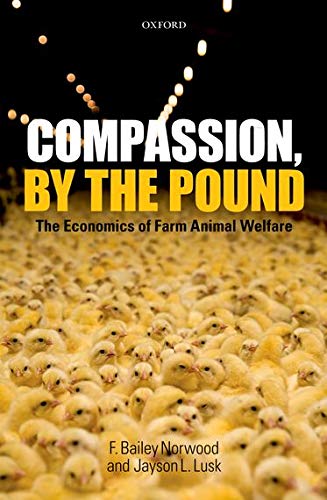
Ebook Info
- Published: 2011
- Number of pages: 432 pages
- Format: PDF
- File Size: 13.72 MB
- Authors: F. Bailey Norwood
Description
For much of human history, most of the population lived and worked on farms but today, information about livestock is more likely to come from children’s books than hands-on experience. When romanticized notions of an agrarian lifestyle meet with the realities of the modern industrial farm, the result is often a plea for a return to antiquated production methods. The result is a brewing controversy between animal activist groups, farmers, and consumers that is currently being played out in ballot boxes, courtrooms, and in the grocery store. Where is one to turn for advice when deciding whether to pay double the price for cage-free eggs, or in determining how to vote on ballot initiates seeking to ban practices such as the use of gestation crates in pork production or battery cage egg production? At present, there is no clear answer. What is missing from the animal welfare debate is an objective approach that can integrate the writings of biologists and philosophers, whileproviding a sound and logical basis for determining the consequences of farm animal welfare policies. What is missing in the debate? Economics. This book journeys from the earliest days of animal domestication to modern industrial farms. Delving into questions of ethics and animal sentience, the authors use data from ingenious consumers’ experiments conducted with real food, real money, and real animals to compare the costs and benefits of improving animal care. They show how the economic approach to animal welfare raises new questions and ethical conundrums, as well as providing unique and counter-intuitive results.
User’s Reviews
Editorial Reviews: About the Author F. Bailey Norwood received his Ph.D. from North Carolina State University and Masters Degree from Kansas State University. Dr. Norwood’s research focuses on consumer behavior, food and livestock marketing, food policy, non-market valuation, and survey techniques. His research has resulted in numerous journal articles, agricultural newspaper articles, and an undergraduate textbook on agricultural marketing and price analysis. Dr. Norwood true passion is teaching. He teaches an introductory course in agricultural economics, a senior-level course in data analysis, and advises over fifty students. Jayson L. Lusk previously served on the faculties of Purdue University and Mississippi State University. He holds a Ph.D. in Agricultural Economics from Kansas State University (2000) and a BS in Food Technology from Texas Tech University (1997). Professor Lusk conducts research related to consumer behavior and decision making, food and livestock marketing and policy, and non-market valuation. In the last 10 years, Lusk has published 3 books and over 100 articles in peer reviewed scientific journals, and has been invited to present his research at over 25 Universities in the U.S. and abroad. He is Associate Editor for 6 academic journals including the American Journal of Agricultural Economics and the Journal of Environmental Economics and Management. Lusk was Chair of the American Agricultural Economics Association’s Food and Agricultural Marketing Policy Section, and serves on the executive board of the Western Agricultural Economics Association and the Southern AgriculturalEconomics Association.
Reviews from Amazon users which were colected at the time this book was published on the website:
⭐Anyone interested in farm animal welfare should read this book!This book may be unique in that it presents (among other things) a detailed, non-biased portrait of factory farms. There’s plenty of literature out there on the subject, but it’s generally written either by overzealous animal activists or by industry insiders seeking to spin public perception. Norwood and Lusk seek only to inform. They certainly offer opinions, with which you may disagree, but they also offer facts, some of which are inconvenient to the stories I (and others) like to tell about factory farming. For example, antibiotics are generally not used in egg or dairy production, and milk or eggs from animals treated with antibiotics are generally diverted away from human consumption. Of course some of the facts do conform with our stories: chickens raised for meat normally have only .7 square feet per bird, against 1.6-1.7 square feet for a pastured broiler in the Salatin-type system.The authors, being economists, also look at the cost of improving animal welfare and attempt to evaluate the extent to which consumers are willing to pay that cost. They even devised some pretty ingenious experiments in order to gather data on consumer preferences. Because ordinary people are for the most part are ignorant about livestock production – on average consumers believe only 37% of all eggs produced in the US come from a cage system (against 90% in reality) – the authors had to provide them with a lot of information before accurate data collection could occur.
⭐This is a fantastic book. Compassion by the Pound is the most comprehensive, rigorous, and systematic attempt to look at animal welfare that I’ve ever seen. Although scholars have looked at animal welfare in other places, this book combines the knowledge so powerfully that it practically creates a new field. Compassion by the Pound uses ethics and economics in a useful and decision-relevant fashion. Would recommend to anyone who has a strong interest in animal welfare and factory farms.
⭐
Keywords
Free Download Compassion, by the Pound: The Economics of Farm Animal Welfare 1st Edition in PDF format
Compassion, by the Pound: The Economics of Farm Animal Welfare 1st Edition PDF Free Download
Download Compassion, by the Pound: The Economics of Farm Animal Welfare 1st Edition 2011 PDF Free
Compassion, by the Pound: The Economics of Farm Animal Welfare 1st Edition 2011 PDF Free Download
Download Compassion, by the Pound: The Economics of Farm Animal Welfare 1st Edition PDF
Free Download Ebook Compassion, by the Pound: The Economics of Farm Animal Welfare 1st Edition