Ebook Info
- Published: 2006
- Number of pages: 534 pages
- Format: PDF
- File Size: 3.12 MB
- Authors: Armin Wachter
Description
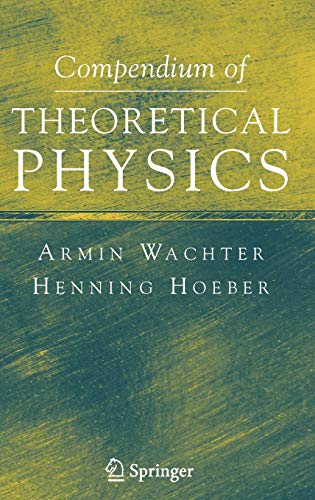
The Compendium of Theoretical Physics contains the canonical curriculum of theoretical physics. From classical mechanics over electrodynamics, quantum mechanics and statistical physics/thermodynamics, all topics are treated axiomatic-deductively and confimed by exercises, solutions and short summaries.
User’s Reviews
Editorial Reviews: From the Back Cover Mechanics, Electrodynamics, Quantum Mechanics, and Statistical Mechanics and Thermodynamics comprise the canonical undergraduate curriculum of theoretical physics. In Compendium of Theoretical Physics, Armin Wachter and Henning Hoeber offer a concise, rigorous and structured overview that will be invaluable for students preparing for their qualifying examinations, readers needing a supplement to standard textbooks, and research or industrial physicists seeking a bridge between extensive textbooks and formula books.The authors take an axiomatic-deductive approach to each topic, starting the discussion of each theory with its fundamental equations. By subsequently deriving the various physical relationships and laws in logical rather than chronological order, and by using a consistent presentation and notation throughout, they emphasize the connections between the individual theories. The reader’s understanding is then reinforced with exercises, solutions and topic summaries.Unique Features:Every topic is reviewed axiomatically-deductively and then reinforced through exercises, solutions and summariesEach subchapter ends with a set of applications, making the Compendium an ideal review of theoretical physics for physicists working in industry or researchA Mathematical Appendix covers vector operations, integral theorems, partial differential quotients, complete function systems, Fourier analysis, Bessel functions, spherical Bessel functions, Legendre functions, Legendre polynomials and spherical harmonicsArmin Wachter holds a Ph.D. in Physics from the John von Neumann Institute for Computing (NIC) / Research Centre of Jülich, Germany. His research interests include theoretical elementary particle physics, heavy quark physics, heavy meson spectroscopy, algorithms on parallel computers, and lattice gauge theory. He is presently writing a textbook on relativistic quantum mechanics for Springer.Henning Hoeber received his Ph.D. in Physics from the University of Edinburgh, Scotland and has since held research positions at the John von Neumann Institute for Computing (NIC) / Research Centre of Jülich, Germany and the University of Wuppertal, Germany. His research interests include elementary particle physics, lattice gauge theory, and computational physics, and since 1998 he has done extensive work in the fields of seismic processing, time series analysis, statistical and transform methods for seismic signal processing, and elastic wave propagation. About the Author Armin Wachter holds a Ph.D. in Physics from the John von Neumann Institute for Computing (NIC) / Research Centre of Jülich, Germany. His research interests include theoretical elementary particle physics, heavy quark physics, heavy meson spectroscopy, algorithms on parallel computers, and lattice gauge theory. He is presently writing a textbook on relativistic quantum mechanics for Springer.Henning Hoeber received his Ph.D. in Physics from the University of Edinburgh, Scotland and has since held research positions at the John von Neumann Institute for Computing (NIC) / Research Centre of Jülich, Germany and the University of Wuppertal, Germany. His research interests include elementary particle physics, lattice gauge theory, and computational physics, and since 1998 he has done extensive work in the fields of seismic processing, time series analysis, statistical and transform methods for seismic signal processing, and elastic wave propagation.
Reviews from Amazon users which were colected at the time this book was published on the website:
⭐This is the best compendium of theoretical physics I could find. It is NOT meant to be a text book. It is merely an organized collection of important results accompanied by brief derivations (when required). It is a great book for someone who does not want to see the full derivations. Also, if one works out all the results/example applications in the book, that person would gain a lot in terms of both problem solving skills and physical understanding by the end of the exercise. It is a compact book, so not very hard to carry around. It would have been nicer if the authors spent more time on general relativity but one must not be greedy 🙂
⭐I am not sure whether the contents of this book are good or not, but the formulas have two serious problems:1) There is no “dot” for the “dot product” (also called scalar product) of two vectors. This makes many equations not understandable! How can it be printed in this way? Who is responsible for this error? The authors or the publisher?2) Operators in quantum mechanics, both scalar and vector, are in bold face. This is very confusing! Note that I am talking about the printed version, not the digital version.I encountered the first problem in the page 3 and then checked the other formulas in the book and found the second problem. These notational problems are not endurable and I decide not to read it further.
⭐
⭐
⭐
Keywords
Free Download Compendium of Theoretical Physics 2006th Edition in PDF format
Compendium of Theoretical Physics 2006th Edition PDF Free Download
Download Compendium of Theoretical Physics 2006th Edition 2006 PDF Free
Compendium of Theoretical Physics 2006th Edition 2006 PDF Free Download
Download Compendium of Theoretical Physics 2006th Edition PDF
Free Download Ebook Compendium of Theoretical Physics 2006th Edition