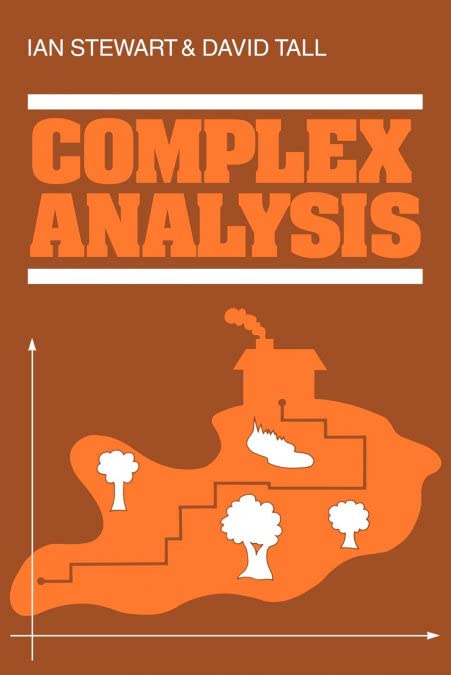
Ebook Info
- Published: 1983
- Number of pages: 304 pages
- Format: PDF
- File Size: 25.44 MB
- Authors: Ian Stewart
Description
This is a very successful textbook for undergraduate students of pure mathematics. Students often find the subject of complex analysis very difficult. Here the authors, who are experienced and well-known expositors, avoid many of such difficulties by using two principles: (1) generalising concepts familiar from real analysis; (2) adopting an approach which exhibits and makes use of the rich geometrical structure of the subject. An opening chapter provides a brief history of complex analysis which sets it in context and provides motivation.
User’s Reviews
Editorial Reviews: Book Description This is a very successful textbook for undergraduate students of pure mathematics.
Reviews from Amazon users which were colected at the time this book was published on the website:
⭐Good textbook.
⭐Get a copy of Churchill and Brown or Dnider and Saff. This book is as well written as its cover is pretty – some call it a classic, I call it junk. But thats just me
⭐Very lovely book.
⭐This despicable book provides a narrow-minded and unattractive introduction to complex analysis. The brief chapter 0 on the history of the subject is thoroughly distorted to conform with the way the authors want to approach the subject. So, for instance, since the authors don’t want to provide any motivation at any stage they simply make up the fact that none is needed, claiming that complex analysis “seems to have been the direct result of the mathematician’s urge to generalize. It was sought deliberately, by analogy with real analysis.” The truth is of course that the mathematicians who developed complex analysis mostly did so with concrete problems in mind, and were convinced of the value of the theory by its many excellent applications as well as its inner beauty, neither of which is conveyed by this book. These mathematicians would rather have poked their eyes out than investigate stupid nonsense problems such as the arc length of t+it(sin(pi/t)) (example 6.3.2, very representative). It must surely be one of the most hypocritical moments in textbook history when the authors claim to be ardent geometers, speaking of “the dangers of blind ‘formula-crunching’ analysis. Complex analysis is a highly geometric subject, and the geometry should not be despised.” They do indeed plot t+it(sin(pi/t)) in their boring example 6.3.2, but that’s the height of their geometric imagination. Formula-crunching is the only way they ever do anything and the entire presentation is deeply antigeometric. Indeed, the authors have worked hard to make sure that no-one obtains any intuitive understanding of the subject at all by postponing the few geometrically insightful topics that actually are discussed (conformality, harmonic functions, Riemann surfaces) until the very end and then treating them extremely briefly without indicating their importance for a geometric understanding of what complex functions, derivatives and integrals really are—which is what all sensible readers were asking themselves 250 pages earlier.
⭐If you have used any other books by Stewart and Tall, then you already know these guys really know what they’re doing. If you find yourself needing to acquire some complex analysis skills, do yourself a favor and pick up a copy of this book. You won’t be disappointed.Best to disregard the previous negative review as that individual clearly doesn’t know a good book when he sees one.
⭐Most of the material is well thought out. Though I wish the author would give more concrete examples of the theory. For example in parametrising of paths :|z|<2 i,-i he would not show how to do this. Though the theory would give you an idea. It would be nice if more concrete examples were shown in the text. Other than , there is much interesting material and most of th e exercises are doable without too much real analysis being neeeded/ ⭐During my second year at Warwick back in 1984, we had to complete a self-taught "reading" course, which basically involved having to buy and read this book. Ian Stewart and David Hall were both lecturers at the Uni, so it was a nice way of getting a bit of cash through forced sales from undergraduates.Cheeky little monkeys - it would have been just as easy to ask us for a whip round LOL.Good book though - nicely laid out as I remember it. ⭐The way the subjects in the book have been organised shows tight control during its creation. Each explanation is crafted; each of the many questions in the chapters has been carefully selected to point something out to the reader that helps its appreciation. The deeper you read into the books topics the more rarefied the level of mathematics.The initial chapters are straightforward bridging level. The usage of many helpfully diagrams explains the importance of `power series' using `x' as the independent variable and allows the transition in their relationships using 'Cauchy-Riemann' partial-differential equations. Then usage of trigonometrically based series with 'Z' functions is painlessly introduced and explored and into the calculus using these functions. The role of the complex logarithm is shown by how many times it's reworked to highlight points in the area.The Calculus with 'Z' variables allows greater depth of Complex functions to be explored and the nature of the requirements in this area is made clearer. I liked especially how the `Cauchy Theorem' was interpreted via the theorem of a triangle, paths in their domains and how this allows homotopy / analytic answers to be made and again slides from Taylor series painlessly into the more applicable `Laurent' series and residues. The latter is a simplified proof reason why a triangle is the basic geometric figure to produce all other images with graphical accelerator cards.The latter parts have greater complexity -excuse the pun- and much more real mathematical reasoning is used to firm the results. I really feel this book is a workshop to sharpen the skills in this area and it's worth every penny I paid for it. This is one of a few books I feel it's worth buying I.M.H.O.[Update: i recommend looking into the two Strouds; preparations with complex issues and topics 'Engineering Mathematics', and later on, 'Advanced Engineering Mathematics' and for its coverage especially 'Complex Analysis' 1-2-3] ⭐I paid £20 plus for the book, on the back of the book there was a price of £10. The write up said good quality, I disagree. The book is in poor condition. I'm not happy with this purchase.
Keywords
Free Download Complex Analysis 1st Edition in PDF format
Complex Analysis 1st Edition PDF Free Download
Download Complex Analysis 1st Edition 1983 PDF Free
Complex Analysis 1st Edition 1983 PDF Free Download
Download Complex Analysis 1st Edition PDF
Free Download Ebook Complex Analysis 1st Edition