

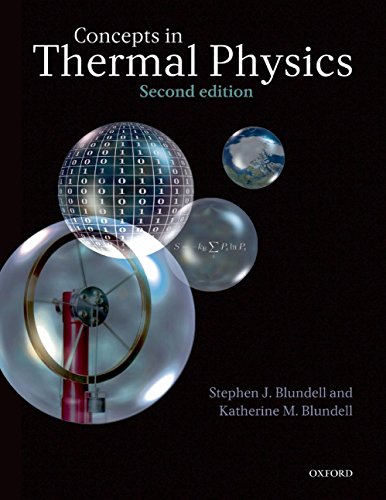
Ebook Info
- Published: 2009
- Number of pages: 516 pages
- Format: PDF
- File Size: 6.44 MB
- Authors: Stephen J. Blundell
Description
An understanding of thermal physics is crucial to much of modern physics, chemistry and engineering. This book provides a modern introduction to the main principles that are foundational to thermal physics, thermodynamics and statistical mechanics. The key concepts are carefully presented in a clear way, and new ideas are illustrated with copious worked examples as well as a description of the historical background to their discovery. Applications are presented tosubjects as diverse as stellar astrophysics, information and communication theory, condensed matter physics and climate change. Each chapter concludes with detailed exercises.The second edition of this popular textbook maintains the structure and lively style of the first edition but extends its coverage of thermodynamics and statistical mechanics to include several new topics, including osmosis, diffusion problems, Bayes theorem, radiative transfer, the Ising model and Monte Carlo methods. New examples and exercises have been added throughout.
User’s Reviews
Reviews from Amazon users which were colected at the time this book was published on the website:
⭐This book is a very nice textbook for an undergraduate statistical physics course. It treats the basics well, explains kinetic theory and thermodynamics, statistical mechanics, as well as some nonequilibrium physics. The chapters are short and self-contained. The examples are interesting and well chosen (for example, the Stirling engine is included in the types of engines treated). For general knowledge a biographical page is included of many of the names mentioned.This book contrasts strongly with a book like Greiner Stocke and Neiser, which aims at very rigorous mathematical foundations. For me, this was missing somewhat, but for modern undergrad courses, probably this approach works very well. (Especially, if the students taking the course are not all physicists, but engineers, or from other science disciplines.) The accessible explanation and treatment of some quite complex phenomena, (for example, Kramers-Kronig relations, Onsager reciprocity) , is a definite virtue of Blundell and Blundell.
⭐I had it for my undergrad thermodynamics class. I really appreciated the organization and the way it presented information. Also, the appendices were absolutely wonderful. Each chapter covers only one solid concept and related concepts, which makes chapters easier to cover within one or two lectures.
⭐I used this book in conjunction with Kittel for an upper division undergraduate course, and was extremely happy that I did. I constantly turned to this text when Kittel became too dense and confusing. This text really helped clarify many of the essential concepts of this course. In addition, I consistently used this as a reference. This book consolidates important information and equations very clearly and concisely; something that Kittel does very poorly.However, Kittel was still essential in getting at the root of the physics behind the concepts. Kittel is a much deeper book when asking “Why?”. Blundell and Blundell is a wonderful text, but is not the best stand-alone text. I highly recommend it as a supplemental text.
⭐This is a fun book to read. No. Really. It is! It is rare for a physics book to talk about spherical chicken or nut roasts, for example. The principles and examples are clearly delineated. There are margin notes from the authors. Suggestions for what math you need for certain sections. Biographies of major players in thermal physics. And suggestions for further reading for some chapters.
⭐What’s there to say that has not been already said? This book is awesome!
⭐Here we have another well written entry in the textbook literature of “thermal physics.” The first edition is the printing I draw upon (2006, nearly identical to the second edition). As usual, with these introductory texts, one can pick and choose that which works best for you (or the needs of a course). The best method I know to assess Blundell’s text is to compare it with two other titles which predate it, Baierlein’s Thermal Physics (1999) and Schroeder’s Thermal Physics (2000):(1) Each of the three texts include mathematics in appendices. But, in the matter of probability, Blundell devotes a separate chapter, Baierlein includes it mostly as an appendix, and Schroeder includes it in the appropriate places of his discussions. For Stirling’s approximation formula, Blundell and Baierlein derive it, Schroeder does same but includes four exercises for you to do (for example: Blundell shows equations for first and second derivatives (page 439), but Schroeder asks you to do it (page 391). Also, if you are not proficient in the mechanics of “integration-by-parts,” then you should practice.(2) All three books are careful in the definition of “heat” (energy in transit), avoiding the word as a noun. Schroeder is best (emphasizing “spontaneous” and reminding us: “Much of student’s difficulties… comes from confusing three concepts with each other– temperature, energy, and heat (page 17).(3) Of the three texts I am comparing, Blundell is the most voluminous (Schroeder is briefest, and also the best). Blundell and Baierlein have this in common: they are verbose. Blundell includes most intermediate steps in derivations. Baierlein includes qualitative explanations to accompany formulas. Now, Schroeder is the best of these: succinct, including some derivations while leaving many for exercises (example: black hole entropy as a problem–page 84, a result which is only stated by Blundell, his page 419).(4) Paramagnetism is qualitatively discussed in Blundell (pages 187-190, no exercises). Baierlein is better for that, yet Schroeder is superior for that (pages 97-107, plus exercises). The topic of non-equlilbrium thermodynamics is a chapter of Blundell and is absent from the other two books. The word “multiplicity” (number of microstates corresponding to a given macrostate) is not mentioned in Blundell (preeminent in the other two with Baierlien leading the way).(5) It is interesting that all three authors feel the need to define “mole.” (that should already be known !).Blundell offers mini-biographies of scientists (not so the other two textbooks). Blundell presents steps which should already be second-nature (example: taking the logarithm of an expression, example #21.3, page 226). In short, Blundell includes a lot of detail (not always explicit in the other two texts).(6) Exercises come at chapter ends (as too in Baierlein). These are mostly straightforward. My preference: exercises should occur within sections, plentiful and often (as with Schroeder).(7) Regards Onsager (Blundell’s section 34.3) please have a look at the beautiful exposition which you will find in Yourgrau, Merwe, and Raw’s Treatise on Irreversible and Statistical Thermophysics (pages 23-43).(8) One review of Blundell states: “the characterization of heat as energy in transit is quite misleading.” (Physics Today, October 2007). Note that Baierlein (page18) and Schroeder (page 18) do the same in that regard (Blundell, page 13). Another review states: “probably the best book I know of…” Contemporary Physics (volume 52, 2011). The bibliography in Blundell does not list Schroeder’s text (Schroeder is the best of the three books I am comparing). But, they are all worth perusal. Study all three.(9) Concluding: Blundell has offered a clear, accessible introduction which attempts to introduce almost any topic you might desire. The sidebars placed in margins are informative (example: “Parseval’s theorem is actually nothing more than Pythagoras theorem in an infinite-dimensional vector space.” page 379). There are brief chapter summaries (Baierlein has his “essentials” as summaries, and Schroeder does not have chapter summaries). Schroeder is first, Baierlein is second, and Blundell is third best…. for my tastes.
⭐I would rate this one of the better undergraduate physics books. Why? Because it most effectively teaches and stresses the important physics behind thermodynamics; this is something that most textbooks don’t do. Once the physics are learnt and deeply understood, going up to higher level books is easy. Having said that, the book could be improved by the authors having given more (at least 2x as many) questions as they have in the current book.
⭐Book is good, as expected. The shipping was terrible. The book was shipped in only a bubble envelope and one corner was ripped open and scuffed the book corner. I would press for a return but I needed it for class. Not happy with shipping quality.
⭐*PhysicalThis book has superb, high quality paper pages within it covers. Also its very securely bound for a paperback. The book has a weight to it that reflects the quality of the educational guidance you will gain from reading it.* H.N.D, Undergraduate, Post graduate?This book covers the wide area of the flow of heat being thermal energy in transit in physical systems. To me, its the way this is cleverly explored in distinct bands of difficulty. These are with some brief exposure to the upper components of a A-Level Math / Chemistry / Physics, the math components of H.N.D and 2nd – year Math parts of a engineering degree. You may fairly attribute these bands of ranking in a different ways, depending on your own study backgrounds? For example. the calculus upon Ln(e), exp(x), and the Greek symbols of summations and products using z variables are well used and very importantly applied many, many times. Also listed are brief life stories of the scientists that helped the development of these sciences.* What does it cover then?The bands of exposure covers, Preliminaries, Kinetic theory of gasses, Transport and thermal diffusion, (The) first law of dynamics, (The) second law of dynamics, (The) third law, Thermodynamics in action, Statistical mechanics, Beyond the ideal gas, Special topics, (a) fundamental constants / (b) useful formulae / (c) Useful mathematics / (D) The electromagnetic spectrum / (e) Some thermodynamic spectrum / Thermodynamic definitions / (g) reduced mass / (h) glossary of main symbols, Bibliography and index.* How is it explained?Throughout the book and within each of the areas there are many mathematical examples to follow. There are many graphs which usefully explain what’s going on. Also there are more set questions with no answers unfortunately. The way these bands harness the new – to – the – reader information is a great way to study these topics. The usage of formulae can use symbols that represent equations with several components. These earlier topics are carefully linked to later topics. Such as state equations and in three dimensions. This is just more basic skills with more dimensions.* SummaryWhat I come away with is a broader background in an important areas of physics, with a decent, increased level of mathematical dexterity. This can be carried to other areas. The earlier – to middle areas I personally found challenging, then with the bulk of the knowledge gathered from earlier parts, it seemed easier.This book seemed worth its cost and I have found this book both interesting and pleasurable to read at the same time. So its a book to read cover – to – cover, rather than drop – in, (i.m.h.o). What I am saying is the ways in which the increments of difficulty been designed and coordinated has probably taken as much or even more time than the time to create the topic examples explored here.[update: i recommend this book after this magnificent volume.A Student’s Guide to Entropyby Don S. LemonsPaperback: 200 pagesPublisher: Cambridge University Press (29 Aug. 2013)ISBN-10: 1107653975ISBN-13: 978-1107653979 ]
⭐A very handy book to both educate and refresh you rmemory on thermal physics for both physicist and engineers, its well layed out and follows through methodically, and there are plenty of examples to sink your teeth into.
⭐This book has been an absolute Godsend for my physics degree. It covers all of the basics of thermodynamics and some of statistical mechanics in an easy to understand way. It’s no exaggeration to say that it’s thanks to this book that I aced my thermodynamics module in first year!
⭐I bought this book to prepare for a resit exam in thermal physics and Kinetic theory. I found it to be an invaluable resource as it is extremely user friendly. Every concept is explained really well with many examples and analogies.I seriously wish I read this book while studying for thermal physics the first time round.RECOMMENDED.
⭐I bought this as I was studying a ‘Thermal Physics’ course, but the content of this book did not seem to have much of the same content at all. The questions were fairly sparse and sometimes only numerical solutions are provided. In contrast, it has great explanations of topics covered.
Keywords
Free Download Concepts in Thermal Physics 2nd Edition in PDF format
Concepts in Thermal Physics 2nd Edition PDF Free Download
Download Concepts in Thermal Physics 2nd Edition 2009 PDF Free
Concepts in Thermal Physics 2nd Edition 2009 PDF Free Download
Download Concepts in Thermal Physics 2nd Edition PDF
Free Download Ebook Concepts in Thermal Physics 2nd Edition