

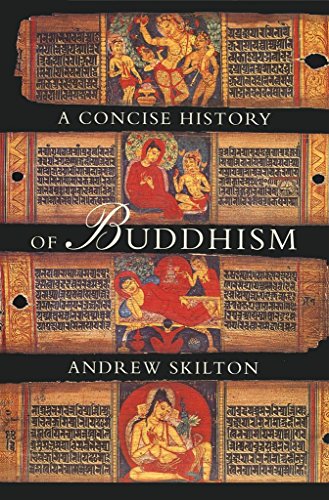
Ebook Info
- Published: 2013
- Number of pages: 272 pages
- Format: PDF
- File Size: 2.64 MB
- Authors: Andrew Skilton
Description
An ideal introduction to the history of Buddhism. Andrew Skilton – a writer on and practitioner of Buddhism – explains the development of the basic concepts of Buddhism during its 2,500 years of history and describes its varied developments in India, Buddhism’s homeland, as well as its spread across Asia, from Mongolia to Sri Lanka and from Japan to the Middle East. A fascinating insight into the historical progress of one of the world’s great religions.”..an excellent synopsis of current scholarship…”—Alan Sponberg, Professor of Asian Philosophy and Religion, University of Montana
User’s Reviews
Reviews from Amazon users which were colected at the time this book was published on the website:
⭐For what I was looking for, I loved this book. Mr. Skilton explains the origins of Buddhism in India and its historical contexts, its early expansion and early controversies, its early codification of its canonical books and latter addition of commentaries, and its evolution as it spread across Asia.I thought Mr. Skilton did a fantastic job in what he aimed to do – provide an academic overview of Buddhist history and its evolution. I disagree with the other reviews who make negative mention of Mr. Skilton’s lack of explanation of scriptures – they’re commenting more on their incorrect choice of books than on Mr. Skilton’s success at his purported aims.The most insightful and enjoyable parts to me were: learning about the early Councils that codified its canon and teachings and respected the historical Buddha’s wishes to have no successor or single leader, learning that Buddhism died out in its homeland of India because of the Islamic invasions – royal patronage for lavish monasteries dried out and the lay people couldn’t distinguish it from the local and longer rooted Hinduism, understanding the differences in the beliefs and focuses of different schools (e.g. scriptural vs commentary focus, whether an external reality exists to ourselves or not, prayer and ritual vs meditation, personal relief from suffering vs relief for all living beings). Also I found the evolution of Buddhism as it spread across Asia to be fascinating – whether it was adopted by the lay people or used by royals as the state religion, whether scriptures came in Pali vs in translations in Chinese or other languages, missionaries from Mahayana vs non-Mahayana schools and who was preferred, and the introduction of Tantra into Buddhism late in the game, as well as the origin of the Dalai Lama.
⭐In Mr. Van Horn’s reader review, he uses a “quote” which is nowhere to be found in the book. This is what Skilton actually says (pgs 67-68) about the brahma-viharas in the Theravadin tradition:”The Theravadin School developed a rather austere orthodoxy, epitomized in the works of the 5th century scholastic Buddhagohosa, especially in his Visuddhi-magga, which on a theoretical level tends to exclude doctrines and practices incompatible with its preferred preoccupations. An example of this exclusion might be the meditational practices called the brahma-viharas, which in its Abhidamma and commentarial literature are relegated to an ancillary function only, whereas its own canon records instances which substantially refute this role. Canonical passages frequently contain editorial additions “demoting” the brahma-viharas but, where parallel texts survive from the Mahasanghika canon, it is interesting to note that the latter did not feel any need to qualify such practices in that way.”As you can see, Mr. Van Horn’s characterization of this point is entirely incorrect, as is his assessment of the book on the whole. One wishes he would have asked himself why Skilton, a longtime Theravadin practitioner himself, would want to write a piece of “Mahayanist propaganda.”In fact, Skilton’s book is a commendably thorough, superbly written, extensively footnoted overview of the subject, with a firm grasp of the issues at hand. I could not recommend it more highly.
⭐It is quite a challenge to write a history of Buddhism, given the complex doctrinal diversification and the wide geographical and timeline spread. Andrew Skilton recognized the difficulty and set out to write a very readable concise history. He succeeded admirably in putting the doctrinal historical development within its geo-political context. He sticks to basic concepts, within the context of its development, and give references for further study of complex points.if you are – like me – lost in the erudite scholarship of Étienne Lamotte’s or Heinrich Dumoulin’s books, this work is a lot more enjoyable reading. It is concise, full of interesting facts, and very engaging. It’s the only History of Buddhism book that I can’t put down and have to read in almost one sitting! It is wonderful as an introductory History of Buddhism book. Thank you Dr. Skilton!
⭐I bought this because I live in a Buddhist country and wanted to understand the foundations of their religion and culture a little more. I’ve had many conversations but wanted to piece it all together. I am having trouble getting through this book. The Author writes in a way that assumes the reader already knows terminology and things about Buddhism. Not a good read if you are starting from scratch because half of the vocabulary is unfamiliar to a non-Buddhist. I’m sure it’s great if you already have a foundation, but it mostly just left me very confused.
⭐Although I did get something out of this book, it is really written for the reader who is already quite familiar with Buddhism and wants to know more about it’s roots. The Sanskrit words and pronunciation were just too frustrating and I quit about 2/3 of the way through. Not really what I was looking for, which was a readable historical account of the Buddha and Buddhism for the uninitiated.
⭐It has a couple inaccuracy due to changing and contested archaeological evidence. There is a lot of terminology in Sanskrit, Pali, etc. You can keep a Buddhist dictionary nearby. The Princeton one weighs about 5 pounds and is not complete. If you get the Kindle version and use it on a device with Internet access, you can highlight a word and do a google search which usually leads somewhere.
⭐Informative, very interesting about early development, but bogs down in later chapters. Difficult to keep track of all the schools that developed. Had to purchase a Buddhist dictionary to negotiate through all the terms and schools.
⭐Not something you’d read for entertainment unless you’re a masochist, but an essential text if you want to understand the broad outlines of how and why buddhism arrived in various places and took/takes the shape that it does.
⭐Writer is a western Buddhist, very fond of technical expressions in original languages; used throughout the text rather than in a glossary at the end. Perhaps due to closeness to the subject, inadequate analysis of relationship to other religious traditions, difference between Buddhist variants, role of native religions in forming syncretist versions of Buddhism. Unfortunately, a waste of money; but the writer does mean well.
Keywords
Free Download Concise History of Buddhism in PDF format
Concise History of Buddhism PDF Free Download
Download Concise History of Buddhism 2013 PDF Free
Concise History of Buddhism 2013 PDF Free Download
Download Concise History of Buddhism PDF
Free Download Ebook Concise History of Buddhism