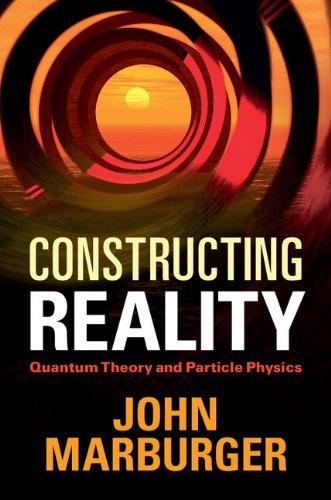
Ebook Info
- Published: 2011
- Number of pages: 296 pages
- Format: PDF
- File Size: 1.18 MB
- Authors: John Marburger
Description
Questions of the fundamental nature of matter continue to inspire and engage our imagination. However, the exciting new concepts of strings, supersymmetry and exotic matter build on ideas that are well known to physicists but mysterious and puzzling to people outside of these research fields. Covering key conceptual developments from the last century, this book provides a background to the bold ideas and challenges faced by physicists today. Quantum theory and the Standard Model of particles are explained with minimal mathematics, and advanced topics, such as gauge theory and quantum field theory, are put into context. With concise, lucid explanations, this book is an essential guide to the world of particle physics.
User’s Reviews
Reviews from Amazon users which were colected at the time this book was published on the website:
⭐One review asked “who is this Marburger?”. I was one of Prof. Marburgers first students going for the PhD at USC in the late 60’s. Dr. John H. Marburger III was absolutely brilliant. One example, of memory: He remembered every math derivation he had done himself and could walk to the blackboard and write it out! Our discussions, amongst others, over beer guided me all my life. I’m 81 now and have been most fortunate to have worked with many accomplished scientists & engineers. I put Marburger & Feynman in the same class. That is who J. H. Marburger III is!
⭐Upfront, the author explains his book is meant as a “next step” for those who have read physics popularizations and are hungry to learn more. (I fit that category since I’ve read 5 Quantum Physics books before this one, but was getting tired of not having any understanding of what a “Hilbert Space” is.) This book definitely delivers on that promise since it very concisely and elegantly describes quantum physics and then the Standard Model of physics (of which the last major piece, the “Higgs Boson”, was recently discovered).Marburger does the difficult task of trying to explain mathematical concepts like vectors, complex numbers, and Hilbert Space without using much math. In this, he largely suceeds- however, I think the book is (at times) too concise. There are some concepts that I never would have understood, if I hadn’t read some other QM books before. I must say that the last major section on the details of the Standard Model lost me.Bottom line: This is a very good book that deserves careful re-reading. However, I think the complete novice to quantum physics will be completely lost. If you fit into that category, then try reading Robert Oerter’s “Standard Model” (2006) or Chad Orzel’s “How to Teach Physics to your Dog” (2009) first.Finally, it’s a shame that the author died recently.
⭐Who IS this Marburger?The same sort of question occurred to me about physicist Bruce Schumm, although I didn’t ask it publicly, when I read his book
⭐. What I mean by this is that, like Schumm, John Marburger seems to have emerged fully formed into the perceptual sphere of those of us who are interested in reading robust, detailed nonprofessional treatments of the current state of physics, astronomy, and mathematics without having professional grounding in any of those areas. He brings us, from a personal history of negligible cross-section in the literature of science popularization, a book that I am confident will become an instant and durable classic. Marburger’s “Constructing Reality” builds the structure of quantum mechanics and the Standard Model of physics, with all their particles, fields, and forces, their laws and symmetries, their mysteries and paradoxes–and their mathematics, from the ground up in historical fashion, as the fields themselves were developed, although it is not strictly speaking a history of either.To his everlasting credit, when Marburger wrote the book “for [his] friends who are not physicists”, he did not stint on challenging the reader who does not have four or five semesters of college mathematics. He does not simply present the math, and he doesn’t teach the math, but he teaches us ABOUT the math in a way that makes a real but reasonable demand on the attention and mental effort of the non-expert reader. This approach allows him, and the reader, to share more fully in the power and the beauty of the deep formulations of modern quantum and particle physics than do almost any other popular books about physics. I cannot recall any other book than Schumm’s before this one that calls for a similar level of attention and rewards it with similar insights. [A slightly puzzled aside: In his endnote “Similar Accounts” for Chapter 1, Marburger omits mention of Schumm’s book. I would have thought that the book, which garnered no shortage of laudatory reviews, would have enjoyed high esteem, and a high “recommendation factor”, among physicists.] For example, the excellent books of Brian Greene about string theory and the nature of the cosmos, such as
⭐, are more easily accessible, so if you’re familiar with them, understand that you’ll find “Constructing Reality” less so but more rewarding. This is in no way a criticism of Greene’s books; the mathematics of string theory is so esoteric that there probably is no middle ground between the math itself on the one hand, and on the other mere qualitative description. But vectors, complex numbers, matrices, group theory, and symmetries can be productively treated with something beyond mere description yet short of a mathematics text. Marburger accomplishes just this.I won’t elaborate on the contents. Prospective readers can assess them with the Look Inside feature. My purpose is to give you my perspective on the level of challenge the author presents to the reader and how enjoyable and rewarding the book is for an educated reader with a general scientific background and a keen interest in knowing as much as possible about the structure of fundamental modern physics. If you fit that description, I urge you to get the book and to read it with care–maybe more than once. I should think it also a salutary survey of the field for the prospective or beginning student of physics. Now, if you’ll excuse me, I want to get started on my second trip through the book…
⭐The author manages to describe modern quantum field theory meaningfully without using much of the mathematical formulations. This is very useful.
⭐Every book on particle physics has several things that are not in the other dozen books on particle physics I have read. Most of whom have a lot of pages devoted to the history of the field. This book does a better job of covering the subject as currently understood than any of the others. The only downside is a few places: when {…} therefore {…} left me befuddled. I will be spending hours digging to find and understand these relationships and connections.
⭐I liked first three chapters. Philosophy is not foreign to the author. However, starting from the fourth chapter he lost the thread. He talked too much about mathematics without proper definition of necessary things. He also started to use the names of various particles without previous clear definition what is what in the world of quantum mechanics.
⭐Marburger does a great job of describing “particles” and “waves” and “fields” as metaphors as measured by particular instruments, not existing as such in the physical world, but too much time is spent of dense descriptions of mathematical equations for a lay person’s understanding.
⭐As someone who is learning to use matrix maths for modelling optical systems I found this book an excellent way of connecting what I was learning at a simple level about how matricies can model rotations in 3D space with the more esoteric wold of quantum mechanics. John Marberger’s style is such that not only is the book very clear at the ‘New Scientist ‘ level but it has so many references that it is very useful for the enquiring student. In particular it is very good at explaining what we do and don’t understand in quantum mechanics and the historical genesis of all the important concepts. John has a real gift for explaining how he personally has come to understand each topic step by step. I have found it very useful in issues like what is the difference between a matter wave – (requiring Shrodinger’s equation) and an electromagnetic wave. He seems to ask all the right questions that someone trying to understand the subject should ask. He then explains what is understood and what isn’t. This is very confidence boosting.
Keywords
Free Download Constructing Reality: Quantum Theory and Particle Physics 1st Edition in PDF format
Constructing Reality: Quantum Theory and Particle Physics 1st Edition PDF Free Download
Download Constructing Reality: Quantum Theory and Particle Physics 1st Edition 2011 PDF Free
Constructing Reality: Quantum Theory and Particle Physics 1st Edition 2011 PDF Free Download
Download Constructing Reality: Quantum Theory and Particle Physics 1st Edition PDF
Free Download Ebook Constructing Reality: Quantum Theory and Particle Physics 1st Edition