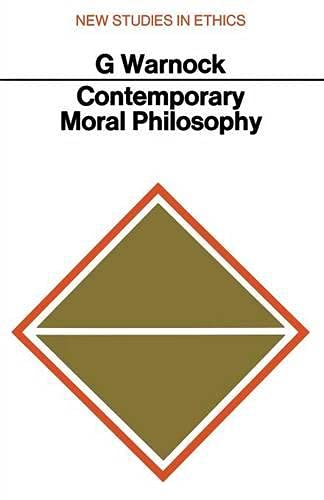
Ebook Info
- Published: 1967
- Number of pages: 92 pages
- Format: PDF
- File Size: 8.02 MB
- Authors: G. J. Warnock
Description
User’s Reviews
Reviews from Amazon users which were colected at the time this book was published on the website:
⭐Looking to quickly survey the history of early twentieth-century meta-ethics in the English-speaking world? Then this is the book for you. If you’ve got about two hours, you can introduce yourself to intuitionism, emotivism, prescriptivism, and some worries about all of them. If you’re too lazy to do that much work, I’ll give you sketch of the story in the next few paragraphs.Our story begins, as do nearly all stories about meta-ethics in this period, with G. E. Moore and his Principia Ethica. Moore’s Principia defends of a particularly puzzling and problematic form of moral realism, non-naturalist intuitionism, and includes his famous Open Question Argument. In Warnock’s presentation, what is important about Moore’s book is the nature of his conclusions and not the details of his arguments. Of particular importance is the fact that Moore’s position commits him to not having a great deal of positive and substantive things to say about the fundamental questions of ethics. Moore’s distinctive meta-ethical conclusions are the following: that certain basic ethical terms cannot be defined (at least by non-moral terms); that ethical properties aren’t natural; and that ethical knowledge isn’t based on anything other than careful consideration of ethical claims. However, Moore doesn’t end up with much of a positive view about the metaphysics or epistemology of ethics. One wants from Moore an answer to questions like the following: What exactly do we mean to be saying about something when we call it morally good (or bad)? What are moral properties like if they aren’t natural? How could we possibly come to know anything about them, and do we have a special faculty that allows us to detect them? But Moore has nothing edifying to say about these matters. Indeed, the core of his view seems to be that there just isn’t much to be said about these things.According to Warnock, the problem with intuitionism is not so much that it involves implausible metaphysical and epistemological views, but that it provides us with a view of moral language and practice on which they have no significant content. The second part of our story is concerned with emotivism, which, according to Warnock, was a fairly natural reaction to the emptiness of intuitionism. A rejection of views of this sort gave rise to various forms of noncognitivism found in the logical positivists (Schlick, Carnap, and Ayer), Stevenson, et al. that dominated English-language meta-ethics in the middle of the twentieth century. These philosophers rejected Moore’s non-naturalist metaphysics and intuitionist epistemology as inconsistent with empiricism and a naturalistic conception of the world. They also rejected moral realism because they thought Moore’s OQA, or something similar to it, showed that realism was committed to defending those doctrines of Moore’s that they found untenable (and perhaps incredible). The route out of the metaphysical and epistemological problems relating to morality, they thought, was to be found in a distinctive account of the nature of moral language In particular, the emotivists argued that moral language is used to express our emotions and attitudes, and not to describe putative moral facts. However, the noncognitivists ended up running into all sorts of problems in accounting for our ordinary beliefs about ways in which moral language can be used, the possibility of moral knowledge, the existence of correct answers to more questions, and the objectivity of morality.Warnock is especially concerned with the problem that the emotivist is apparently unable to account for the rationality of moral argument. If moral debate is simply a matter of trading emotional expressions back and forth, it is unclear that we can formulate any conception of what constitutes a good moral argument. In fact, we may end up with a crude position according to which a good moral argument is simply one that is effective, and this seems to be a position that precludes distinguishing moral argumentation from propaganda.And this problem for emotivism leads Warnock to a consideration of the prescriptivism of R. M. Hare, one of whose goals was to formulate a form of noncognitivism that allowed for rational disputation about moral issues. According to Hare, moral judgments are universal prescriptions. They are prescriptive insofar as genuine acceptance of these judgments commits one to acting in a certain way, and they are universal insofar as one cannot accept these judgments in one case without accepting them in all relevantly similar cases. This view, Hare thinks, allows for rational debate in ethics, since we can convict people of irrationality if (i) their moral judgments involve conflicting prescriptions or (ii) they apply their judgments in ways inconsistent with the universalizability of moral judgments. Warnock’s response is that this simply isn’t enough to get us all the rationality we want in moral debate, and that, even if it were, Hare is still committed to the unworkable aim of reducing the variety of moral discourse in such a way that all of it can be understood as centered around the usage of universal prescriptions.That’s the first two-thirds of Warnock’s book, and it’s a model of succinctness in philosophical exposition and criticism. (If you want a work that covers this period in more detail, there are several out there. Some I know of are Mary Warnock’s Ethics Since 1900, W. D. Hudson’s Modern Moral Philosophy, and Roger Hancock’s Twentieth Century Ethics. I haven’t read these works, however, and so I make no claims for their quality.) As Warnock himself points out, these parts of his book are almost wholly negative since he thinks there is little worth salvaging in the various positions he discusses. But he isn’t being captious, and I find his misgivings about the views he discusses to be well-founded.In the final third of the book, Warnock abandons historical narrative and focuses on developing the rudiments of a naturalistic conception of ethics.This book is probably accessible to anyone with interest in the subject, though some background in ethics wouldn’t hurt.
⭐
Keywords
Free Download Contemporary Moral Philosophy in PDF format
Contemporary Moral Philosophy PDF Free Download
Download Contemporary Moral Philosophy 1967 PDF Free
Contemporary Moral Philosophy 1967 PDF Free Download
Download Contemporary Moral Philosophy PDF
Free Download Ebook Contemporary Moral Philosophy