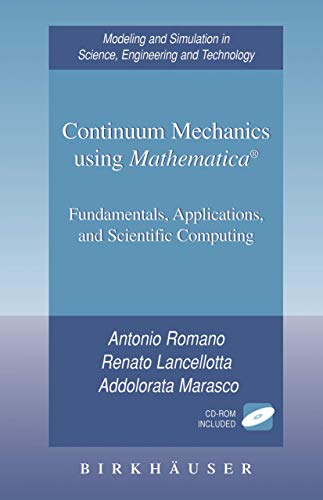
Ebook Info
- Published: 2006
- Number of pages: 388 pages
- Format: PDF
- File Size: 1.88 MB
- Authors: Antonio Romano
Description
This book examines mathematical tools, principles, and fundamental applications of continuum mechanics, providing a solid basis for a deeper study of more challenging problems in elasticity, fluid mechanics, plasticity, piezoelectricity, ferroelectricity, magneto-fluid mechanics, and state changes. The work is suitable for advanced undergraduates, graduate students, and researchers in applied mathematics, mathematical physics, and engineering.
User’s Reviews
Editorial Reviews: Review “[The authors] bring a fresh quality to this subject. Their book of 11 chapters rigorously and clearly introduces various attributes often lacking in other books. Starting with basic linear algebra, the book migrates smoothly to curvilinear coordinates. There, the authors analyze different coordinates and introduce singular surfaces important in porous media analysis. From that point onward the authors present balance and constitutive equations common to other classical books. However, this book resourcefully goes a step further by applying Mathematica in order to clarify key concepts; this attractive feature is one of the book’s strengths. In each Mathematica case, the authors define the aim of the program, description of the problem, and relative algorithm. All chapters are well written, particularly the last four on wave propagation, linear elasticity, and other topics including shock waves, Rayleigh waves, and SH waves. Given this book’s elucidative and concise approach, the scientific community should look forward to reading the second volume, to treat mixtures, phase change, magnetoelastic bodies, and other important topics. Summing Up: Highly recommended. Graduate students through professionals.” —Choice”The book will be an invaluable reference for all those with active interest in the areas of continuum mechanics and its fundamental applications: balance laws, constitutive axioms, linear elasticity, fluid dynamics, waves, etc. It may serve as a supplement to any of the standard textbooks for undergraduate students, graduate students, and researchers in applied mathematics, mathematical physics, and engineering.” —Zentralblatt MATH From the Back Cover This book’s methodological approach familiarizes readers with the mathematical tools required to correctly define and solve problems in continuum mechanics. The book covers essential principles and fundamental applications, and provides a solid basis for a deeper study of more challenging and specialized problems related to elasticity, fluid mechanics, plasticity, materials with memory, piezoelectricity, ferroelectricity, magneto-fluid mechanics, and state changes.Key topics and features: * Concise presentation strikes a balance between fundamentals and applications* Requisite mathematical background carefully collected in two introductory chapters and two appendices* Recent developments highlighted through coverage of more significant applications to areas such as porous media, electromagnetic fields, and phase transitionsContinuum Mechanics using Mathematica® is aimed at advanced undergraduates, graduate students, and researchers in applied mathematics, mathematical physics, and engineering. It may serve as a course textbook or self-study reference for anyone seeking a solid foundation in the field.
Reviews from Amazon users which were colected at the time this book was published on the website:
⭐The mathematics discussed here is quite involved. Including tensor analysis, stress-strain relations and the non-linear Navier Stokes equation. Much of the work involves numerical analysis, as there are no analytic solutions to many problems.You can treat the book as a standard, advanced text on the subject. But the added filip here is how it shows Mathematica can be used. Most general purpose texts on Mathematica involve simpler maths; high school or undergraduate level. Yet the program is quite powerful.The book seems aimed at those scientists and engineers who are not primarily programmers. The idea is to let Mathematica offload much of the programming burden. The tradeoff might be that a loss of efficiency vis a vis custom code. But that might be acceptable to you.
⭐
⭐
⭐
⭐
⭐
⭐
Keywords
Free Download Continuum Mechanics using Mathematica®: Fundamentals, Applications and Scientific Computing (Modeling and Simulation in Science, Engineering and Technology) 2006th Edition in PDF format
Continuum Mechanics using Mathematica®: Fundamentals, Applications and Scientific Computing (Modeling and Simulation in Science, Engineering and Technology) 2006th Edition PDF Free Download
Download Continuum Mechanics using Mathematica®: Fundamentals, Applications and Scientific Computing (Modeling and Simulation in Science, Engineering and Technology) 2006th Edition 2006 PDF Free
Continuum Mechanics using Mathematica®: Fundamentals, Applications and Scientific Computing (Modeling and Simulation in Science, Engineering and Technology) 2006th Edition 2006 PDF Free Download
Download Continuum Mechanics using Mathematica®: Fundamentals, Applications and Scientific Computing (Modeling and Simulation in Science, Engineering and Technology) 2006th Edition PDF
Free Download Ebook Continuum Mechanics using Mathematica®: Fundamentals, Applications and Scientific Computing (Modeling and Simulation in Science, Engineering and Technology) 2006th Edition