

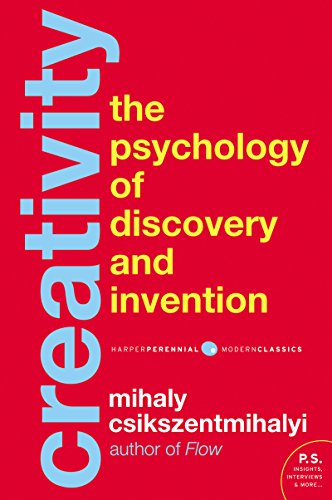
Ebook Info
- Published: 2013
- Number of pages: 480 pages
- Format: PDF
- File Size: 38.81 MB
- Authors: Mihaly Csikszentmihalyi
Description
“Although the benefits of this study to scholars are obvious, this thought-provoking mixture of scholarly and colloquial will enlighten inquisitive general readers, too.” — Library Journal (starred review)The classic study of the creative process from the bestselling author of Flow.Creativity is about capturing those moments that make life worth living. Legendary psychologist Mihaly Csikszentmihalyi (“The leading researcher into ‘flow states.’” — Newsweek) reveals what leads to these moments—be it the excitement of the artist at the easel or the scientist in the lab—so that this knowledge can be used to enrich people’s lives. Drawing on nearly one hundred interviews with exceptional people, from biologists and physicists, to politicians and business leaders, to poets and artists, as well as his thirty years of research on the subject, Csikszentmihalyi uses his famous flow theory to explore the creative process. He discusses such ideas as why creative individuals are often seen as selfish and arrogant, and why the “tortured genius” is largely a myth. Most important, he explains why creativity needs to be cultivated and is necessary for the future of our country, if not the world.
User’s Reviews
Editorial Reviews: Review “Although the benefits of this study to scholars are obvious, this thought-provoking mixture of scholarly and colloquial will enlighten inquisitive general readers, too.” — Library Journal (starred review)“Accessible and enjoyable reading.” — Washington Times From the Back Cover The classic study of the creative process from the national bestselling author of Flowcreativity is about capturing those moments that make life worth living. Legendary psychologist Mihaly Csikszentmihalyi reveals what leads to these moments—be it the excitement of the artist at the easel or the scientist in the lab—so that this knowledge can be used to enrich people’s lives. Drawing on nearly one hundred interviews with exceptional people, from biologists and physicists, to politicians and business leaders, to poets and artists, as well as his thirty years of research on the subject, Csikszentmihalyi uses his famous flow theory to explore the creative process. He discusses such ideas as why creative individuals are often seen as selfish and arrogant, and why the “tortured genius” is largely a myth. Most important, he explains why creativity needs to be cultivated and is necessary for the future of our country, if not the world. About the Author Mihaly Csikszentmihalyi (1934-2021) was a professor at Claremont Graduate University and former chair of the Department of Psychology at the University of Chicago. His books include Creativity, The Evolving Self and the national bestseller Flow. Read more
Reviews from Amazon users which were colected at the time this book was published on the website:
⭐This was a good if not a great book. Its greatest strength lies in the thesis introduced early on and supported throughout that the kind of creativity that leaves a trace in the cultural matrix rests not in the personal creativity of the individual, but in what Csikszentmihalyi tags the “systems approach ” to creativity. To have any effect, a creative idea must be couched in terms that are understandable to others, pass muster with the experts in the field (i.e. the gatekeepers to the domain), and be included within the cultural domain (the set of symbolic rules or procedures) to which it belongs. In this systems view, the definition of a creative person is someone whose thoughts or actions change a domain or establish a new domain (pp. 27-28). This is no easy task, especially since he or she needs to learn the existing domain or domains first, and almost always necessitates being in the right place at the right time (e.g. studying quantum physics at the beginning of the 20th century or women seeking academic opportunities when WWII broke out).Having established this in the first 30 pages, if you didn’t read the remaining 350 you wouldn’t miss much. But I still enjoyed reading the stories and thoughts of selected individuals whom the author deemed as “creative” according to the definition above (However, I disagreed with the selection of a few of these and would have chosen at least one more person of faith in addition to the Quaker who was briefly highlighted. Also on the issue of faith, I found the author’s grouping on page 371 of studying the bible with addictive behaviors such as cruising the internet and betting on horse races to be rather laughable!).Some additional personal nuggets I gleaned from this book include the following:1. Those who persevere and succeed must be creative not only in their manipulation of symbols but maybe even more in shaping a career and a future for themselves that will enable them to survive while continuing to explore the strange universe in which they live (p. 199).2. When seeking to allow your mind to make new connections in a beautiful setting, just sitting and watching is fine, but taking a leisurely walk seems to be even better. The shaping of one’s personal space is also important. The Greek philosophers settled on the peripatetic method, preferring to discuss ideas walking up and down in the courtyards of the academy. When we participate in this kind of “semiautomatic activity” that uses a certain amount of attention, we allow the rest of it to be free to make connections among ideas, often from different domains, well below the threshold of conscious intentionality. “Devoting full attention to a problem is not the best recipe for having creative thoughts. “(p. 138)3. Both creativity and innovation on the one hand and conservation and traditionalism on the other are both equally important. “Neither uncritical acceptance nor wholesale dismissal of human creativity will lead us far. ” (p. 322)The final section deals with how to enhance personal creativity. Some of these ideas were helpful (e.g. to seek to be surprised and to seek to surprise another person at least once every day, to seek to look at problems from multiple perspectives instead of assuming you see the issue clearly from one perspective, etc.) but others just seem to be taking up space on the page. I’m afraid the phraseology of how to use psychic energy more effectively on page 356 and a few other places lost my interest almost completely.
⭐“This book is about creativity, based on histories of contemporary people who know about it firsthand. It starts with a description of what creativity is, it reviews the way creative people work and live, and it ends with ideas about how to make your life more like that of the creative exemplars I have studied. There are no simple solutions in these pages and a few unfamiliar ideas. The real story of creativity is more difficult and strange than many overly optimistic accounts have claimed. For one thing, as I will try to show, an idea or product that deserves the label ‘creative’ arises from the synergy of many sources and not only from the mind of a single person. It is easier to enhance creativity by changing conditions in the environment than by trying to make people think more creatively. And a genuinely creative accomplishment is almost never the result of a sudden insight, a lightbulb flashing on in the dark, but comes after years of hard work.”~ Mihaly Csikszentmihalyi from CreativityCreativity with a capital C—the type of Creativity that changes the world.How can we go about cultivating it in our lives? That’s what this book is all about.Our guide is Mihaly Csikszentmihalyi—one of the founders of the positive psychology movement. Csikszentmihalyi (pronounced “cheeks sent me high”) is a professor at Claremont Graduate University and the former Chair of the Department of Psychology at the University of Chicago who wrote the classic book Flow: The Psychology of Optimal Experience .This book features the wisdom gained from over three decades of research along with over one hundred interviews with extraordinary people—from scientists and business leaders to artists and poets.Warning: Although deeply insightful, it’s not an easy read. If you’re looking to understand creativity at a deeper level via one of the world’s leading (and legendary) psychologists then I think you’ll enjoy it as much as I did.Here are some of my favorite Big Ideas:1. What is Creativity – Domain + field + person.2. Attention – + Being kind weird3. Complexity – + Resolving dischotomies.4. Rhythms – Your ideal days?5. Creativity + Flow – The 9 elementsWell, there we go. That’s a super quick look at this great book. Time to get our flow on as we tap into our Creativity and optimize + actualize!More goodness— including PhilosophersNotes on 300+ books in our *OPTIMIZE* membership program. Find out more at brianjohnson . me.
⭐At the first reading I thought that this book was totally away from the remaining books over creativity however, upon reading more chapters it became more thorough than other books and handle creativity perspective in a new interesting way
⭐Idont read booksBut one dayMy roomate who is a drunk and a fail teacherRead books at the toilet left a book this oneAnd i used the toilet accidentally read itHalfwayTook time ,But it was worthyThis book is worth morethan my 10$ i search it on amazon and its thereCant believe how life turns out awesome More to book after a month and its still next to my bedMay be its the colors5 months after and its still thereReading it to bedAnd idont read much it might take an eternity lolUntil ifinish this book being read but ok you get how good is it
⭐Deep interesting read about the origins of creativity.The only thing is that the paperback version (the one with red and blue and yellow titles) is with a suuuuper fragile paper. The pages are super thin (I like to underline some paragraphs, and the pen always goes to the other side of the page.Apart from that, Mihaly shows a great respect from creativity and the creative process.
⭐Having just finished reading Creativity by Csikszentmihalyi I have become fascinated by the topic. His book is detailed and highly analytical. This is not a fantastical book of spurious claims nor a self-help book. Having said that, he sets out concisely at the end how one might apply certain principles and approaches to life based on those of successful creative people (such as those he refers to in previous chapters). The most contentious argument put forward is that one is only creative if that creativity is recognised by others of sufficient standing in a field and/or domain. However, in the ‘Notes’ section at the end he goes on to explain the importance of adopting this position in order to apply the scientific metheod to the study of creativity. Clearly if everyone could self-validate their creativity in terms of quantity and quality the subject would be completely subjective. I appreciate this difficulty but it is nonetheless hard to divorce oneself from the conviction that one has, on occasion, been genuinely creative even if it has not been validated by anyone else.I was unsure as to whether to rate this book as four stars or five on the basis that, although Csikszentmihalyi has approached the matter rigourously and makes few assumptions about the nature of creativity, it would have been valuable, i think, to evaluate the experiences and lives of those who are supposedly not creative. In a similar vein the question of how intelligence should be defined is often studied and disputed, although it seems equally challenging to precisely define its opposite, whatever that is – perhaps ‘stupidity’?However, Csikszentmihalyi has published widely and thoroughly on the matter and as such I would not expect any book, brilliant as it may be, to address every aspect of such a complex notion as ‘creativity’, with all its far reaching implications for mankind. As such I rate this book five stars as it is a well-written and stimulating foray into this area of psychology. I would reccommend this book to people of all levels of knowledge of the field of psychology, although it is not a ‘quick-flick’ read by any means. I have already started reading another of his books.
⭐I used this book as the basis for a thesis on creative writing and it received a first, that’s a win in my book! Mainly, Csikszentmihalyi’s presentation of ideas and the way he juxtaposes what defines an incredibly intangible subject in a not too dryly academic way helped guide me in making the same concepts and ideas accessible and meaningful in my chosen field. However, the book itself does not limit itself to any given creative discipline, rather opens up the concept of creativity as a broad church and bolsters this with many testaments from successful people in creative endeavours both ordinary and spectacular.This is what makes it an intriguing read, I think. Its very breadth of scope paradoxically narrowing down what it means to be creative and how we ourselves define it through our own eyes. The differences and the similarities of creative process and the removal of stigma and mystique surrounding our various perceptions gives a fresh perspective on what is essentially a very innate force, present in all of us and only waiting to be tapped into.
⭐Cover is really thin, as is the paper, which makes this feel really cheap. The content is good, but the structure seemed a little odd to me – I ended up reading the chapters in a different order, because they made more sense that way. Nothing really groundbreaking I don’t think, but to be fair to the author, they do say that themselves. A good overview of the subject – would have liked a bit more neurology in it, but I do understand that the book didn’t promise that.
⭐Used it for my uni studies. Very interesting read. Good theory. It is a hungarian work. Very very good.
Keywords
Free Download Creativity: Flow and the Psychology of Discovery and Invention in PDF format
Creativity: Flow and the Psychology of Discovery and Invention PDF Free Download
Download Creativity: Flow and the Psychology of Discovery and Invention 2013 PDF Free
Creativity: Flow and the Psychology of Discovery and Invention 2013 PDF Free Download
Download Creativity: Flow and the Psychology of Discovery and Invention PDF
Free Download Ebook Creativity: Flow and the Psychology of Discovery and Invention