Ebook Info
- Published: 2009
- Number of pages: 398 pages
- Format: PDF
- File Size: 6.97 MB
- Authors: Thomas C. Hammergren
Description
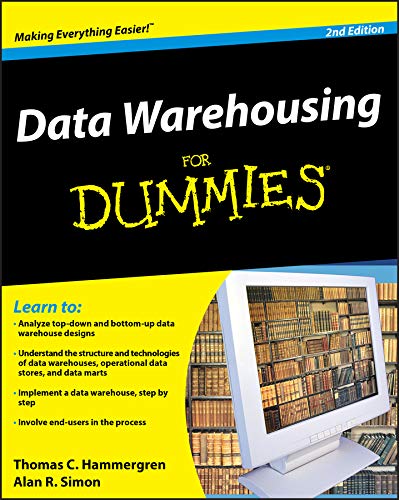
Data warehousing is one of the hottest business topics, and there’s more to understanding data warehousing technologies than you might think. Find out the basics of data warehousing and how it facilitates data mining and business intelligence with Data Warehousing For Dummies, 2nd Edition.Data is probably your company’s most important asset, so your data warehouse should serve your needs. The fully updated Second Edition of Data Warehousing For Dummies helps you understand, develop, implement, and use data warehouses, and offers a sneak peek into their future. You’ll learn to:Analyze top-down and bottom-up data warehouse designsUnderstand the structure and technologies of data warehouses, operational data stores, and data martsChoose your project team and apply best development practices to your data warehousing projectsImplement a data warehouse, step by step, and involve end-users in the processReview and upgrade existing data storage to make it serve your needsComprehend OLAP, column-wise databases, hardware assisted databases, and middlewareUse data mining intelligently and find what you needMake informed choices about consultants and data warehousing productsData Warehousing For Dummies, 2nd Edition also shows you how to involve users in the testing process and gain valuable feedback, what it takes to successfully manage a data warehouse project, and how to tell if your project is on track. You’ll find it’s the most useful source of data on the topic!
User’s Reviews
Editorial Reviews: From the Inside Flap Learn to:Analyze top-down and bottom-up data warehouse designsUnderstand the structure and technologies of data warehouses, operational data stores, and data martsImplement a data warehouse, step by stepInvolve end-users in the processThere’s more to data warehousing than you think, so start right here!You don’t need a forklift to work with a data warehouse, but you do need a hefty load of know-how to make wise decisions when setting one up. Data is probably your company’s most important asset, so your data warehouse should serve your needs. Here’s how to understand, develop, implement, and use data warehouses, plus a sneak peek into their future. Know your stuff — understand what a data warehouse is, what should be housed there, and what data assets areGet a handle on technology — learn about column-wise databases, hardware assisted databases, middleware, and master data managementThe intelligent view — see how business intelligence and data warehousing work togetherAsk the right questions — explore data mining and learn to find what you needDo the groundwork — choose your project team and apply best development practices to your data warehousing projectsKeep the user in mind — involve your users in defining business needs through testing, and learn how to get valuable feedbackFix or replace? — learn how to review and upgrade existing data storage to make it serve your needsBuyer beware — be prepared when dealing with data warehousing product vendorsOpen the book and find:What to expect from your data warehouseThe difference between data warehouses and data martsAll about specialty database technologiesWhat to look for in a consultantHow your data warehouse feeds dashboards and scorecardsSecrets for managing a successful data warehouse projectHow to effectively capture business needs and requirementsTen signs your project is in trouble From the Back Cover Learn to:Analyze top-down and bottom-up data warehouse designsUnderstand the structure and technologies of data warehouses, operational data stores, and data martsImplement a data warehouse, step by stepInvolve end-users in the processThere’s more to data warehousing than you think, so start right here!You don’t need a forklift to work with a data warehouse, but you do need a hefty load of know-how to make wise decisions when setting one up. Data is probably your company’s most important asset, so your data warehouse should serve your needs. Here’s how to understand, develop, implement, and use data warehouses, plus a sneak peek into their future. Know your stuff — understand what a data warehouse is, what should be housed there, and what data assets areGet a handle on technology — learn about column-wise databases, hardware assisted databases, middleware, and master data managementThe intelligent view — see how business intelligence and data warehousing work togetherAsk the right questions — explore data mining and learn to find what you needDo the groundwork — choose your project team and apply best development practices to your data warehousing projectsKeep the user in mind — involve your users in defining business needs through testing, and learn how to get valuable feedbackFix or replace? — learn how to review and upgrade existing data storage to make it serve your needsBuyer beware — be prepared when dealing with data warehousing product vendorsOpen the book and find:What to expect from your data warehouseThe difference between data warehouses and data martsAll about specialty database technologiesWhat to look for in a consultantHow your data warehouse feeds dashboards and scorecardsSecrets for managing a successful data warehouse projectHow to effectively capture business needs and requirementsTen signs your project is in trouble About the Author Thomas C. Hammergren has been involved with business intelligence and data warehousing since the 1980s. He has helped such companies as Procter & Gamble, Nike, FirstEnergy, Duke Energy, AT&T, and Equifax build business intelligence and performance management strategies, competencies, and solutions. Alan R. Simon is a data warehousing expert and author of many books on data warehousing. Read more
Reviews from Amazon users which were colected at the time this book was published on the website:
⭐This was my first book about Data Warehousing. As a book in the Dummies series from Wiley it more than lived up to my expectations. You will get introduced to the nuts and bolts of the Data Warehouse-concept, and a strategy from decision to implementation and maintenance. The book will introduce you to several DW-vendors, but does not go into a specific vendors products. After this book I read Business Intelligence for Dummies, and I was afraid there would be a lot of overlap between the two, but I was happily surprised that wasn’t the case. I can recommend both of them for anyone who is looking for a fast-track introduction to DW and BI. As other reviewers has pointed out, this book isn’t the end of the line, but we already knew that. If you start from scratch you will have plenty of information to keep and reading other books, getting your feet wet. If you start from zero (or even beyond that) I can promise you’ll find lot of interesting information in this book.
⭐The book provides a useful introduction to Data warehousing. It is well written, easy to follow and a handy reference.
⭐This is an excellent book for people who are new to data warehousing and just need an overview.
⭐I knew nothing about it but now I do thanks to this simple book on the subject and well laid out to get a good overview and now I could easily get involved and learn more knowing the basics.
⭐Great Book on Data Warehousing concepts. I am only half way through the book, but I do not see any actual examples or samples on setting something up. My mistake for not investigating the book throughly. Great book for the concepts though.
⭐Such a great book for one who just needs infrastructure and history to be able to effectively work with the IT folks.
⭐not a easy read but if your into data…..its a must.
⭐Look, this look isn’t for experienced DW people. However, it wouldn’t hurt some of the DW “experts” I know to read it.The author gived down to earth comments and examples of what the industry entails and what DW is all about. He covers most of the issues and gave me some interesting insight into some areas that I haven’t yet delt with.I’ve been working in DW for over 5 years. Even so, I think this book is worth reading. I’m gald I did.
⭐I imagine that this book was written normally and then either the author or the publisher or both decided “hey, this is a ‘for dummies’ book we need to make it lively and fun to read” and so they decided to pepper it with fun, wacky jokes and comments in the belief that this would somehow make it more enjoyable to read.Let me tell you, there is nothing ‘fun’ about data warehousing, which is not to say that it isn’t interesting or relevant if you are in that line of work, however it’s not something you are going to be joking about down the pub. In fact, if you are even talking about it at all down the pub then it had better be with work colleagues (who also work in data warehousing) and not your mates, otherwise they won’t be your mates for very long.The way the author has done this makes him come across as some hideous, Alan Partridge-esque geek snorting through laughs as he makes ridiculous, patronising comments about relational database technology and OLAP cubes.Possibly there is a cultural mismatch here and this is all completely acceptable in America, however if that is the case then it really doesn’t translate well.However, if you can rise above or ignore completely those few peppered comments the book is actually a very good and well-written overview of data warehousing, hence the 3 stars
⭐Makes it all so easy
⭐Provided me with exactly the information I needed in an easy and understandable manner. Often the explanations of these type of subject matters can be over complicated. This was a great introduction.
⭐As someone new to Data Warehousing I found this book to be an excellent introduction and more. It takes a reader with little knowledge and makes him/her comfortable with DW concepts and principles, and more importantly, the DW language and jargon. It also takes the reader to a level beyond just the basics so that he/she understands how DW works in practice, and importantly it focuses on the realities, benefits and pitfalls of getting DW to work for real. There is therefore a very important theme running throughout the book of the importance of practical implementation and the challenges that will be encountered in executing a DW strategy. The book also covers Business Intelligence (BI) which is the whole reason for DWs and similarly it provides an excellent overview of the various aspects of this crucial topic. I feel this book has now given me confidence to know and understand how DW works and what it is all about despite having little in the way of IT background. There were some elements where database techniques are discussed that left me with a few questions. However, these were easily answered by consulting other books or going online. Overall – an excellent book with an easy, informal, well-written style and very comprehensive and authoritative content.
⭐JUST THE RIGHT BOOK FOR BEGINNERS
Keywords
Free Download Data Warehousing For Dummies 2nd Edition in PDF format
Data Warehousing For Dummies 2nd Edition PDF Free Download
Download Data Warehousing For Dummies 2nd Edition 2009 PDF Free
Data Warehousing For Dummies 2nd Edition 2009 PDF Free Download
Download Data Warehousing For Dummies 2nd Edition PDF
Free Download Ebook Data Warehousing For Dummies 2nd Edition