

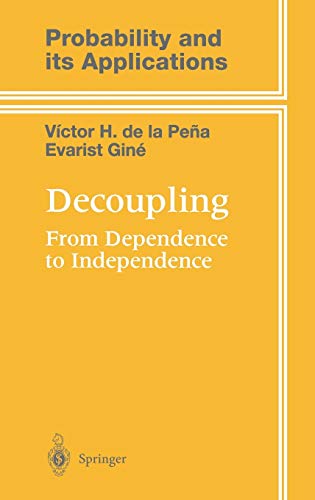
Ebook Info
- Published: 1999
- Number of pages: 407 pages
- Format: PDF
- File Size: 18.73 MB
- Authors: Victor de la Peña
Description
A friendly and systematic introduction to the theory and applications. The book begins with the sums of independent random variables and vectors, with maximal inequalities and sharp estimates on moments, which are later used to develop and interpret decoupling inequalities. Decoupling is first introduced as it applies to randomly stopped processes and unbiased estimation. The authors then proceed with the theory of decoupling in full generality, paying special attention to comparison and interplay between martingale and decoupling theory, and to applications. These include limit theorems, moment and exponential inequalities for martingales and more general dependence structures, biostatistical implications, and moment convergence in Anscombe’s theorem and Wald’s equation for U–statistics. Addressed to researchers in probability and statistics and to graduates, the expositon is at the level of a second graduate probability course, with a good portion of the material fit for use in a first year course.
User’s Reviews
Editorial Reviews: Review From a review:MATHEMATICAL REVIEWS”The book is written in an excellent way. The exposition is clear and effective. The results are well motivated.”
Reviews from Amazon users which were colected at the time this book was published on the website:
⭐This is a highly theoretical text that covers a topic that many statisticians and even some probabilist are not familiar with. Modeling dependent data is more complicated and complex compared to independent data. Decoupling is a general approach that uses probability inequalities to relate joint probabilities for dependent variables to independent ones with the same univariate marginal structure. For example certain forms of positive dependence can lead to useful inequalities such as total positivity or association. It has been used particularly for randomly stopped stochastic processes and U-processes. Martingale inequalities provided the impetus for this theory. But it has grown substantially in other directions. Conditional independence is another way to achieve decoupling.This book is very abstract and heavy with probability theory. But it also contains statistical applications.
Keywords
Free Download Decoupling: From Dependence to Independence (Probability and Its Applications) 1999th Edition in PDF format
Decoupling: From Dependence to Independence (Probability and Its Applications) 1999th Edition PDF Free Download
Download Decoupling: From Dependence to Independence (Probability and Its Applications) 1999th Edition 1999 PDF Free
Decoupling: From Dependence to Independence (Probability and Its Applications) 1999th Edition 1999 PDF Free Download
Download Decoupling: From Dependence to Independence (Probability and Its Applications) 1999th Edition PDF
Free Download Ebook Decoupling: From Dependence to Independence (Probability and Its Applications) 1999th Edition