Ebook Info
- Published: 2017
- Number of pages: 384 pages
- Format: PDF
- File Size: 10.91 MB
- Authors: Francois Chollet
Description
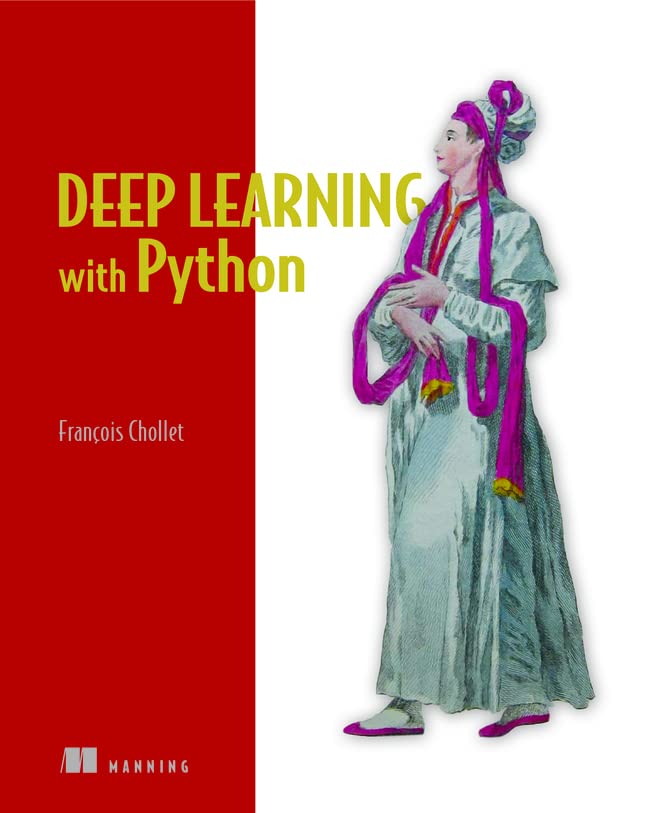
SummaryDeep Learning with Python introduces the field of deep learning using the Python language and the powerful Keras library. Written by Keras creator and Google AI researcher François Chollet, this book builds your understanding through intuitive explanations and practical examples.Purchase of the print book includes a free eBook in PDF, Kindle, and ePub formats from Manning Publications.About the TechnologyMachine learning has made remarkable progress in recent years. We went from near-unusable speech and image recognition, to near-human accuracy. We went from machines that couldn’t beat a serious Go player, to defeating a world champion. Behind this progress is deep learning—a combination of engineering advances, best practices, and theory that enables a wealth of previously impossible smart applications.About the BookDeep Learning with Python introduces the field of deep learning using the Python language and the powerful Keras library. Written by Keras creator and Google AI researcher François Chollet, this book builds your understanding through intuitive explanations and practical examples. You’ll explore challenging concepts and practice with applications in computer vision, natural-language processing, and generative models. By the time you finish, you’ll have the knowledge and hands-on skills to apply deep learning in your own projects. What’s InsideDeep learning from first principlesSetting up your own deep-learning environment Image-classification modelsDeep learning for text and sequencesNeural style transfer, text generation, and image generationAbout the ReaderReaders need intermediate Python skills. No previous experience with Keras, Tensor Flow, or machine learning is required.About the AuthorFrançois Chollet works on deep learning at Google in Mountain View, CA. He is the creator of the Keras deep-learning library, as well as a contributor to the Tensor Flow machine-learning framework. He also does deep-learning research, with a focus on computer vision and the application of machine learning to formal reasoning. His papers have been published at major conferences in the field, including the Conference on Computer Vision and Pattern Recognition (CVPR), the Conference and Workshop on Neural Information Processing Systems (NIPS), the International Conference on Learning Representations (ICLR), and others.Table of ContentsPART 1 – FUNDAMENTALS OF DEEP LEARNING What is deep learning?Before we begin: the mathematical building blocks of neural networks Getting started with neural networksFundamentals of machine learningPART 2 – DEEP LEARNING IN PRACTICEDeep learning for computer visionDeep learning for text and sequencesAdvanced deep-learning best practicesGenerative deep learningConclusionsappendix A – Installing Keras and its dependencies on Ubuntuappendix B – Running Jupiter notebooks on an EC2 GPU instance.
User’s Reviews
Editorial Reviews: About the Author François Chollet is a software engineer at Google and creator of Keras.
Reviews from Amazon users which were colected at the time this book was published on the website:
⭐Read this cover to cover for my senior project and loved every minute of it, Francois Chollet was somehow able to make a textbook into a page turner, explaining challenging concepts conceptually while giving implementation examples. I also got the second addition and I would recommend using that one just so you are working through up-to-date examples with tensorflow/keras. The field of deep learning is really vast and Chollet covers an impressive amount in this book mostly at a relatively high/applied level, which I think is a good thing. There were a few of the later chapters I wish he went into more depth with, for the advanced computer vision chapter I really which he had touched on some more modern architectures like Mask- RCNN and other stuff
⭐This book is a great hands-on introduction to Keras. If you expected a Deep Learning (graduate-level) textbook, however, you’ve come to the wrong place. This is not it. If, at the other hand, you’re looking for a crash course on Keras that gets you up-and-running in record time without going to too much mathematical overhead, you probably couldn’t do much better.So why only 4 stars? Craftsmanship! The text has been obviously previously formatted differently, and now there are hyphenated word-breaks in the middle of the lines all over the place – doesn’t help a professional look from a publisher’s point of view. Then, nobody caught Chollet’s occasional slips when he attributes human sentiments to networks (networks “prefer”… etc) – not overly professional from a scientific point of view. Then some plots are mislabeled (“Loss” instead of “Accuracy”). All little things, but one can do better.Overall, I would (and have!) recommend this book to a friend to get started with Keras.
⭐I have bought 10 books on ML/DL, and of those this is the 9th book that I have read (actually I have just started reading this book, but it’s been so good thus far that I wanted to write a review.) As another reviewer noted, one should read other books on ML/DI to get a deeper understanding of the topic. This book explains using programs instead of using much mathematics. The advantage that I have had is my review of the same topics from other perspectives in books such as the followingIntro to statistical learning (by Hastie et al)Intro to Machine Learning (by Alpaydin)Deep Learning (by Goodfellow, Bengio etc)Hands-on ML w SciKit, Keras and Tensorflow (by Geron)When I first tried to read this book by Chollet in early April I was not as conversant with Python, and so I took a break and decided to brush up my limited Python knowledge by going through the first 6 chapters of “Automate the Boring Stuff with Python” (by Sweigert). Now that I have more knowledge of Python this book by Chollet is so much more comprehensible. As I said I have the advantage of having learned many of these concepts earlier. I love Chollet’s interpretation and explanations. I wish I could do the exercises but am having difficulty setting up the GPU machine.The problem I am dealing with with this book by Chollet is the setup of a GPU machine in the Amazon Cloud. If anyone can help me that would be greatly appreciated (I understand that this is not the forum to seek technical help on AWS, but I thought I’d give it a try)
⭐If the paperback book I received didn’t look and feel like an illegal physical copy or a rather poor quality physical product, I’d be giving it 5 stars, so 3 stars here is for the crappy production quality and not for the content. I borrowed this paperback book from our public library and really liked it. The content is great, and it’s a useful tool to get up and started with machine learning — IF — you already know how to write code in Python. If you aren’t at least familiar with some Python and you aren’t going to bother making an effort to learn more, then get a different book. Good luck finding one as good.Since I really liked the copy I borrowed from the library, and prefer paper books to eBooks (I’m old — MSDOS old), I decided to get a (paper) copy and saw a good price from an Amazon re-seller. But what I got differed physically quite a bit from the copy I’d borrowed from the library. When I first received the paperback book from a 3rd party vendor, it seemed “off”, as if it weren’t new or even like new. The cover had some wrinkling near the binding and the book is warped a bit, as if it was stored in a humid environment. It’s not warped in a way that makes it unusable, just in that way that gives the entire book a slight curl near the edges. Furthermore, the binding seems “stiff” compared to other Manning Publications products; but this can happen if too much glue is used in the binding during fabrication process. Then, as I flipped through the pages, a lot of them look like they were photocopied (!!!) as opposed to printed, especially with respect to the images. The difference between what I received and the much higher quality book I’d borrowed from the library was dramatic in this regard. I had a panic moment thinking I had purchased a well-done “fake” or illegal copy of the physical book (which might still be true). Manning Publications let’s you get a free eBook copy of many of their books, so I went through the steps and was able to register and get my eBook without any problems, so maybe the copy is legit after all. If not, maybe I registered prior to the owner of the original? I have no idea. Since my purchase was through a 3rd party on Amazon and not Amazon directly, the eBook process worked, and it was inexpensive, I’m not going to waste more of my life beyond this review going through the hassle of trying to return it, since the content IS really good, and with wrinkled brow I can deal with with the annoyances of the sub-par product. But I felt that it was important to bring awareness to the fact that either (i) there IS some possibility that illegal paperback copies are being sold, or (ii) that you might get a poorly produced physical copy. If you prefer an ebook version, maybe go with that. The PDF version I got after registration seems fine.
⭐I have ordered tens of books of books from Amazon overseas.There were many times when the corners of the books were crumbled,front/back cover dirty, showing sign of age when it’s suppose to be new..but this is the first time when I’ve seen a really nice packaging on my delivery of books overseas.No crumbles, good as new, safely delivered – even before the delivery due date!Very satisfied.
⭐This book is making something as intricate and advanced as deep learning understandable in a very clear and concise way.If you want to get started with Keras, deep learning, neural networks and all that – this is one of the best books I’ve ever seen. If not the best.It doesn’t go full tilt into all the mathematics behind it – something I appreciate – but it sure gives you enough to get you started as well as a good way towards the more advanced subjects in this field. If you want all the formulas and algorithms behind this – there are better books but if you want to hit the ground running this is the book for you.I don’t think I can recommend this book highly enough.
⭐This book is written by someone who clearly has two major abilities: they have a love of the subject, and they communicate it clearly.The book contains real examples of Python/Keras code to do deep learning on standard data sets. Some knowledge of Python is required, but I think that any competent programmer can get this as they go along. I certainly improved my Python while working through the examples.The author makes clear their belief that a Linux system is required to do the examples in the book. This is the author’s only major mistake. I have tried the examples under Windows 10/Anaconda 3 and they simply work. Perhaps the GPU based examples work better under Linux – I didn’t try these.After finishing the book, the reader will be well placed to know the basics of deep learning, and to take the subject further.
⭐The content is clear and ideas are succinct. I am a masters AI student so to see the material written this way is great and fairly straight forward. If you are not familiar with DL at all read blogs/articles first. If you are then it will be easy to follow.However, if you want to follow along with some very simple exercises don’t expect to get the same results (i.e. loss or accuracy as francis attains with the provided code). In other words he’s half assed this, if he’s reading this get it sorted asap mate! (very poor and frustrating for the standard at which he is working at). All of the code should be replicable within ~1% here and there as far as i’m concerned.For practical hands on experience get onto a udemy course for £15.For a quick and concise guide its okay as well – not read other books as of yet which are as accessible without heavy math and programming so from this point its well done
⭐This is a hands on practical book for people who want to get into deep learning quickly. It requires knowledge of python but almost no knowledge of AI, explaining for instance the basic concepts of annotation, labelled instances and the difference between supervised and unsupervised learning.It starts with a series on simple practical examples which the reader can easily reproduce and explore alone. The explanations are readable and understandable away from a computer (I read much of it on holiday). It then goes into detail of the two most advanced applications of deep learning – image processing and text processing.The notation throughout is python rather than formal mathematical notation. If you like reading code but don’t like reading matrix equations, this will be ideal. The one possible shortcoming is that it veers heavily to the practical side and isn’t concerned with the theory. Thus it doesn’t explain how backprop works or even give you the equations, merely noting that most packages automate them so you might as well not waste your time and get on with learning how to do it. This is perhaps a wise approach since Hinton’s excellent coursera lectures are freely available and are both accessible and rigorous.
⭐Fake book provided by Amazon.They are cheating there customers.All images and charts are black and white.Its just fake print of the book
Keywords
Free Download Deep Learning with Python 1st Edition in PDF format
Deep Learning with Python 1st Edition PDF Free Download
Download Deep Learning with Python 1st Edition 2017 PDF Free
Deep Learning with Python 1st Edition 2017 PDF Free Download
Download Deep Learning with Python 1st Edition PDF
Free Download Ebook Deep Learning with Python 1st Edition