

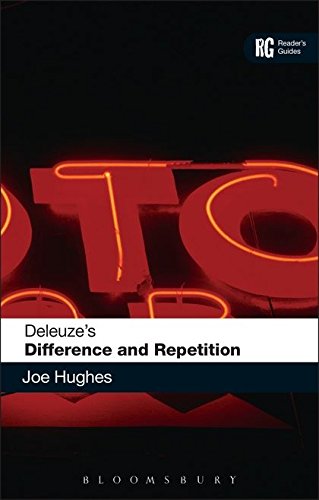
Ebook Info
- Published: 2009
- Number of pages: 232 pages
- Format: PDF
- File Size: 1.24 MB
- Authors: Joe Hughes
Description
Gilles Deleuze is without question one of the most influential thinkers of the twentieth century. Difference and Repetition is a classic work of contemporary philosophy and a key text in Deleuze’s oeuvre, a brilliant exposition of the critique of identity that develops two key concepts: pure difference and complex repetition. Deleuze’s ‘Difference and Repetition’: A Reader’s Guide offers a concise and accessible introduction to this hugely important and yet notoriously demanding work.
User’s Reviews
Editorial Reviews: Review “Beautifully written, Hughes’ book brings an immense amount of clarity to Difference and Repetition … Hughes’ book is not only a great introduction to Difference and Repetition, but a great book in its own right.” — Leonard Lawlor, Edwin Erle Sparks Professor of Philosophy, Penn State University, USA”Beautifully written, Hughes’ book brings an immense amount of clarity to Difference and Repetition … Hughes’ book is not only a great introduction to Difference and Repetition, but a great book in its own right.” – Leonard Lawlor, Edwin Erle Sparks Professor of Philosophy, Penn State University, USA About the Author Joe Hughes received his PhD from the University of Edinburgh, UK and currently teaches at the University of Minnesota, USA. He is the co-translator of Deleuze’s Pericles and Verdi (Columbia University Press, 2002).
Reviews from Amazon users which were colected at the time this book was published on the website:
⭐Hughes’ close reading of Difference and Repetition (D&R), especially up to page 86 was the second best close reading of D&R, while the Sommers-Hall close reading was best (page 62 on), and Williams was third best (chapters 3,4,5,8)
⭐There are two commentaries on Difference and Repetition in English. This book by Joe Hughes and
⭐by James Williams. I have gone back and forth on which book I think is superior. The first time I tried reading them both I thought Hughes’ book was clearly superior. I am currently engaged in an independent study/reading group on Deleuze and I am reading both of them again and this time around I am finding Williams’ book to be superior. Neither book is perfect, however, and they complement each other so I recommend the reader pick up both of them. Anyone making their way through Difference and Repetition for the first time will need all the help they can get.The first couple of chapters of Hughes’ book are truly excellent. Hughes situates Deleuze in relation to the history of philosophy (Leibniz, Kant, Hegel, Husserl, Heidegger, Merleau-Ponty, Ricouer, etc.) and explains the primary themes and the subject of the book. Hughes believes that Difference and Repetition is Deleuze’s attempt to rewrite the Critique of Pure Reason and I think he is right about that. The later sections of the book I did not think were as strong as the beginning. Like the previous reviewer I felt the last two chapters which dealt with the ideal synthesis of difference and the asymmetrical synthesis were somewhat of a “jarbled mess”. To be fair to Hughes, I think that was largely because the later sections of Difference and Repetition are more difficult than the earlier sections, so it makes sense that Hughes’ commentary would become more dense and obscure. Of course, those are the sections the reader is most eager to get help with, so it can be frustrating for the reader when the commentary is nearly as obscure as the book they are trying to get clarification on. This is not entirely the fault of the author but it would have been nice to have been given some concrete examples illustrating the ideas in these more difficult sections. Hughes offers few, if any, concrete examples in these later sections and simply summarizes Deleuze’s ideas using Deleuze’s own obscure terminology without, in my opinion, adequately explaining that terminology. If you already understand Deleuze’s terminology, I have a feeling you will find the later chapters to be an excellent summary of the last two chapters of Difference and Repetition; if, however, you are like me, and you are still trying to achieve a basic understanding of Deleuze’s terminology, you will almost certainly find the last two chapters of Hughes’ book frustrating.I think what both Hughes and Williams provide are what my Kant professor liked to call “islands of intelligibility”. That is perhaps the most that can be reasonably expected from any commentary. Anyone coming to a commentary in the hopes that it will be able to make every sentence of Difference and Repetition intelligible is bound to be disappointed. But Hughes and Williams can give the reader footholds within the text, places where the reader feels relatively secure, and from those footholds the reader can then begin the arduous task of making sense of other sections of the text.Before ending my review I would like to give the reader some general advice that I have found helpful when tackling very difficult texts like Difference and Repetition. Do not spend too much time agonizing over specific passages your first few times through the text. There are going to be passages that just make no sense the first (or even second or third) time through and it is usually (but not always) a waste of time to try making sense of them. It is better to read the whole text through focusing on the sections that you do understand. What you will find is that the second time through some of the more difficult parts make sense now in the light of what you understood on your first read through. Those sections will then help shed light on new passages on the third read through and so on. This seems to me to be a better method than the method of focusing on a single paragraph and refusing to move on until you have understood it. Sometimes the clarification you need for that paragraph comes later in the book and so it seems to me to be a better use of your time to just move on and hope that when you read it a second time it will make more sense.And finally, I cannot end this review without mentioning my favorite book on Deleuze in English:
⭐by Levi Bryant. There was a new commentary on Difference and Repetition just released by Henry Somers-Hall:
⭐. I have not read it yet, but I have read some articles by Henry Somers-Hall that I thought were quite good, so I expect his commentary will be of a high quality as well. I would recommend checking it out.
⭐Hughe’s guide to Deleuze’s great opus, `Difference and Repetition,’ begins as a model of philosophical exegesis. Hughes is brilliantly clear in laying out the prominent concepts in Deleuze’s immensely complicated system. He is able to articulate the centrality of difference and repetition against the background of Hegel’s dialectic of determinate negation. For Deleuze, synthesis is a series of asymmetrical repetitions which bring forth the Idea of thought. In many ways, Difference and Repetition comes off as a book of logic, albeit a logic that is infinitely esoteric. Hughes reads Deleuze particularly within the context of his complex relations to Kant and Husserl, which may be the most helpful framework for getting a working understanding of his system. However, the latter sections which deal with intensity and virtuality slide into a jarbled mess. Still, an excellent commentary, complete with astute engagements with the leading Deleuze scholars.
Keywords
Free Download Deleuze’s ‘Difference and Repetition’: A Reader’s Guide (Reader’s Guides) in PDF format
Deleuze’s ‘Difference and Repetition’: A Reader’s Guide (Reader’s Guides) PDF Free Download
Download Deleuze’s ‘Difference and Repetition’: A Reader’s Guide (Reader’s Guides) 2009 PDF Free
Deleuze’s ‘Difference and Repetition’: A Reader’s Guide (Reader’s Guides) 2009 PDF Free Download
Download Deleuze’s ‘Difference and Repetition’: A Reader’s Guide (Reader’s Guides) PDF
Free Download Ebook Deleuze’s ‘Difference and Repetition’: A Reader’s Guide (Reader’s Guides)