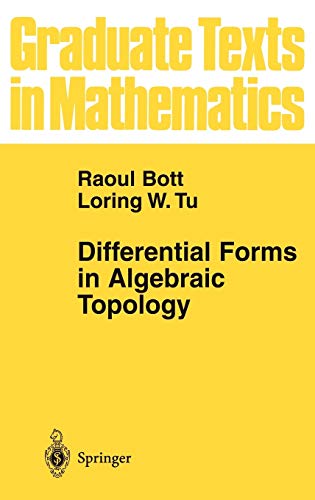
Ebook Info
- Published: 1982
- Number of pages: 352 pages
- Format: PDF
- File Size: 4.17 MB
- Authors: Raoul Bott
Description
Developed from a first-year graduate course in algebraic topology, this text is an informal introduction to some of the main ideas of contemporary homotopy and cohomology theory. The materials are structured around four core areas: de Rham theory, the Cech-de Rham complex, spectral sequences, and characteristic classes. By using the de Rham theory of differential forms as a prototype of cohomology, the machineries of algebraic topology are made easier to assimilate. With its stress on concreteness, motivation, and readability, this book is equally suitable for self-study and as a one-semester course in topology.
User’s Reviews
Editorial Reviews: Review “Bott and Tu give us an introduction to algebraic topology via differential forms, imbued with the spirit of a master who knew differential forms way back when, yet written from a mature point of view which draws together the separate paths traversed by de Rham theory and homotopy theory. Indeed they assume “an audience with prior exposure to algebraic or differential topology”. It would be interesting to use Bott and Tu as the text for a first graduate course in algebraic topology; it would certainly be a wonderful supplement to a standard text. “Bott and Tu write with a consistent point of view and a style which is very readable, flowing smoothly from topic to topic. Moreover, the differential forms and the general homotopy theory are well integrated so that the whole is more than the sum of its parts. “Not intended to be foundational”, the book presents most key ideas, at least in sketch form, from scratch, but does not hesitate to quote as needed, without proof, major results of a technical nature, e.g., Sard’s Theorem, Whitney’s Embedding Theorem and the Morse Lemma on the form of a nondegenerate critical point.”—James D. Stasheff (Bulletin of the American Mathematical Society) “This book is an excellent presentation of algebraic topology via differential forms. The first chapter contains the de Rham theory, with stress on computability. Thus, the Mayer-Vietoris technique plays an important role in the exposition. The force of this technique is demonstrated by the fact that the authors at the end of this chapter arrive at a really comprehensive exposition of Poincaré duality, the Euler and Thom classes and the Thom isomorphism.“The second chapter develops and generalizes the Mayer-Vietoris technique to obtain in a very natural way the Čech-de Rham complex and the Čech cohomology for presheaves. The third chapter on spectral sequences is the most difficult one, but also the richest one by the various applications and digressions into other topics of algebraic topology: singular homology and cohomology with integer coefficients and an important part of homotopy theory, including the Hopf invariant, the Postnikov approximation, the Whitehead tower and Serre’s theorem on the homotopy of spheres. The last chapter is devoted to a brief and comprehensive description of the Chern and Pontryagin classes.“A book which covers such an interesting and important subject deserves some remarks on the style: On the back cover one can read “With its stress on concreteness, motivation, and readability, Differential forms in algebraic topology should be suitable for self-study.” This must not be misunderstood in the ense that it is always easy to read the book. The authors invite the reader to understand algebraic topology by completing himself proofs and examples in the exercises. The reader who seriously follows this invitation really learns a lot of algebraic topology and mathematics in general.” —Hansklaus Rummler (American Mathematical Society)
Reviews from Amazon users which were colected at the time this book was published on the website:
⭐This book is simply the best book on the interface between differential geometry and algebraic topology, although I would venture a guess that this is an opinion shared rather by differential geometers than algebraic topologists. The former probably have a greater need for the latter’s subject than the other way around. I recommend starting with Tu’s wonderful book on manifolds and then going to the present book. It’s a fabulous way to get into this subject.
⭐Nice book
⭐Really good, help me to understand things in a more geometric way.
⭐Starts at the right place and gives good examples.The delivery was excellent.
⭐The authors of this book, through clever examples and in-depth discussion, give the reader a rare accounting of some of the important concepts of algebraic topology. The introduction motivates the subject nicely, and the authors succeed in giving the reader an appreciation of where the concepts of algebraic topology come from, how they do their jobs, and their limitations. The de Rham cohomology, which is the main subject of the book, is explained in here in a way that gives the reader an intuitive and geometric understanding, which is sorely needed, especially for physicists who are interested in applications. As an example, they give a neat argument as to why de Rham cohomology cannot detect torsion. In chapter 1, the authors get down to the task of constructing de Rham cohomology, starting with the de Rham complex on R(n). The de Rham complex is then specialized to the case where only C-infinity functions with compact support are used, giving the de Rham complex with compact supports on R(n). The de Rham complex is then generalized to any differentiable manifold and the de Rham cohomology computed using the Mayer-Vietoris sequence. The discussion gets a little more involved when the authors characterize the cohomology of a fiber bundle. The all-important Thom isomorphism for vector bundles, is treated in detail. The authors give several good examples of the Poincare duals of submanifolds. The connection to ideas in differential topology is readily apparent in this chapter, namely transversality and the degree of a map. In addition, the first construction of a characteristic class, the Euler class, is done in this chapter. The Mayer-Vietoris sequence is generalized to the case of countably many open sets in chapter 2, and shown to be isomorphic to the Cech cohomology for a “good” cover of a manifold. Good examples are given for computing the de Rham cohomology from the combinatorics of a good cover. The authors then characterize Cech cohomology groups in more detail, introducing the important concept of a presheaf. Presheaves are usually introduced abstractly in most books, so it is a real treat to see them described here in such an understandable way. Computations of the case of a sphere bundle are given, and the role of orientability and the Euler class in giving the existence of a global form on the total space is detailed. The Thom isomorphism theorem and Poincare duality are generalized to the cases where the manifold does not have a finite good cover and the vector bundle is not orientable. A very concrete introduction to monodromy is given and nice examples of presheaves that are not constant are given. The authors treat spectral sequences in chapter 4, and as usual with this topic, the level of abstraction can be a stumbling block for the newcomer. The authors though explain that the spectral sequence is nothing other than a generalization of the double complex of differential forms that was considered in chapter 2. The crucial step in the chapter is the transition to cohomology with integer coefficients, which is necessary if one is to study torsion phenomena. The De Rham theory is then extended to singular cohomology and the Mayer-Vietoris sequence studied for singular cochains. The authors show that the singular cohomology of a triangularizable space is isomorphic to its Cech cohomology with the constant presheaf the integers. After a fairly detailed review of homotopy theory (including a discussion of Morse theory) the authors compute the fourth and fifth homotopy groups of S(3). The last section of the chapter discusses the rational homotopy theory of Sullivan as applied to differentiable manifolds. The authors discussion is illuminating, and shows how eliminating any torsion information allows one to prove some interesting results on the homotopy groups of spheres. One such result is Serre’s theorem, the other being the computation of some low-dimensional homotopy groups of the wedge product of S(2) with itself. The last chapter of the book considers the theory of characteristic classes, with Chern classes of complex vector bundles being treated first. The theory of characteristic classes is usually treated formally, and this book is no exception, wherein the authors formulate it using ideas of Grothendieck. They do however give one nice example of the computation of the first Chern class of a tautological bundle over a projective space. The Pontryagin class is defined in terms of a complexification of a real vector bundle and computed for spheres and complex manifolds. A superb discussion is given of the construction of the universal bundle and the representation of any bundle as the pullback map over this bundle.
⭐This is a beautiful book which I have read and re-read with much profit and pleasure over the years. It presents topics in a very unusual order, which minimizes boring technicalities and develops intuition. Everything is very concrete and explicit, with lots of nice pictures and diagrams.The book begins with a clear and concise treatment of deRham cohomology. If one hasn’t seen differential forms before, then it might be a bit too brief and one might need to supplement it. But if one is comfortable with differential forms, then de Rham theory is a setting in which theorems such as Poincare duality can be proved with a minimum of pain. It is also very edifying to see the Poincare dual of a submanifold as a differential form. There is then a natural transition to Cech cohomology and double complexes. With this as a warmup, it is then a small additional step to spectral sequences (although the derived couple approach used here is perhaps not the most elementary possible). This machinery is then used to discuss an assortment of topics in homotopy theory and characteristic classes, which always sticks to the most important points without getting bogged down in technicalities.It is highly unusual that the definition of singular homology only comes after the introduction of spectral sequences! This book might be best appreciated if one has some familiarity with singular homology and wants to better understand its geometric meaning.Despite the avoidance of technicalities, the book is carefully written, although there is the occasional sign error. For example, the sign given for the Lefschetz fixed point theorem is wrong for odd-dimensional manifolds; try it for the circle and you will see. (Several other books make the same mistake.)
⭐Wonderful book. The real theme of this book is to get the reader to some powerful and compelling applications of algebraic topology and comfort with spectral sequences. The use of differential forms avoids the painful and for the beginner unmotivated homological algebra in algebraic topology. E.g., For example, the wedge product of differential forms allow immediate construction of cup products without digression into acyclic models, simplicial sets, or Eilenberg-Zilber theorem. The authors later come back and do the now-motivated version for singular homology later.I really like the idea of using spectral sequences from the beginning. It quickly brings in the actual flavor of algebraic topology by introducing today’s workhorse tool. Also, because spectral sequences take a long time to become second nature (at least they did for me), the earlier the exposure to them the quicker the reader will be able to do more advanced topics comfortably. Again, spectral sequences are introduced in a painless special case, that of a double complex, and more difficult cases are not treated until the reader feels comfortable with basic spectral sequence calculations.Finally, the prerequisites are less than or equal to those for other algebraic topology books, making this a nice choice for a first exposure to algebraic topology.
⭐Very interesting but hard to follow without prior exposition to the concepts
⭐既に古典となった代数トポロジーの名著。著者達のトポロジーに対する見識の深さ、説明の巧みさは既に本の序説から伺うことが出来る。代数トポロジー全般についての見通しを得たいと思っている読者には序説を読むだけでも有意義であろう。第1章ではド・ラーム コホモロジー(微分形式で表されたコホモロジー)を用いてメイヤー・ヴィエトリス系列、ポアンカレ双対性、キュネトの公式、トム形式などの基本を明快に説明する。微分形式をある程度知っていて、代数トポロジーを初めて学ぶ読者は、この章を読了しただけでもトポロジーの基本について最も能率的な仕方で学ぶことが出来るだろう。第2章ではチェック コホモロジーが層の概念を用いて導入され、ド・ラーム コホモロジーとの関係が2重複体を用いて明らかにされる。この2重複体は、第3章で本格的に解説されるスペクトル系列の基礎である。その他、オイラー標数やポアンカレ・ホップの定理などが簡潔に紹介される。第3章では前述のスペクトル系列を縦横に用いて、ファイバー束のコホモロジーや球面ホモトピーの計算の仕方を学ぶ。第4章は特性類についてである。これまでに説明されてきた概念を使って、複素ベクトル束のチャーン類、実ベクトル束のポントリャーギン類等が明解に論じられる。代数トポロジーとは即ち特異ホモロジーの理論のことであると言う先入観をお持ちの方は、もしかしたらこの本から「目から鱗」の体験をなさるかも知れない。また理論物理を専攻する大学院生で、定番のシュティーンロッドの「ファイバー束」を読みかけてはみたがどうも肌に合わないと感じている方、一般位相から厳密な仕方で進んでいかないと代数トポロジーを本当にきちんと理解することは出来無いのではないかと思い込んでいる方、ホモロジー代数の余りにも抽象的な諸概念が具体的にはどの様に位相幾何学の中で用いられるのかを知りたい方などは、是非とも本書を手に取ってみて頂きたい。
⭐
Keywords
Free Download Differential Forms in Algebraic Topology (Graduate Texts in Mathematics, 82) 1st Edition in PDF format
Differential Forms in Algebraic Topology (Graduate Texts in Mathematics, 82) 1st Edition PDF Free Download
Download Differential Forms in Algebraic Topology (Graduate Texts in Mathematics, 82) 1st Edition 1982 PDF Free
Differential Forms in Algebraic Topology (Graduate Texts in Mathematics, 82) 1st Edition 1982 PDF Free Download
Download Differential Forms in Algebraic Topology (Graduate Texts in Mathematics, 82) 1st Edition PDF
Free Download Ebook Differential Forms in Algebraic Topology (Graduate Texts in Mathematics, 82) 1st Edition