

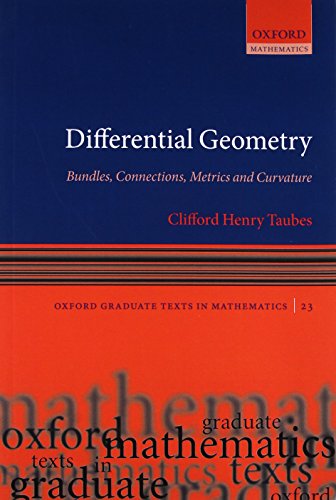
Ebook Info
- Published: 2011
- Number of pages: 312 pages
- Format: PDF
- File Size: 1.51 MB
- Authors: Clifford Henry Taubes
Description
Bundles, connections, metrics and curvature are the ‘lingua franca’ of modern differential geometry and theoretical physics. This book will supply a graduate student in mathematics or theoretical physics with the fundamentals of these objects. Many of the tools used in differential topology are introduced and the basic results about differentiable manifolds, smooth maps, differential forms, vector fields, Lie groups, and Grassmanians are all presented here. Other material covered includes the basic theorems about geodesics and Jacobi fields, the classification theorem for flat connections, the definition of characteristic classes, and also an introduction to complex and Kahler geometry.Differential Geometry uses many of the classical examples from, and applications of, the subjects it covers, in particular those where closed form expressions are available, to bring abstract ideas to life. Helpfully, proofs are offered for almost all assertions throughout. All of the introductory material is presented in full and this is the only such source with the classical examples presented in detail.
User’s Reviews
Editorial Reviews: Review “Taube’s proofs are wonderful, complete and elegant… He is clear and concise, and indeed presents all the material beautifully and in a self contained manner, to the degree possible. … He amplifies everything with generous allusions to other sources so that the reader is easily able to follow up on certain themes with considerable ease.” –MAA Reviews About the Author Clifford Henry Taubes is the William Petschek Professor of Mathematics at Harvard University. He is a member of the National Academy of Sciences and also the American Academy of Sciences. He was awarded the American Mathematical Society’s Oswald Veblen Prize in 1991 for his work in differential geometry and topology. He was also the recipient of the French Academy of Sciences Elie Cartan Prize in 1993, the Clay Research Award in 2008, the National Academy of Sciences’ Mathematics Award in 2008, and the Shaw Prize in Mathematics in 2009.
Reviews from Amazon users which were colected at the time this book was published on the website:
⭐I bought this book for Kindle. The book is badly formatted. For mathematical symbols a square with a question mark appears in the page. Whoever at Oxford Press formatted thsis for Kindle screwed up. There are many equations that have unreadable( you can’t understand) symbols. For a book on DiferrentialGeometry this is unacceptable. I was told that Amazon no longere sells the Kindle version of this book. Maybe when a new fixed version is on the way. By the way, the book can be read on Kindle for PC. Everything is fine under Kindle for PC
⭐Differential geometry is the branch of advanced mathematics that probably has more quality textbooks then just about any other. It has some true classics that everyone agrees should at least be browsed: Spivak’s beautiful,lavishly illustrated and historically informed opus, John M. Lee’s more topologically grounded but equally beautiful “trilogy”,the more advanced tomes of Conlon and Jost,the more recent opuses by Jeffery Lee and Novikov, etc. It seems lately everyone and his cousin is trying to write The Great American Differential Geometry Textbook. It’s really not hard to see why: The subject of differential geometry is not only one of the most beautiful and fascinating applications of calculus and topology,it’s also one of the most powerful.The language of manifolds is the natural language of most aspects of both classical and modern physics- neither general relativity or particle physics can be correctly expressed without the concepts of coordinate charts on differentiable manifolds, Lie groups or fiber bundles. I was really looking forward to the finished text based on Cliff Taubes’ Math 230 lectures for the first year graduate student DG course at Harvard, which he has taught on and off there for a number of years. A book by a recognized master of the subject is to be welcomed, as one can hope they bring their researcher’s perspective to the material. Well,the book’s finally here and I’m sorry to report it’s a bit of a letdown. On the positive side, it’s VERY well written and covers virtually the entire current landscape of modern differential geometry.It has many good and well chosen examples in each section,something I feel is very important.It even covers material on complex manifolds and Hodge theory,which most beginning graduate textbooks avoid because of the technical subtleties of separating the strictly differential-geometric aspects from the algebraic geometric ones. So what’s in here is very good. Unfortunately,there are 3 problems with the book that make it a bit of a disappointment and they all have to do with what’s NOT in the book. The first and most serious problem with Taubes’ book is that it’s not really a textbook at all,it’s a set of lecture notes. It has ZERO exercises.Indeed-the book looks like Oxford University Press just took the final version of Taubes’ online notes and slapped a cover on them. Not that that’s a BAD thing,of course-some of the best sources there are on differential geometry (and advanced mathematics in general) are lecture notes (S.S.Chern and John Milnors’s classic notes come to mind). But for coursework and something you want to pay considerable money for-you really want a bit more then just a printed set of lecture notes someone could have downloaded off the web for free. They’re also a lot harder to use as a textbook since you need to look elsewhere for exercises. I don’t think a corresponding set of exercises FROM THE AUTHOR to test your understanding is really too much to ask for in something you’re spending 30-40 bucks on,is it? I’m sure Taubes has all the problem sets from the various sections of the original course-I’d STRONGLY encourage him to include a substantial set of them in the second edition. The second problem-although this isn’t as serious as the first-is that from a researcher of Taubes’ credentials,you’d expect a little more creativity and insight into what all this good stuff is good for.Ok, granted,this is a beginners’ text and you can’t go too far off the basic playbook or it’s going to be useless as a foundation for later studies. That being said,a closing chapter summarizing the current state of play in differential geometry using all the machinery that had been developed-particularly in the realm of mathematical physics-would help a lot to give the novice a exciting glimpse into the forefront of a major branch of pure and applied mathematics. He does digress sometimes into nice original material that’s usually not touched in such books: The Schwarzchild metric, for instance. But he doesn’t give any indication why it’s important or it’s role in general relativity. Lastly-there’s virtually no pictures in the book. NONE.ZERO.NADA. Ok,granted this is a graduate level text and graduate students really should draw their own pictures.But to me,one of the things that makes differential geometry so fascinating is that it’s such a visual and visceral subject: One gets the feeling in a good classical DG course that if you were clever enough, you could prove just about everything with a picture. Giving a completely formal, non-visual presentation removes a lot of that conceptual excitement and makes it look a lot drier and less interesting then it really is. In that second edition, I’d consider including some visuals. You don’t have to add many if you’re a purist.But a few,particularly in the chapters on characteristic classes and sections of vector and fiber bundles,would clarify these parts immensely. So the final verdict? A very solid source from which to learn DG for the first time at the graduate level,but it’ll need to be supplemented extensively to fill in the shortcomings. Fortunately, each chapter comes with a very good set of references.Good supplementary reading and exercises can easily be selected from these. I would strongly recommend Guillemin and Pollack’s classic as preliminary reading, the “trilogy” by John M.Lee for collateral reading and exercises,the physics-oriented text by Frankel for applications to physics and many good pictures and Wells’ book for complex DG. With all these to compliment Taubes,you’ll be in excellent shape for a year long course.
⭐When I started reading this book I was shocked – first chapter was full of imprecise notation, half-proved statements; it was very hard to learn from the book.But everything changes when you go through the first two chapters and arrive to chapter 3 – the exposition becomes very elaborate and easy to learn from.I believe Clifford Taubes regards first two chapters as known material (basics about manifolds and matrix Lie groups) and that is why these chapters aren’t as good as the rest of the book.Further chapters of the book are about most important differential geometric structures: vector bundles, connections and Riemann geometry. The author workes out lots of examples to the theory he is presenting.All in all, I give only four stars – there still are many mistypes in the text and sadly there are no problem sets for the reader. And on a completely subjective note – i don’t like the typesetting that much. I hope that later editions would significantly improve the book
⭐Has a lot of good sections and filled with interesting examples, which, as Taubes notes, bring the theory to life. There are nevertheless a lot of problems with the book. A lot of typos. There are a lot of missed details in the book, and if you’re not familiar with the material presented, you’re going to have a hard time learning it. In conclusion, the book is good as a reference, but not very pedagogical.
⭐kindle版は買わないようにしましょう。記号が化けて読めません。-が†(ダガー)に化けています。-も†も頻出する記号なので,どちらを指しているのかわかりません。まったく読めたものではありません。kindleでは返品もできません。最悪です。amazonさん,こんないい加減な代物で4,330円もとるのですか?Good!
Keywords
Free Download Differential Geometry: Bundles, Connections, Metrics and Curvature (Oxford Graduate Texts in Mathematics, Vol. 23) 1st Edition in PDF format
Differential Geometry: Bundles, Connections, Metrics and Curvature (Oxford Graduate Texts in Mathematics, Vol. 23) 1st Edition PDF Free Download
Download Differential Geometry: Bundles, Connections, Metrics and Curvature (Oxford Graduate Texts in Mathematics, Vol. 23) 1st Edition 2011 PDF Free
Differential Geometry: Bundles, Connections, Metrics and Curvature (Oxford Graduate Texts in Mathematics, Vol. 23) 1st Edition 2011 PDF Free Download
Download Differential Geometry: Bundles, Connections, Metrics and Curvature (Oxford Graduate Texts in Mathematics, Vol. 23) 1st Edition PDF
Free Download Ebook Differential Geometry: Bundles, Connections, Metrics and Curvature (Oxford Graduate Texts in Mathematics, Vol. 23) 1st Edition