

Ebook Info
- Published: 2010
- Number of pages: 440 pages
- Format: PDF
- File Size: 12.27 MB
- Authors: Stephen T. Lovett
Description
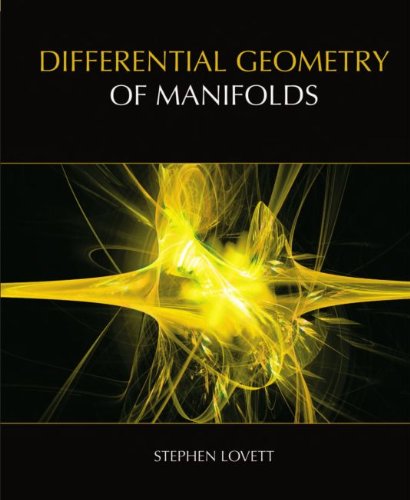
From the coauthor of Differential Geometry of Curves and Surfaces, this companion book presents the extension of differential geometry from curves and surfaces to manifolds in general. It provides a broad introduction to the field of differentiable and Riemannian manifolds, tying together the classical and modern formulations. The three appendices provide background information on point set topology, calculus of variations, and multilinear algebra—topics that may not have been covered in the prerequisite courses of multivariable calculus and linear algebra.Differential Geometry of Manifolds takes a practical approach, containing extensive exercises and focusing on applications of differential geometry in physics, including the Hamiltonian formulation of dynamics (with a view toward symplectic manifolds), the tensorial formulation of electromagnetism, some string theory, and some fundamental concepts in general relativity.
User’s Reviews
Reviews from Amazon users which were colected at the time this book was published on the website:
⭐Lovett provides a nice introduction to the differential geometry of manifolds that is useful for those interested in physics applications, including relativity. It is clearly written, rigorous, concise yet with the exception of the complaints mentioned below, generally reader-friendly and useful for self-study. The difficulty level is midway between O’Neill’s
⭐and Tu’s
⭐.The pace is quite fast. As you can see in more detail from the “search inside this book” function: Ch. 1 Analysis of Multivariable Functions [pp. 1-36] provides some background math; Ch. 2 [pp. 37-78] Coordinates, Frames, and Tensor Notation discusses some more applied topics needed for physics applications; Ch. 3 Differential Manifolds [pp. 79-124] and Ch. 4 Analysis on Manifolds [pp. 125-184] discuss essential standard topics including differential maps; immersions, submersions and submanifolds; vector bundles; differential forms; integration and Stokes’ Theorem; Ch. 5 [pp. 185-248] provides an introduction to Riemannian Geometry, including vector fields, geodesics and the curvature tensor; and finally Ch. 6 [pp. 249-294] provides very brief discussions of some applications to physics including Hamiltonian mechanics, electromagnetism, string theory and general relativity.I like the fact that it includes an exposition of Pseudo-Riemannian metrics in section 5.1.4 and 5.3.3 and in section 6.4, a short introduction to general relativity. It’s the only book I am familiar with that can help one make the leap from very elementary books like O’Neill’s
⭐, Pressley’s
⭐or Banchof and Lovett’s
⭐to graduate level books like Tu’s
⭐, John Lee’s
⭐, Jeffrey Lee’s massive
⭐or for the relativity buffs, O’Neill’s brilliant
⭐, all of which I also recommend after Lovett.Now for the drawbacks: (1) My main gripe is that there are no answers to problems, which detracts from its value for self-study (but to fill that gap, cf.
⭐). This is especially annoying because Lovett refers to answers to some problems in his mathematical exposition, e.g., on p. 234 (section 5.4.1), he refers to problem 5.2.17 on page 217 in his discussion of connections that are not symmetric; moreover answers to some exercises depend on material in other problems, e.g., the answer to problem 5.2.17 refers to problem 5.2.14. This is an all too common practice I dislike because it seriously degrades from a book’s value for self-study. Overall, this is a small part of the book. (2) A Heads up: some of the exposition in Ch 5 Introduction to Riemannian Geometry strikes me as a bit too terse and the demands on one’s stamina and ability to comprehend highly abstract mathematical concepts is highest. One example you can partly check out for yourself with Search Inside is section 5.2 Connections and Covariant Differentiation (cf. pp 204-206). If you’re ok with that, you should be “good to go”. This is too bad as this is chapter is fascinating and the material is required for a modern understanding of relativity. (3) A minor point to be aware of is that the physics applications are extremely terse. To be fair to Lovett he does state in the preface that he does not “supply all the physical theory”. Fair enough.Overall, this textbook is a useful addition to the many books on differential geometry because of its refreshing, “no nonsense” clarity, rigor and conciseness as well as the topics covered. It seems to me suitable for self-study provided you are confident in your math skills, have the required prerequisites and can tolerate the fact that in some places, the development rests on results you are expected to provide without any guidance. Since I read more than one book on a subject as a matter of course, these drawbacks / limitations were not a show-stopper for me but they might be for others.UPDATE 10/29/2011: Lovett perhaps deserves only a *** 1/2 star rating based on the drawbacks I mentioned. I rounded up because I consider *** stars a mediocre evaluation and I do think the book has merit. I’d rely more on my description than the stars.
⭐I was looking for a self-study introductory book on DG and manifolds, to strengthen my basis for General Relativity study, but this book is not what I was looking for.Starting somewhere in Chapter 3 I was not able to follow 100% of the material. The “definition+theorem+proof” methodology might be good for rigorousness, but is terrible as pedagogy, and it is not conducive to building your geometrical intuition. I was looking for a book that explains the motivation behind a given (and usually strange) definition, instead of using the “fallen from the gods of the Olympus” approach.The book relies on the other book by the author more than what I expected.
⭐I really liked the flow of topics and the author’s exposition style. I also loved the background material in the appendices and the clear definitions. This book was used for a course in differential geometry after doing semester of self-study. I found that I could easily go between the notation that I had learned and the notation in this text (a real plus when it comes to this subject.)So you might be wondering if I accidentally clicked the wrong rating above. Sadly the answer to this question is no. Although I enjoy this book in many respects, I cannot recommend it due to the many typos and the occasional false statement. This book has great potential, but it should not have made it to press in its current form.For example page 381: The author says that a bilinear transformation satisfiesf ( v_1 + v_2 , w ) = f ( v_1 ) + f (v_2 , w )This statement does not make sense. Anyone studying the subject would know this, but it is frustrating nevertheless. On the same page the author states that the Cartesian product of V and W is not a vector space. This statement is also false, the obvious counter example would be RxRx…xR = R^n.With all of this being said, if you already know a decent amount of upper level math, you should be able to spot the mistakes. So in the end my suggestion would be to wait for a second edition, but if you have to get this for class, be suspicious… be very suspicious.
⭐Meiner Ansicht nach gibt es bessere Bücher zu dem Thema als das hier Angebotene. Es gibt aber auch noch qualitativ Schlechteres am Markt, daher 3 Sterne (Mittelmaß).I’m not complaining about the content of this book but you will get paperback book instead of hardcover.
⭐Awesome book for first reading in differential geometry and good for self study. It contains a lot many examples.
⭐Best book of Manifolds and Riemannian geometry.
⭐As usual good.Simple language!
Keywords
Free Download Differential Geometry of Manifolds (Textbooks in Mathematics) 1st Edition in PDF format
Differential Geometry of Manifolds (Textbooks in Mathematics) 1st Edition PDF Free Download
Download Differential Geometry of Manifolds (Textbooks in Mathematics) 1st Edition 2010 PDF Free
Differential Geometry of Manifolds (Textbooks in Mathematics) 1st Edition 2010 PDF Free Download
Download Differential Geometry of Manifolds (Textbooks in Mathematics) 1st Edition PDF
Free Download Ebook Differential Geometry of Manifolds (Textbooks in Mathematics) 1st Edition