

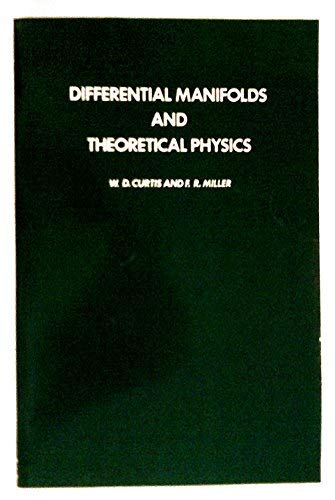
Ebook Info
- Published:
- Number of pages:
- Format: PDF
- File Size: 11.94 MB
- Authors: W. D. Curtis
Description
This work shows how the concepts of manifold theory can be used to describe the physical world. The concepts of modern differential geometry are presented in this comprehensive study of classical mechanics, field theory, and simple quantum effects.
User’s Reviews
Reviews from Amazon users which were colected at the time this book was published on the website:
⭐An interesting tome. Relationships between concepts of theoretical physics and geometrical concepts emphasized.Published 1985, a student had (at that time) limited options for perusal of this material. Examples which spring to mind: Topology and Geometry For Physicists, Nash and Sen (1983) and Gravitation, Gauge Theories and Differential Geometry (Physics Reports) by Eguchi, et. al. (1980). Many such publications followed. From the preface we read of mathematics prerequisites: advanced calculus, linear algebra and point-set topology. The preface fails to note necessary physics background. If you are quite familiar with Lagrangians and Hamiltonians, then you are probably prepared in that physical sense. Now, onward to the review proper:(1) A brief chapter one (five pages) paves the way regarding modeling physical systems via mathematical concepts.(2) The ten-page chapter two takes what you already know about Hamiltonian mechanics and translates it into geometrical language. Differential manifolds appear as topic of the following chapter: All progresses smoothly assuming your multi-variable calculus is up-to-par. At twenty pages, a brisk pace, but espouses essentials.Differential equations on manifolds is the crowning achievement theory-wise, here it serves to cement foundations going forward. Preliminaries dispensed with, then, in the initial sixty pages.(3) If you have followed the text thus far, nothing going forward should cause particular concern. In fact, the book proves more enlightening as the chapters proceed: with exposition of tangent vectors, covectors, tensors, metrics.I rather enjoyed two chapters: eight and nine. Those chapters pertainto tensors and differential forms. Integration,a brief chapter, of some interest. Read: “…integrals should be interpreted as Lebesgue, however, Riemann will suffice.” Chapters 11 through 18, this is where this text hits its stride.Special Relativity given a nice discussion. Electromagnetism is given the differential forms treatment with attention paid to physical dimensions. It is brief, if only because many of the actual computations are deferred to exercises.Rigid body motion will prove to be more difficult. That exposition is (happily) thirty pages in length. A tough topic ! What I find compelling is to take the tools learned in this chapter and using those tools to understand the elementary equations which one learns in an earlier elementary mechanics course. Exercises, here, are mostly proofs of theorems.(4) Next is a ten-page excursion of Lie Groups, it being a prelude to the next chapter of geometrical modeling:here we cross the intersection between physical theory and mathematical structure. Tough going, yet, fascinating. Finally, we reach the final three chapters: highlighting gauge fields (classical and quantum). Suffice it to say that the exposition surrounding quantum effects and probability amplitudes offers interesting perspective. But, too brief.(5) Concluding: The book has merit and overlaps very little with the two publications mentioned previously.This book is probably more mathematical than those two, and yet, suffused with simple physical concepts.Thus, I can recommend the text for collateral enrichment. As a stand-alone text, it is uneven.That is, the short excursion into integration needs further elaboration, as well amplification the quantum aspects.
⭐I discovered this book quite late. It gave me a better understanding of Classical Mechanics. Hence, I recommend it. I have examined its first sixteen chapters, but I concentrated in its treatement of Mechanics, which is presented in a rather clinical but pedagogical way. It starts with a finite number of particles in an open set of euclidean space, subject to no constraint (it’s better to think on one or two particles only, getting rid of too many indices; the trajectory of three particles without constraints is in general very hard to handle, see the solution of the three body problem in Siegel’s book
⭐). The tangent bundle (set of pairs (x,v), where x is position and v is velocity) is used to express Newton’s second order differential equation F=mx” as a first order system x’=v, v’=(1/m)F. Lagrange’s equations are then presented and clearly compared with Newton’s system (of course, they are equivalent). For a conservative field of forces, Newton system is shown to be equivalent to the Hamilton’s equations (which simply say that the trajectory of the system is tangent to the vector field representing the differential dH of the total energy function, with respect to a symplectic bilinear form on the cotangent bundle; in other words: the trajectories of the system are tangent to the symplectic gradient of the total energy H). The Legendre transformation (a simple formal trick to represent velocity vectors as covectors) provides a crystal clear link between Newton’s and Hamilton’s equations. Constraints are presented in the language of manifolds, which is carefully developped by the authors. For systems with a finite number of particles subject to constraints, the formulation of Dynamics require a serious technical effort, accomplished in this book. In chapter 13, the dynamic of rigid bodies is studied with much accuracy, much better than in most classical treatises. Conservation laws are clearly stated. A rather extensive study of differential forms is given to support a modern treatement of Electromagnetism (chapter 12). Lie goups are dealt with before gauge theories (that is to say, principal bundles and Ehresmann connections). There are also chapters on special relativity and quantization. Maybe a new edition could add additional examples and more (much more) exercises. But as it is, this is a great book. It’s a painful task to read any of those uncountable old good books which use no more geometry than the expression “generalized coordinates” to deal with Lagrangian Dynamics. I will cite two, which I found less tough: (a)
⭐; (b)
⭐. On the other hand, there is a growing number of books using differential geometry to explain physics. Among those that I once used, and that compare well with Curtis-Miller’s, I can cite:(1)
⭐; (2)
⭐; (3)
⭐; (4)
⭐; (5)
⭐; (6)
⭐; (7)
⭐.
⭐As an introductory text, I personal think, a reasonable motivation of the subject is the key to success of a book. And that’s exactly why it deserve 5 stars, and my 1st time review.
Keywords
Free Download Differential Manifolds & Theoretical Physics, Volume 116 (Pure and Applied Mathematics) in PDF format
Differential Manifolds & Theoretical Physics, Volume 116 (Pure and Applied Mathematics) PDF Free Download
Download Differential Manifolds & Theoretical Physics, Volume 116 (Pure and Applied Mathematics) PDF Free
Differential Manifolds & Theoretical Physics, Volume 116 (Pure and Applied Mathematics) PDF Free Download
Download Differential Manifolds & Theoretical Physics, Volume 116 (Pure and Applied Mathematics) PDF
Free Download Ebook Differential Manifolds & Theoretical Physics, Volume 116 (Pure and Applied Mathematics)