

Ebook Info
- Published: 2019
- Number of pages: 304 pages
- Format: PDF
- File Size: 3.45 MB
- Authors: Michael Oppenheimer
Description
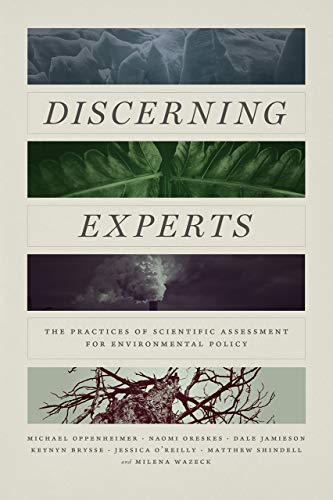
Discerning Experts assesses the assessments that many governments rely on to help guide environmental policy and action. Through their close look at environmental assessments involving acid rain, ozone depletion, and sea level rise, the authors explore how experts deliberate and decide on the scientific facts about problems like climate change. They also seek to understand how the scientists involved make the judgments they do, how the organization and management of assessment activities affects those judgments, and how expertise is identified and constructed. Discerning Experts uncovers factors that can generate systematic bias and error, and recommends how the process can be improved. As the first study of the internal workings of large environmental assessments, this book reveals their strengths and weaknesses, and explains what assessments can—and cannot—be expected to contribute to public policy and the common good.
User’s Reviews
Editorial Reviews: Review “This book provides an essential examination of the factors that shape and dictate our climate policy.” ― Choice”A meticulously researched study . . . . Oppenheimer et al. have produced what is essentially an assessment of assessments, and so its syntheses of insights across the case-study chapters add new knowledge even while they validate old knowledge that had formerly been largely anecdotal for most of us. This volume is therefore essential reading for participants of any large environmental assessment. . . . Discerning Experts is not exactly the ‘first’ comparative study of multiple assessments, but it is an important one because of the extraordinary quality of its documentation and analysis as well as its clever creation of critical and instructive diversity across its three case studies. . . . Natural and physical scientists will see how their work can be transmitted across humanity to help inform opinion about what is going on and perhaps what to do—on the basis of rigorous science. Perhaps, the largest value will be found among the young scholars who do their homework after being invited to participate in their first assessment. After they read this volume, they will understand what to expect and why their signing on is a valuable investment of their time.” ― Climatic Change”What do the ozone layer, the Antarctic ice sheet, and acid rain have in common? All are sites of scientific ‘assessments’: prolonged, focused, collaborative, and often international work of experts. The thousands of pages of reports they draft offer the hope of summarizing scientific findings, extending scientific questions, and recommending policy outcomes. But do the elusive dream of consensus and fear of accusations of political bias produce watered down policy? Or should scientists be bolder in their assessments of impending disasters? Combining the insights of science, policy, and science studies, this valuable book offers a guide for experts of all kinds navigating the always messy world of policy-relevant science.” — Janet Vertesi, Princeton University”This book is a must-read for scientists and leaders of ongoing assessments, because it showcases the dilemma between consolidated knowledge, communicated as consensus, and challenges of uncertainties associated with emerging science.” — Thomas Stocker, University of Bern, Co-Chair of IPCC from 2008 to 2015″This is the first major study of what scientists actually do when they ‘assess’ in an assessment. It makes graphic how the development and assessment of scientific knowledge are interwoven and the vexed production of ‘policy-ready knowledge’ from this. Altogether a rich, original, and thought-provoking work.” — Nancy Cartwright, Durham University”The book is rich with insights about the ways assessments contribute to the agendas of science and policy, often in unintended ways. Reading it can improve the contribution of every scientist thinking of working on an assessment and the value obtained by every policymaker planning to use one.” — Chris Field, Stanford University, co-chair of IPCC WGII, 2008-2015 About the Author Matthew Shindell curates the Smithsonian National Air and Space Museum’s collection of spacecraft, instruments, and other artifacts related to the exploration and study of our Earth and solar system. He co-hosts the Museum’s podcast, AirSpace. A historian of science, he is also the author of The Life and Science of Harold C. Urey and coauthor of Spaceships and Discerning Experts, and coeditor of Smithsonian American Women.
Reviews from Amazon users which were colected at the time this book was published on the website:
⭐This book examines the questions of what assessments are actually for, how effective are they, whether they might be biased and whether they can be trusted. This is done through the lens of close examination of three past assessments, one in the US for acid rain, the ozone assessments and the IPCC with respect to ice sheet collapse. The book comes to some very interesting conclusions regarding assessments such as: (i) They have to have a very clear purpose (ii) The science in assessments is always entangled with policy, regardless of the best efforts of the scientists involved (iii) Assessments are of course not independently refereed in the same way as peer-reviewed papers (iv) Bias creeps into assessments through a number of routes including the bias of the sponsoring / participating agencies, exclusion of experts who have been perceived to have given their public opinion on science matters and finally the desire of scientists to avoid drama by driving towards a single point of view. The book also tackles the interesting balance between the desire for scientific neutrality and the role of scientists as sentinels on matters environmental. Overall this is a very well researched and fascinating book which should be read by any scientist contemplating participation in an assessment, by policy makers either setting up assessments or using them and of course members of civil society who have interests in their outcomes. My only negative criticism is the slightly clumsy writing style in places (how many times did I read the word “epistemological” or variants thereof!) and some issues around proof reading. It is quite alot of money for a relatively slim paperback. Essential reading nonetheless.
⭐
Keywords
Free Download Discerning Experts: The Practices of Scientific Assessment for Environmental Policy in PDF format
Discerning Experts: The Practices of Scientific Assessment for Environmental Policy PDF Free Download
Download Discerning Experts: The Practices of Scientific Assessment for Environmental Policy 2019 PDF Free
Discerning Experts: The Practices of Scientific Assessment for Environmental Policy 2019 PDF Free Download
Download Discerning Experts: The Practices of Scientific Assessment for Environmental Policy PDF
Free Download Ebook Discerning Experts: The Practices of Scientific Assessment for Environmental Policy