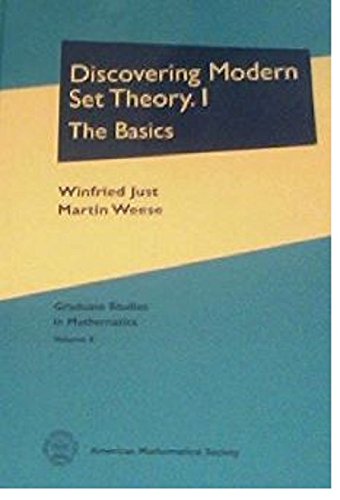
Ebook Info
- Published: 1995
- Number of pages: 210 pages
- Format: PDF
- File Size: 4.32 MB
- Authors: Winfried Just
Description
This book is an introduction to set theory for beginning graduate students who want to get a sound grounding in those aspects of set theory used extensively throughout other areas of mathematics. Topics covered include formal languages and models, the power and limitation of the Axiomatic Method, the Axiom of Choice, including the fascinating Banach-Tarski Paradox, applications of Zorn’s Lemma, ordinal arithmetic, including transfinite induction, and cardinal arithmetic. The style of writing, more a dialogue with the reader than that of the Master indoctrinating the pupil, makes this also very suitable for self-study.
User’s Reviews
Editorial Reviews: Review “These books aim to support first courses in rigorous set theory … are thoroughly competent: well-organized, scrupulous in pointing out both mathematical and philosophical difficulties, carefully graded from relatively straightforward beginnings to demanding conclusions. The more interesting, and more demanding, approach is that of Just and Weese. These books are for those who not only want to learn mathematics, but want to think about mathematics.” — –Bulletin of the London Mathematical Society”Well written and userfriendly.” —- Zentralblatt MATH”Serious graduate students … would profit from reading the book for the mathematical maturity they would gain in the process. The conversational, almost Socratic, style of exposition is well suited to giving students some insight into the process of doing mathematics as well as to the importance of asking the right questions … Just and Weese’s text would be ideally suited for … students who are serious about studying set theory.” —- Journal of Symbolic Logic
Reviews from Amazon users which were colected at the time this book was published on the website:
⭐What to write as a review of this book ? Great plot ? Sure there is. Approachable language ? Certainly you can find it there. Even though the title says ‘Set theory’ you can find very useful stuff there – no matter how advanced you are. Just simply pick it, open up and read. It gives you either a decent way of entering the Set theory or a solid basis once you are at ease with it. What is the biggest disadvantage to me is a little abbreviations while proving some theorems. However the educational value of this book is clearly above my expectations hence I consider it to be worth every single penny it costs.
⭐Set theory presents many unusual challenges to the mathematician who wishes to pursue independent study of the subject at an advanced level. All mathematicians learn enough “naive” set theory to get by in their undergraduate and graduate coursework, and there is no shortage of good introductory texts in that subject. But when one decides to take the next step and study more formal, axiomatic set theory (specifically, Zermelo-Fraenkel set theory with the Axiom of Choice, or ZFC), the situation becomes far more challenging.The primary problem is the difficult, circular relationship between formal mathematical logic and axiomatic set theory. One simply cannot attempt a serious study of ZFC as a formal system without having the requisite background in first-order mathematical logic; but one quickly learns that it is impossible to understand any of the good introductions to mathematical logic without having a considerable background in not-so-naive set theory! Set theory serves a perplexing dual role as (1) an example of a formal axiomatic system of considerable interest in its own right, and (2) the source of all the formal models than one builds in mathematical logic to show that various axiomatic systems are consistent. The often-made claim that all or nearly all of mathematics can be “embedded” in ZFC indicates to the student that this particular formal system has a very privileged role; it can be extremely difficult to understand precisely how this “embedding” is to unfold, and how one can use one axiomatic system (ZFC) to produce models for other axiom systems, thereby demonstrating their consistency.Just and Weese have produced two remarkable and very unusual books on set theory, and they do a much better job than any of their competitors at helping the mathematically mature reader break into this difficult closed loop. They state in the preface that the books were written at least in part for the graduate student or professional mathematician who wishes to study alone; the format suggests a series of lectures and discussions in print, rather than the dry “Lemma-proof-theorem-proof” format one often sees in graduate-level mathematics books. The books are not “chatty,” but they provide far more inspiration, explanation and motivation than one might expect. The books also contains a wealth of discussions of philosophical fine points, historical issues, and identification of common fallacies. There is even a very good chapter on formal languages and models, but the student who has not had an introduction to mathematical logic (say at the level of Enderton) will find this tough going.To balance the preceding remarks, I should emphasize that the books are not merely introductory in nature. Volume II in the series introduces the reader to some very serious research topics in modern set theory, including Martin’s axiom, stationary ideals, measurable cardinals, and the interactions between game theory and set theory.A reader who desires to study set theory at the highest level, perhaps specializing in the subject, will eventually want to look at the definitive work by Thomas Jech. But even for these students, their understanding of Jech’s book will be significantly enhanced by a preliminary reading of Volume I of Just and Weese. And for those who merely want a reasonably serious introduction to set theory, along with a discussion of the larger role of ZFC in mathematical logic, Just and Weese’s two books represent an excellent first source.
Keywords
Free Download Discovering Modern Set Theory. I: The Basics (Graduate Studies in Mathematics, Vol 8) (Pt.1) in PDF format
Discovering Modern Set Theory. I: The Basics (Graduate Studies in Mathematics, Vol 8) (Pt.1) PDF Free Download
Download Discovering Modern Set Theory. I: The Basics (Graduate Studies in Mathematics, Vol 8) (Pt.1) 1995 PDF Free
Discovering Modern Set Theory. I: The Basics (Graduate Studies in Mathematics, Vol 8) (Pt.1) 1995 PDF Free Download
Download Discovering Modern Set Theory. I: The Basics (Graduate Studies in Mathematics, Vol 8) (Pt.1) PDF
Free Download Ebook Discovering Modern Set Theory. I: The Basics (Graduate Studies in Mathematics, Vol 8) (Pt.1)