

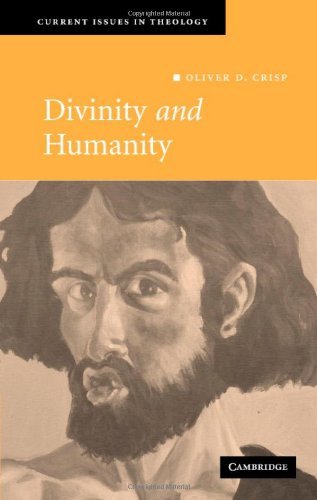
Ebook Info
- Published: 2007
- Number of pages: 202 pages
- Format: PDF
- File Size: 1.53 MB
- Authors: Oliver D. Crisp
Description
The doctrine of the Incarnation lies at the heart of Christianity. But the idea that ‘God was in Christ’ has become a much-debated topic in modern theology. Oliver Crisp addresses six key issues in the Incarnation defending a robust version of the doctrine, in keeping with classical Christology. He explores perichoresis, or interpenetration, with reference to both the Incarnation and Trinity. Over two chapters Crisp deals with the human nature of Christ and then provides an argument against the view, common amongst some contemporary theologians, that Christ had a fallen human nature. He considers the notion of divine kenosis or self-emptying, and discusses non-Incarnational Christology, focusing on the work of John Hick. This view denies Christ is God Incarnate, regarding him as primarily a moral exemplar to be imitated. Crisp rejects this alternative account of the nature of Christology.
User’s Reviews
Reviews from Amazon users which were colected at the time this book was published on the website:
⭐Just how important is orthodoxy for the doctrine of the incarnation for Christian theology? Well, according to Dr. Oliver Crisp, the answer is very much so.In the past century, the incarnation has been distorted and dismissed as either contradictory or paradox. Unwittingly, much of these debates are rehashings of earlier heresies, specifically Apollinarianism (“God in a bod”) and Nestorianism (“Two persons in one body”). So, in six successive essays, Crisp defends and draws from a ‘broadly’ Chalcedonian Christology [sic]. Lucid and accessible (with a handful of Superman references), Crisp, in the first half, clarifies the perichoretic problem with the hypostatic union, sifts through various proposals of Christ’s human nature, and untangles the anhypostasia-enhypostasia distinction. In the second half, Crisp rides on the momentum of the first half to engage and disarm theological claims of Christ assuming a fallen human nature, divine kenosis, and John Hick’s non-incarnational theology.The reader might be tempted to think that theologians, like Crisp, and their theologies are ‘mere word plays.’ For example, what’s the difference between the incarnation as paradox or mystery? Or God taking on a human body vs. God taking on a human nature? These questions and more are, indeed, tempting to lure one to dismiss the enterprise as a whole. But, allow Crisp to help you to wade through the fog, and, (hopefully) in the process, you’ll see and understand that words–especially words about God–matter very much so.cf. sooholee.wordpress
⭐Crisp explicates and promotes a Chalcedonian Christology in the first half of the book while defending this view against three attacks on this classical stance in the second half specifically: a proposition that Christ had a fallen human nature, modern kenosis theories, and a non-incarnational Christology.Crisp’s explanation of “nature-perichoresis,” which attempts to define the relationship between Christ’s divine and human natures in hypostatic union (chapter one), sets up his own “divine krypsis” in the chapter regarding kenosis. Kenosis is a doctrine in which the Word either divests Himself completely of (at least) omnipotence, omniscience, and omnipresence during the Incarnation; or, alternatively, the Word voluntarily limits the exercise of these traits while still possessing them. The ‘strong’ (ontological) view of kenosis is identified as being “serious and debilitating” while the ‘weak’ (functionalist) view is termed “not conventional” (specifically, the belief that it was the Holy Spirit who performed all Jesus Christ’s miracles [p 25]).His “divine krypsis” [pp 147-153] is defined as non-kenotic (not ontological or functionalist) since the Logos is not limited in any way. This works in virtue of the perichoretic relationship of the divine nature to the human in hypostatic union while restricting any transference of essences or properties. While the person of Jesus Christ is obviously limited in physical location, the Logos remains omnipresent (and omnipotent as well as omniscient) in sustaining the cosmos extra carnem – outside the body – via the so-called extra calvinisticum. The limitation on the person of Jesus Christ is only qua human. This is somewhat analogous to the way in which the Holy Spirit works in and through Christians [pp 25-27]; however, there are times that the Incarnate Christ is clearly using His inherent divine nature [e.g. Mark 4:35-41; John 5:21-24 (granting eternal life, cf. Luke 23:43)] even though there are others in which it can be argued He relied on the Spirit instead.The author handily defends Chalcedonian Christology in his refutation of John Hick’s doctrine of the Incarnation as identified in the titles of two of his books, “The Myth of God Incarnate” and its follow-up “The Metaphor of God Incarnate” in which Hick proffers his doctrine of a non-divine Christ (who is instead metaphorically ‘incarnate’ as God being that He was merely in “right relationship” with the Father instead of actually being deity Himself) in his quest for religious pluralism. Crisp illustrates that Hick’s view has difficulty being termed “Christian” (in the historically orthodox sense) since a non-Christian would have no trouble affirming Hick’s doctrine of Incarnation as metaphor.Not being a theology student myself, i.e., having had no formal schooling, the book was a bit challenging requiring me to really study bits of it and to learn new terms in the process; however, I did not find the book a particularly difficult read. Well done, I say.
⭐The “Current Issues in Theology” series is excellent, and this addition to the series is no different. Oliver Crisp is part of a growing movement of analytic theologians who are seeking to clearly define and defend many of the traditional Orthodox understandings of Christian doctrine. In this volume Crisp sets out to clearly define Chalcedonian Christology and then defend it from 3 current threats. The first threat is the notion that Christ had a fallen human nature. The second is a divine kenosis view where God the Son emptied Himself of His divinity in order to become human. Finally, the third threat is a non-Incarnational Christology where Christ is not the Son of God. Perhaps the Incarnation is beautiful metaphor (John Hick)that is meant to inspire us.Personally, I found Crisp’s defense against the last two threats to be quite solid and philosophically astute. I am not entirely sure if I accept his defense against the first threat, nor am I sure that it is in fact a threat to Christology. Here is why. The classical understanding of the doctrine of original sin entailed the doctrine of original guilt. As such the traditional articulation of the Incarnation was that Christ was born without original sin which entails a lack of original guilt. Recent discussions in philosophical theology have denied that humans are born with original guilt. One could go on to argue that Christ qua human was born with original sin, born corrupted, but remained sinless His entire life because a corrupted nature does not necessitate sinful behavior. Crisp is willing to concede that this is a possible way to articulate a robust Christology (p108-9), but goes on to argue that this account would still suffer from other difficulties. I will not mention what those are because this review is long enough.After reading this I look forward to Crisp’s forthcoming works on the Incarnation and previous work on the metaphysics of sin.
Keywords
Free Download Divinity and Humanity: The Incarnation Reconsidered (Current Issues in Theology Book 5) 1st Edition in PDF format
Divinity and Humanity: The Incarnation Reconsidered (Current Issues in Theology Book 5) 1st Edition PDF Free Download
Download Divinity and Humanity: The Incarnation Reconsidered (Current Issues in Theology Book 5) 1st Edition 2007 PDF Free
Divinity and Humanity: The Incarnation Reconsidered (Current Issues in Theology Book 5) 1st Edition 2007 PDF Free Download
Download Divinity and Humanity: The Incarnation Reconsidered (Current Issues in Theology Book 5) 1st Edition PDF
Free Download Ebook Divinity and Humanity: The Incarnation Reconsidered (Current Issues in Theology Book 5) 1st Edition