

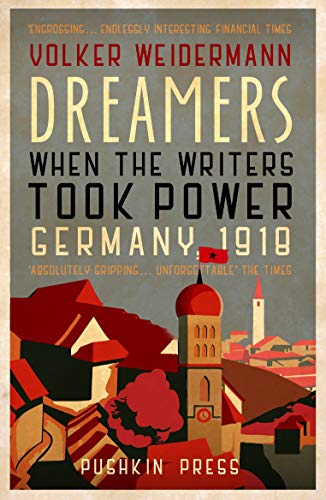
Ebook Info
- Published: 2018
- Number of pages: 203 pages
- Format: PDF
- File Size: 1.33 MB
- Authors: Volker Weidermann
Description
History that reads like a novel: the story of the writers and intellectuals behind the failed Bavarian Revolution of 1918, by the author of the acclaimed Summer Before the DarkThe bloody war has lasted more than four years. They aren’t just going to let it burn out… Something bright and new has to—has to—come out of the darkness.Munich, November 1918: in the final days of the First World War, revolutionaries open the doors of military prisons, occupy official buildings and overthrow the monarchy. At the head of the newly declared Free State of Bavaria is journalist and theatre critic Kurt Eisner, and around him rally luminaries of German cultural history: Thomas Mann, Ernst Toller and Rainer Maria Rilke.Yet the dream cannot last: in February 1919, Eisner is assassinated and the revolution fails. But while it survived, it was the writers, the poets. the playwrights and the intellectuals who led the way, imagining new ways of shaping the world.In his characteristically vivid, sharp prose, Volker Weidermann hones in on a short moment in history, revealing an extraordinary flourishing of revolutionary potential that could have altered the course of the twentieth century.The award-winning writer and literary critic Volker Weidermann was born in Germany in 1969, and studied political science and German language and literature in Heidelberg and Berlin. He is the cultural editor of the Der Spiegel, and the author of Summer Before the Dark, which is also published by Pushkin Press.
User’s Reviews
Reviews from Amazon users which were colected at the time this book was published on the website:
⭐WARNING: THE NARRATIVE OF THE BAVARIAN REVOLUTIONS WHICH FOLLOWS IS, AS SUCH, A SPOILER; BUT IT CANNOT CONVEY THE FLAVOUR OF THE BOOK.This book conveys the facts, personalities and the atmosphere of the short-lived Bavarian Republic, 1918 to 1919. There is no background chapter, and no setting of the story against the wider background of the immediate post-war government in Berlin. In that respect, the book is inferior to the relevant parts of Robert M. Watts’ “The Kings Depart” (which also disagrees on some minor points with Weidermann’s account.)The book begins with the revolution in Munich on 7th November 1918, which, without bloodshed, overthrew the existing government and made the Jewish Kurt Eisner of the anti-war Independent Socialist Party (the USPD) Prime Minister. We are introduced, in a whirlwind and in the historic present tense, to a host of revolutionaries, many of them journalists, poets, literary critics, illustrators, dramatists – most of whom are little known. Councils (Räte) on the Soviet model were set up, coexisting with the Landtag.Then the book takes us away from the new government for a while and gives has more or less extensive passages about Rainer Maria Rilke (cautiously sympathetic to the revolution), of the Olympian Thomas Mann (a very hostile portrait), of his son Klaus Mann, and of Adolf Hitler. Since these only comment on, but play no active role in the history of the Bavarian republic, I cannot see the point of these digressions, and these and similar ones (about Oswald Spengler, Hermann Hesse, Rudolf Hess) will recur again later in the book.We return to the revolutionary government. Eisner was a real idealist, believed in non-violence, moral education, in the value of the arts to shape a new humanity, in as much cooperation as possible with other parties, especially on the left, and in reconciliation with Germany’s enemies, in admitting Germany’s war guilt. But the euphoria of the first few days rapidly evaporated. By the end of a fortnight he was assailed from all sides: from the left – the Social Democrats (SPD), the Communists, and the newly-founded Spartacists – for not being radical enough; and on the right, he was hated by conservatives, nationalists and the anti-Semites. The countryside was indifferent to him. The Allies did not take him seriously. Only at an international socialist gathering in Basel was he acclaimed. He was forced into an early election of the Landtag – and his USPD scored a derisory 2.5% and won just three seats out of 180. And as Eisner went to the Landtag to deliver his resignation speech, he was assassinated, just 15 weeks after he had become Prime Minister.The radical left demonstrated en masse against the murder, and made it unsafe for the deputies of the Landtag, most of whom fled Munich and set up an SPD government under Johannes Hoffman in Bamberg, while the Councils had a rival government in Munich and proclaimed a Soviet Republic. For six days, from April 5th to 12th, 1919, it was headed by the Jewish playwright Ernst Toller of the USPD. The farcical proceedings of setting up this government, with some grotesque appointments, especially to Foreign Affairs, to Finance and to Education, are very well described. All kinds of cranks flooded into Munich. During his six days in office, Toller issued a stream of socialist decrees. But because his government was committed to non-violence, the communists refused his requests to join it. The communists were now led by a trio of Jews who were also half-Russian: Eugen Leviné, Max Levien and Towia Axelrod (the last of these three is not mentioned in the book.) On 9th April 1919, they proclaimed a new government; they arrested Toller; Toller was rescued by troops; on the 12th April a few of Toller’s troops went over to Hoffman’s government in Bamberg and overthrew the government; an uprising by the communists against these putschists succeeded, and they formed a new hard-line revolutionary government, prepared to use violence. Curiously, they allowed Toller, because of his popularity, to join it. Toller, who had begged them to join his government, agreed.Now Hoffman appealed to Berlin for help, and the Weimar Defence Minister, Gustav Noske, readily consented, and sent some 45,000 troops and members of the Freikorps against the perhaps 15,000 strong Red Army which backed the new government. The pacific Toller found himself in command of the temporarily successful counter-offensive, but refused to have captured officers executed. But on 29th April the government executed a number of Whites.On 1st May, the White Army and the Freikorps entered Munich. The revolution was over. The executions of 29th April became the pretext if one were needed – for the orgy of killings which followed. (Estimates vary between 600 and 1,000). Denunciations of the Reds abound. Hitler, who had served in the Republic’s army as a battalion representative, now saved his skin by becoming an informer against his comrades. It is at this point that he embraces anti-communism and open anti-Semitism.Leviné was shot. (Weidermann does not tell us that Levien and Axelrod were imprisoned, but survived.) Toller was captured, but was saved from execution because Thomas Mann, bravely and unexpectedly in view of what has been said about him before, spoke up for him, and he went to prison for five years. He was exiled by the Nazis and hanged himself in New York in May 1939.
⭐I received an electronic copy of this book via NetGalley in exchange for an honest review.This is an interesting book of German pop history in English translation, looking at a fairly brief revolutionary interlude in Munich’s history in 1918/1919. It’s easy to forget, especially from an American perspective, how many changes in power and short-lived revolutions occurred in the immediate aftermath of the First World War, and this one is perhaps especially eclipsed by subsequent history. The book provides an easy-to-read account, and in addition to discussing the roles of the writers and other intellectuals who were directly involved, touches on the responses of various prominent figures of the German literary world.The book’s very conversational style makes it a rather quick read, though the blending of past and present tense makes for a somewhat odd reading experience (in my opinion, anyway). I don’t know whether this is the result of the translation, the source material, or both. The book’s content seems fairly clearly intended for a non-specialist German audience, which presents a little bit of a question on who exactly the intended audience is for the translation–a niche subject for a general pop history-reading audience (though there seems to be above-average interest in interwar Germany at the moment), but treated in a form clearly not intended for a more academic one.
⭐WARNING: THE NARRATIVE OF THE BAVARIAN REVOLUTIONS WHICH FOLLOWS IS, AS SUCH, A SPOILER; BUT IT CANNOT CONVEY THE FLAVOUR OF THE BOOK.This book conveys the facts, the personalities and the atmosphere of the short-lived Bavarian Republic, 1918 to 1919. There is no background chapter, and no setting of the story against the wider background of the immediate post-war government in Berlin. In that respect, the book is inferior to the relevant parts of Robert M. Watts’ “The Kings Depart” (which also disagrees on some minor points with Weidermann’s account.)The book begins with the revolution in Munich on 7th November 1918, which, without bloodshed, overthrew the existing government and made the Jewish Kurt Eisner of the anti-war Independent Socialist Party (the USPD) Prime Minister. We are introduced, in a whirlwind and in the historic present tense, to a host of revolutionaries, many of them journalists, poets, literary critics, illustrators, dramatists – most of whom are little known. Councils (Räte) on the Soviet model were set up, coexisting with the Landtag.Then the book takes us away from the new government for a while and gives has more or less extensive passages about Rainer Maria Rilke (cautiously sympathetic to the revolution), of the Olympian Thomas Mann (a very hostile portrait), of his son Klaus Mann, and of Adolf Hitler. Since these only comment on, but play no active role in the history of the Bavarian republic, I cannot see the point of these digressions, and these and similar ones (about Oswald Spengler, Hermann Hesse, Rudolf Hess) will recur again later in the book.We return to the revolutionary government. Eisner was a real idealist, believed in non-violence, moral education, in the value of the arts to shape a new humanity, in as much cooperation as possible with other parties, especially on the left, and in reconciliation with Germany’s enemies, in admitting Germany’s war guilt. But the euphoria of the first few days rapidly evaporated. By the end of a fortnight he was assailed from all sides: from the left – the Social Democrats (SPD), the Communists, and the newly-founded Spartacists – for not being radical enough; and on the right, he was hated by conservatives, nationalists and the anti-Semites. The countryside was indifferent to him. The Allies did not take him seriously. Only at an international socialist gathering in Basel was he acclaimed. He was forced into an early election of the Landtag – and his USPD scored a derisory 2.5% and won just three seats out of 180. And as Eisner went to the Landtag to deliver his resignation speech, he was assassinated, just 15 weeks after he had become Prime Minister.The radical left demonstrated en masse against the murder, and made it unsafe for the deputies of the Landtag, most of whom fled Munich and set up an SPD government under Johannes Hoffman in Bamberg, while the Councils had a rival government in Munich and proclaimed a Soviet Republic. For six days, from April 5th to 12th, 1919, it was headed by the Jewish playwright Ernst Toller of the USPD. The farcical proceedings of setting up this government, with some grotesque appointments, especially to Foreign Affairs, to Finance and to Education, are very well described. All kinds of cranks flooded into Munich. During his six days in office, Toller issued a stream of socialist decrees. But because his government was committed to non-violence, the communists refused his requests to join it. The communists were now led by a trio of Jews who were also half-Russian: Eugen Leviné, Max Levien and Towia Axelrod (the last of these three is not mentioned in the book.) On 9th April 1919, they proclaimed a new government; they arrested Toller; Toller was rescued by troops; on the 12th April a few of Toller’s troops went over to Hoffman’s government in Bamberg and overthrew the government; an uprising by the communists against these putschists succeeded, and they formed a new hard-line revolutionary government, prepared to use violence. Curiously, they allowed Toller, because of his popularity, to join it. Toller, who had begged them to join his government, agreed.Now Hoffman appealed to Berlin for help, and the Weimar Defence Minister, Gustav Noske, readily consented, and sent some 45,000 troops and members of the Freikorps against the perhaps 15,000 strong Red Army which backed the new government. The pacific Toller found himself in command of the temporarily successful counter-offensive, but refused to have captured officers executed. But on 29th April the government executed a number of Whites.On 1st May, the White Army and the Freikorps entered Munich. The revolution was over. The executions of 29th April became the pretext if one were needed – for the orgy of killings which followed. (Estimates vary between 600 and 1,000). Denunciations of the Reds abound. Hitler, who had served in the Republic’s army as a battalion representative, now saved his skin by becoming an informer against his comrades. It is at this point that he embraces anti-communism and open anti-Semitism.Leviné was shot. (Weidermann does not tell us that Levien and Axelrod were imprisoned, but survived.) Toller was captured, but was saved from execution because Thomas Mann, bravely and unexpectedly in view of what has been said about him before, spoke up for him, and he went to prison for five years. He was exiled by the Nazis and hanged himself in New York in May 1939.
⭐a fascinating insight into the weimar republic
⭐A present
⭐very entertaining. if you have spare time to read
Keywords
Free Download Dreamers: When the Writers Took Power, Germany 1918 in PDF format
Dreamers: When the Writers Took Power, Germany 1918 PDF Free Download
Download Dreamers: When the Writers Took Power, Germany 1918 2018 PDF Free
Dreamers: When the Writers Took Power, Germany 1918 2018 PDF Free Download
Download Dreamers: When the Writers Took Power, Germany 1918 PDF
Free Download Ebook Dreamers: When the Writers Took Power, Germany 1918