

Ebook Info
- Published: 2000
- Number of pages: 440 pages
- Format: PDF
- File Size: 14.18 MB
- Authors: HSIN-I Chang
Description
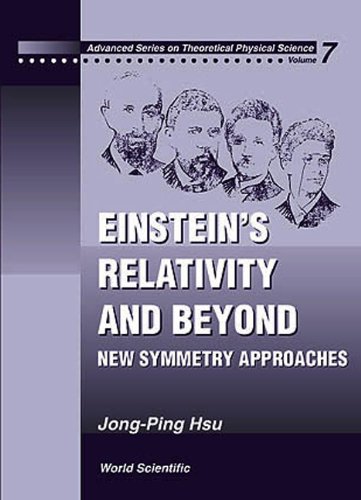
The purposes of this book are (1) to explore and expound relativity physics and four-dimensional symmetry from the logically simplest viewpoint by making one single postulate instead of two; and (2) to indicate the simplest generalization of the Lorentz transformation in order to cope with frames with constant linear accelerations. The fundamentally new ideas of the first purpose are developed on the basis of the term paper of a Harvard physics undergraduate. They lead to an unexpected affirmative answer to the long-standing question of whether it is possible to construct a relativity theory without postulating the constancy of the speed of light and retaining only the first postulate of special relativity. This question was discussed in the early years following the discovery of special relativity by many physicists, including Ritz, Tolman, Kunz, Comstock and Pauli, all of whom obtained negative answers. Furthermore, the new theory of relativity indicates the truly universal and fundamental constants in physics, and provides a broad view of relativistic physics beyond special relativity. It substantiates the view and sheds light on the understanding that the four-dimensional symmetry framework can accommodate many different concepts of physical time, including common time and Reichenbach’s general concept of time. This logically simplest viewpoint of relativity allows a natural extension of the physics of particles and fields from inertial frames to noninertial frames in which the speed of light is not constant. New predictions in physics resulting from this new viewpoint are discussed. The book is based on papers by the author and his collaborators in Physics Letters A, Nuovo Cimento B, and Physical Review A and D.
User’s Reviews
Reviews from Amazon users which were colected at the time this book was published on the website:
⭐After Yuan Zhong Zhangs’ book Special Relativity and its experimental foundations another book on Special Relativity has been recently published in World Scientific’s Advanced Series on Theoretical Physical Science: Jong-Ping Hsu’s book Einstein’s Relativity and Beyond – New Symmetry Approaches shows, that the theoretical research concerning Einstein’s theory of Special Relativity is by far not finished. The book is based on papers by the author and his collaborators in Physics Letters A, Nuovo Cimento B, and Physical Review A and D.The first part of the book gives a brief review of the historical development of Special Relativity by Voigt, Lorentz, Einstein, Poincaré and others. It is interesting to note that Hsu attaches importance to the work of the almost unknown German physicist Woldemar Voigt, who appears to be the first physicist to conceive the idea of the universal speed of light and who was very close to suggest a conceptual framework for Special Relativity, when he derived around 1887 a type of 4-dimensional space-time transformation which was very similar to the Lorentz transformation.In second part of the book the theory of Special Relativity is extended to a more general theory with four-dimensional symmetry, which is based solely on the first postulate of relativity. Hsu’s main objective is to make clear that “any specific system of time such as relativistic time and the universal speed of light are not physical entities inherent in nature but human conventions imposed upon it. However, the four-dimensional symmetry appears to be inherent and truly fundamental in nature” (Phys. Lett. A 196, 1994). It might be a surprising fact for many physicists that relativistic time, or any particular time system, is apparently not a necessary ingredient of a theory for it to to be consistent with all experiments.Hsu’s theory is shown to have new implications for modern physics which differ from those found in Special Relativity: A very interesting special case called `Common Relativity’ is considered which is based on the postulate of a a common time instead of a constant speed of light within the four-dimensional symmetry framework. Common Relativity leads to a simplification of the maze of many coupled Liouville equations presented by Special Relativity and makes it possible to derive an invariant Planck distribution. This implies the impossibility of detecting an `absolute’ motion of the earth with respect to the cosmic microwave background radiation.The third part of the book is about generalized Lorentz transformations for constant-linear-acceleration frames based on the principle of limiting four-dimensional symmetry. Two types of transformations are considered: The generalized Møller-Wu-Lee transformations (which are based on earlier, not completely satisfactory approaches to derive transformations for non-inertial frames by Møller, Wu and Lee) and the so-called Wu transformations for accelerated frames. Implications for electrodynamics and quantum field theory are discussed, like the dynamics of classical and quantum particles and the quantisation of scalar, spinor and electromagnetic fields in non-inertial frames. Experimental tests of these transformations are also proposed, e.g. a measurement of the so-called Wu-Doppler effect which differs from the usual Doppler effect in Special Relativity and could be measured by precision experiments.One point which I would like to critisize is the fact, that there are special topics covered, of which some are not related to the main topics mentioned above. One of these topics is, for instance, a discussion of a De Sitter and Poincaré gauge-invariant fermion Lagrangian. However, this does not imply that most of them will not be interesting to the reader: For example, one part of a chapter is dedicated to the the invariance group of the Maxwell equations, of which the relevance is not yet clear, as Steven Weinberg commented in his well known book on quantum field theory; furthermore, the question is considered whether the Michelson-Morley experiment really implies a constant and isotropic speed of light; transformations from inertial into rotational frames based on the principle of limiting four-dimensional symmetry are derived in another chapter. At last, the appendix contains calculations concerning Noether’s theorem and quantum electrodynamics in linearly accelerated frames. Other special topics, like a proposed experimental test for the twin paradox, are also treated in the appendix.Nowadays Special Relativity has become a cornerstone of all modern physical theories which have been invented in the 20th century. Hsu’s book shows many new aspects of Einstein’s theory which are not taught in lectures or by any other books on this subject. Hsu’s work shows once again that it is worthwhile not to accept the principles of physical theories uncritically, especially those which have been introduced by people who are regarded as authorities in a field of research. His understanding and appreciation of the Special Theory of Relativity make, in my opinion, the book worth reading for every physicist who is interested in Special Relativity.Andreas ErnstUniversity of HeidelbergHeidelberg, Germany
⭐
Keywords
Free Download Einstein’s Relativity and Beyond: New Symmetry Approaches (Advanced Theoretical Physical Science) in PDF format
Einstein’s Relativity and Beyond: New Symmetry Approaches (Advanced Theoretical Physical Science) PDF Free Download
Download Einstein’s Relativity and Beyond: New Symmetry Approaches (Advanced Theoretical Physical Science) 2000 PDF Free
Einstein’s Relativity and Beyond: New Symmetry Approaches (Advanced Theoretical Physical Science) 2000 PDF Free Download
Download Einstein’s Relativity and Beyond: New Symmetry Approaches (Advanced Theoretical Physical Science) PDF
Free Download Ebook Einstein’s Relativity and Beyond: New Symmetry Approaches (Advanced Theoretical Physical Science)