Ebook Info
- Published: 2019
- Number of pages: 352 pages
- Format: PDF
- File Size: 8.79 MB
- Authors: Lee Smolin
Description
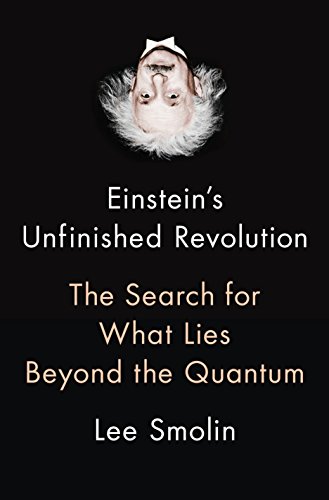
A daring new vision of quantum theory from one of the leading minds of contemporary physicsQuantum physics is the golden child of modern science. It is the basis of our understanding of atoms, radiation, and so much else, from elementary particles and basic forces to the behavior of materials. But for a century it has also been the problem child of science: it has been plagued by intense disagreements between its inventors, strange paradoxes, and implications that seem like the stuff of fantasy. Whether it’s Schrödinger’s cat–a creature that is simultaneously dead and alive–or a belief that the world does not exist independently of our observations of it, quantum theory challenges our fundamental assumptions about reality. In Einstein’s Unfinished Revolution, theoretical physicist Lee Smolin provocatively argues that the problems which have bedeviled quantum physics since its inception are unsolved and unsolvable, for the simple reason that the theory is incomplete. There is more to quantum physics, waiting to be discovered. Our task–if we are to have simple answers to our simple questions about the universe we live in–must be to go beyond quantum mechanics to a description of the world on an atomic scale that makes sense. In this vibrant and accessible book, Smolin takes us on a journey through the basics of quantum physics, introducing the stories of the experiments and figures that have transformed our understanding of the universe, before wrestling with the puzzles and conundrums that the quantum world presents. Along the way, he illuminates the existing theories that might solve these problems, guiding us towards a vision of the quantum that embraces common sense realism. If we are to have any hope of completing the revolution that Einstein began nearly a century ago, we must go beyond quantum mechanics to find a theory that will give us a complete description of nature. In Einstein’s Unfinished Revolution, Lee Smolin brings us a step closer to resolving one of the greatest scientific controversies of our age.
User’s Reviews
Editorial Reviews: Review “[A] compelling narrative about the development of different strands of quantum physics.” — Financial Times“Smolin is an extremely creative thinker who has been a leader in theoretical physics for many years. He is also a gifted writer who manages to translate his own insights about how science works into engaging language and compelling stories . . . Smolin’s description of how quantum mechanics works is both elegant and accessible.” —NPR“[A]mbitious . . .upbeat and, finally, optimistic . . . Smolin is a lucid expositor.”— Nature“As the latest entry into the conversation, Smolin’s book feels the most immediate and personal. Here is no detached narrator, but an active participant in the fray who perceives the debate over the nature of reality in personal terms. . . While the way forward remains elusive, Smolin and others who seek to illuminate how physics got to where it is today are at least making the quest for answers a bit less costly.” —The Globe and Mail (Toronto) “Well-written and engaging.” —Sabine Hossenfelder, Backreaction “Smolin offers a masterful exposition on the state of quantum physics, smoothly blending a history of the field with clear explanations, philosophical context and an accessible introduction to fresh ideas. His narrative on how two competing perspectives on quantum behaviour hardened into Bohr’s counter-intuitive orthodoxy, is spellbinding.” —Financial Times (UK)”Smolin is never less than an inventive and provocative thinker, as well as an engaging writer….his explanations are especially lucid.” —Philip Ball, Physics World”A tantalizing glimpse of the theoretical possibilities beyond Einstein’s grasp.” —Booklist, starred review“The best explanation yet of what has yet to be explained.” —George Dyson, author of Turing’s Cathedral“Lee Smolin has written a superb and sweeping book. He takes us to Bohr, Bohm, Everett and far beyond in a masterful assessment, then on to the struggle to go beyond quantum mechanics towards quantum gravity. Einstein’s Unfinished Revolution is truly a fine work.” —Stuart Kauffman, author of At Home in the Universe”Smolin elucidates complex science without equations . . . [and] demonstrates there isn’t a thing in nature whose ‘contemplation cannot be a route to a wordless sense of wonder and gratitude just to be a part of it all.'” —Publishers Weekly About the Author Lee Smolin has made influential contributions to the search for a unification of physics. He is a founding faculty member of the Perimeter Institute for Theoretical Physics. His previous books include Time Reborn, The Trouble with Physics, and Three Roads to Quantum Gravity.
Reviews from Amazon users which were colected at the time this book was published on the website:
⭐In the closing years of the nineteenth century, one of those nagging little discrepancies vexing physicists was the behaviour of the photoelectric effect. Originally discovered in 1887, the phenomenon causes certain metals, when illuminated by light, to absorb the light and emit electrons. The perplexing point was that there was a minimum wavelength (colour of light) necessary for electron emission, and for longer wavelengths, no electrons would be emitted at all, regardless of the intensity of the beam of light. For example, a certain metal might emit electrons when illuminated by green, blue, violet, and ultraviolet light, with the intensity of electron emission proportional to the light intensity, but red or yellow light, regardless of how intense, would not result in a single electron being emitted.This didn’t make any sense. According to Maxwell’s wave theory of light, which was almost universally accepted and had passed stringent experimental tests, the energy of light depended upon the amplitude of the wave (its intensity), not the wavelength (or, reciprocally, its frequency). And yet the photoelectric effect didn’t behave that way—it appeared that whatever was causing the electrons to be emitted depended on the wavelength of the light, and what’s more, there was a sharp cut-off below which no electrons would be emitted at all.In 1905, in one of his “miracle year” papers, “On a Heuristic Viewpoint Concerning the Production and Transformation of Light”, Albert Einstein suggested a solution to the puzzle. He argued that light did not propagate as a wave at all, but rather in discrete particles, or “quanta”, later named “photons”, whose energy was proportional to the wavelength of the light. This neatly explained the behaviour of the photoelectric effect. Light with a wavelength longer than the cut-off point was transmitted by photons whose energy was too low to knock electrons out of metal they illuminated, while those above the threshold could liberate electrons. The intensity of the light was a measure of the number of photons in the beam, unrelated to the energy of the individual photons.This paper became one of the cornerstones of the revolutionary theory of quantum mechanics, the complete working out of which occupied much of the twentieth century. Quantum mechanics underlies the standard model of particle physics, which is arguably the most thoroughly tested theory in the history of physics, with no experiment showing results which contradict its predictions since it was formulated in the 1970s. Quantum mechanics is necessary to explain the operation of the electronic and optoelectronic devices upon which our modern computing and communication infrastructure is built, and describes every aspect of physical chemistry.But quantum mechanics is weird. Consider: if light consists of little particles, like bullets, then why when you shine a beam of light on a barrier with two slits do you get an interference pattern with bright and dark bands precisely as you get with, say, water waves? And if you send a single photon at a time and try to measure which slit it went through, you find it always went through one or the other, but then the interference pattern goes away. It seems like whether the photon behaves as a wave or a particle depends upon how you look at it.Fundamentally, quantum mechanics seems to violate the principle of realism, which the author defines as follows.“The belief that there is an objective physical world whose properties are independent of what human beings know or which experiments we choose to do. Realists also believe that there is no obstacle in principle to our obtaining complete knowledge of this world.”This has been part of the scientific worldview since antiquity and yet quantum mechanics, confirmed by innumerable experiments, appears to indicate we must abandon it. Quantum mechanics says that what you observe depends on what you choose to measure; that there is an absolute limit upon the precision with which you can measure pairs of properties (for example position and momentum) set by the uncertainty principle; that it isn’t possible to predict the outcome of experiments but only the probability among a variety of outcomes; and that particles which are widely separated in space and time but which have interacted in the past are entangled and display correlations which no classical mechanistic theory can explain—Einstein called the latter “spooky action at a distance”. Once again, all of these effects have been confirmed by precision experiments and are not fairy castles erected by theorists.From the formulation of the modern quantum theory in the 1920s, often called the Copenhagen interpretation after the location of the institute where one of its architects, Neils Bohr, worked, a number of eminent physicists including Einstein and Louis de Broglie were deeply disturbed by its apparent jettisoning of the principle of realism in favour of what they considered a quasi-mystical view in which the act of “measurement” (whatever that means) caused a physical change (wave function collapse) in the state of a system. This seemed to imply that the photon, or electron, or anything else, did not have a physical position until it interacted with something else: until then it was just an immaterial wave function which filled all of space and (when squared) gave the probability of finding it at that location.In 1927, de Broglie proposed a pilot wave theory as a realist alternative to the Copenhagen interpretation. In the pilot wave theory there is a real particle, which has a definite position and momentum at all times. It is guided in its motion by a pilot wave which fills all of space and is defined by the medium through which it propagates. We cannot predict the exact outcome of measuring the particle because we cannot have infinitely precise knowledge of its initial position and momentum, but in principle these quantities exist and are real. There is no “measurement problem” because we always detect the particle, not the pilot wave which guides it. In its original formulation, the pilot wave theory exactly reproduced the predictions of the Copenhagen formulation, and hence was not a competing theory but rather an alternative interpretation of the equations of quantum mechanics. Many physicists who preferred to “shut up and calculate” considered interpretations a pointless exercise in phil-oss-o-phy, but de Broglie and Einstein placed great value on retaining the principle of realism as a cornerstone of theoretical physics. Lee Smolin sketches an alternative reality in which “all the bright, ambitious students flocked to Paris in the 1930s to follow de Broglie, and wrote textbooks on pilot wave theory, while Bohr became a footnote, disparaged for the obscurity of his unnecessary philosophy”. But that wasn’t what happened: among those few physicists who pondered what the equations meant about how the world really works, the Copenhagen view remained dominant.In the 1950s, independently, David Bohm invented a pilot wave theory which he developed into a complete theory of nonrelativistic quantum mechanics. To this day, a small community of “Bohmians” continue to explore the implications of his theory, working on extending it to be compatible with special relativity. From a philosophical standpoint the de Broglie-Bohm theory is unsatisfying in that it involves a pilot wave which guides a particle, but upon which the particle does not act. This is an “unmoved mover”, which all of our experience of physics argues does not exist. For example, Newton’s third law of motion holds that every action has an equal and opposite reaction, and in Einstein’s general relativity, spacetime tells mass-energy how to move while mass-energy tells spacetime how to curve. It seems odd that the pilot wave could be immune from influence of the particle it guides.Moving on from pilot wave theory, the author explores other attempts to create a realist interpretation of quantum mechanics: objective collapse of the wave function, as in the Penrose interpretation; the many worlds interpretation (which Smolin calls “magical realism”); and decoherence of the wavefunction due to interaction with the environment. He rejects all of them as unsatisfying, because they fail to address glaring lacunæ in quantum theory which are apparent from its very equations.The twentieth century gave us two pillars of theoretical physics: quantum mechanics and general relativity—Einstein’s geometric theory of gravitation. Both have been tested to great precision, but they are fundamentally incompatible with one another. Quantum mechanics describes the very small: elementary particles, atoms, and molecules. General relativity describes the very large: stars, planets, galaxies, black holes, and the universe as a whole. In the middle, where we live our lives, neither much affects the things we observe, which is why their predictions seem counter-intuitive to us. But when you try to put the two theories together, to create a theory of quantum gravity, the pieces don’t fit. Quantum mechanics assumes there is a universal clock which ticks at the same rate everywhere in the universe. But general relativity tells us this isn’t so: a simple experiment shows that a clock runs slower when it’s in a gravitational field. Quantum mechanics says that it isn’t possible to determine the position of a particle without its interacting with another particle, but general relativity requires the knowledge of precise positions of particles to determine how spacetime curves and governs the trajectories of other particles. There are a multitude of more gnarly and technical problems in what Stephen Hawking called “consummating the fiery marriage between quantum mechanics and general relativity”. In particular, the equations of quantum mechanics are linear, which means you can add together two valid solutions and get another valid solution, while general relativity is nonlinear, where trying to disentangle the relationships of parts of the systems quickly goes pear-shaped and many of the mathematical tools physicists use to understand systems (in particular, perturbation theory) blow up in their faces.Ultimately, Smolin argues, giving up realism means abandoning what science is all about: figuring out what is really going on. The incompatibility of quantum mechanics and general relativity provides clues that there may be a deeper theory to which both are approximations that work in certain domains (just as Newtonian mechanics is an approximation of special relativity which works when velocities are much less than the speed of light). Many people have tried and failed to “quantise general relativity”. Smolin suggests the problem is that quantum theory itself is incomplete: there is a deeper theory, a realistic one, to which our existing theory is only an approximation which works in the present universe where spacetime is nearly flat. He suggests that candidate theories must contain a number of fundamental principles. They must be background independent, like general relativity, and discard such concepts as fixed space and a universal clock, making both dynamic and defined based upon the components of a system. Everything must be relational: there is no absolute space or time; everything is defined in relation to something else. Everything must have a cause, and there must be a chain of causation for every event which traces back to its causes; these causes flow only in one direction. There is reciprocity: any object which acts upon another object is acted upon by that object. Finally, there is the “identity of indescernibles”: two objects which have exactly the same properties are the same object (this is a little tricky, but the idea is that if you cannot in some way distinguish two objects [for example, by their having different causes in their history], then they are the same object).This argues that what we perceive, at the human scale and even in our particle physics experiments, as space and time are actually emergent properties of something deeper which was manifest in the early universe and in extreme conditions such as gravitational collapse to black holes, but hidden in the bland conditions which permit us to exist. Further, what we believe to be “laws” and “constants” may simply be precedents established by the universe as it tries to figure out how to handle novel circumstances. Just as complex systems like markets and evolution in ecosystems have rules that change based upon events within them, maybe the universe is “making it up as it goes along”, and in the early universe, far from today’s near-equilibrium, wild and crazy things happened which may explain some of the puzzling properties of the universe we observe today.This needn’t forever remain in the realm of speculation. It is easy, for example, to synthesise a protein which has never existed before in the universe (it’s an example of a combinatorial explosion). You might try, for example, to crystallise this novel protein and see how difficult it is, then try again later and see if the universe has learned how to do it. To be extra careful, do it first on the International Space Station and then in a lab on the Earth. I suggested this almost twenty years ago as a test of Rupert Sheldrake’s theory of morphic resonance, but (although doubtless Smolin would shun me for associating his theory with that one), it might produce interesting results.The book concludes with a very personal look at the challenges facing a working scientist who has concluded the paradigm accepted by the overwhelming majority of his or her peers is incomplete and cannot be remedied by incremental changes based upon the existing foundation. He notes:“There is no more reasonable bet than that our current knowledge is incomplete. In every era of the past our knowledge was incomplete; why should our period be any different? Certainly the puzzles we face are at least as formidable as any in the past. But almost nobody bets this way. This puzzles me.”Well, it doesn’t puzzle me. Ever since I learned classical economics, I’ve always learned to look at the incentives in a system. When you regard academia today, there is huge risk and little reward to get out a new notebook, look at the first blank page, and strike out in an entirely new direction. Maybe if you were a twenty-something patent examiner in a small city in Switzerland in 1905 with no academic career or reputation at risk you might go back to first principles and overturn space, time, and the wave theory of light all in one year, but today’s institutional structure makes it almost impossible for a young researcher (and revolutionary ideas usually come from the young) to strike out in a new direction. It is a blessing that we have deep thinkers such as Lee Smolin setting aside the easy path to retirement to ask these deep questions today.
⭐Lee Smolin (born 1955) is an American theoretical physicist, a faculty member at the Perimeter Institute for Theoretical Physics, an adjunct professor of physics at the University of Waterloo and a member of the graduate faculty of the philosophy department at the University of Toronto.He wrote in the Preface to this 2019 book, “The best understanding of what … atoms and electrons are, is expressed by … quantum physics. But, as it seems everyone knows by now, that is a realm full of paradox and mystery. Quantum physics describes a world in which nothing has a stable existence… This is great for popular culture, which has made ‘quantum’ a buzzword for cook, geek mystification. But it’s terrible for those of us who want to understand the world we live in… a theory called ‘quantum mechanics’ … has been… the golden child of science… It has also been… a troubled child. From its beginning… Some expressed shock and misgivings, even outrage. Others declared it a revolutionary new kind of science, which shattered the metaphysical assumptions about nature and our relationship to it that previous generations had thought essential…“I hope to convince you that the conceptual problems and raging disagreements that have bedeviled quantum mechanics since its inception are unsolved and unsolvable, for the simple reason that the theory is wrong. It is … incomplete. Our task… must be to go beyond quantum mechanics to a description of the world on an atomic scale that makes sense. This task might seem overwhelmingly difficult, were it not for … an alternative version of quantum physics that does make complete sense… The scandal… is that this alternative form of quantum theory is rarely taught… There are several alternative formulations of quantum physics that make consistent sense. The challenge now is to build on these to find the right way to understand quantum physics…Problems such as quantum gravity and the unification of the forces… are, I believe, foundering because at the foundations of our theorizing is an incorrect theory.”He outlines, “Behind the century-long argument over quantum mechanics is a fundamental disagreement about the nature of reality… Two questions underlie the schism. First off, does the natural world exist independently of our minds? … does matter have a stable set of properties in and of itself, without regard to our perceptions and knowledge? Second, can those properties be comprehended and described by us? Can we understand enough about the laws of nature to explain the history of our universe and predict its future?… People who answer ‘yes’ to these two questions are called realists. Einstein was a realist. I am also a realist. We realists believe that there is a real world out there, whose properties in no way depend on our knowledge or perception of it.” (Pg. xix)He explains, “This book has three purposes. First, I want to explain to lay-people just what the puzzles at the heart of quantum mechanics are…. I will not stay impartial… .I side with Einstein. I believe that there is a layer of reality deeper than that described by Bohr… Thus, my second purpose is to advocate a point of view about the puzzles of quantum mechanics… I can make this claim because we have known since the invention of quantum mechanics how to present the theory in a way that dissolves the mysteries and resolves the puzzles. In this approach, there is no challenge to our usual beliefs in an objective reality, a reality unaffected by what we know or do about it… I have been thinking about the question of how to go beyond quantum mechanics since the mid-1970s, and I’ve never been more excited and optimistic about the prospects for success. So this is my third reason for writing this book, which is to bring to a wider audience a report from the front in our search for the world beyond the quantum.” (Pg. 10-13)Of the acceptance of quantum mechanics by most physicists, he comments, “One of the hardest lessons to learn in academic life… is the speed with which a radical insurgency can become orthodoxy. In just a few years a generation of students championing a dangerous new idea are elevated by an initial success into professorships. From these positions of influence they form a powerful network … which they use to ensure the continuation of the revolution. Such was the case with the generation of quantum revolutionaries.” (Pg. 94)He recounts, “[An] obvious solution to the challenge of the wave-particle duality was thought up by Louis de Broglie. He worked it out in detail and called it the ‘pilot wave theory.’ … The core of pilot wave theory was… that the electron is actually two entities, one particle-like and one wave-like. The particle is always located some particular place and always follows some particular path. Meanwhile, the wave flows through space, taking simultaneously all the possible paths or routs through the experiment.” (Pg. 98) He laments, “Few quantum physicists mentioned de Broglie’s theory … after its presentation in 1927… no textbooks mentioned it for decades after. It is not that there were Copenhagen textbooks and pilot wave textbooks. There were only Copenhagen textbooks.” (Pg. 103) He continues, “if someone raised the possibility of a realist version of quantum mechanics, the response… [was] ‘von Neumann proved there is no alternative.’ One can imagine it would have changed things … if Grete Hermann’s paper showing that no, con Neumann hadn’t proved anything, had been known. But it simply wasn’t.” (Pg. 106)He asserts, “The pilot wave theory explains everything that ordinary quantum mechanics does, without the awkwardness… What is new is that there is a particle that moves according to its own law, guided by the wave function… pilot wave theory explains what quantum theory does not. It gives a complete description of what goes on in every individual process… It explains where the uncertainties and probabilities come from… And it solves the measurement problem because there is no need to distinguish experiments from other processes.” (Pg. 116-117)He states, “The wave function surrounds where I am now, but it also has other branches where I might be, but am not… the one branch that guides me now is that only one branch coincides with, and guides, the atoms that make me up. The myriad other branches flow on, empty… there is basically no chance that the empty branches representing the loves we didn’t live and the choices we didn’t make will have any effect on our futures… So for all practical and moral purposes, if pilot wave theory is right, we can ignore the empty branches. We are real only once, and live out that life on that one occupied branch. We need care about, and be responsible for, only what the one real version of each of us does.” (Pg. 126-127)He says of Hugh Everett III’s ‘Many Worlds Interpretation,’ “it turned out to be a bit naïve, as it ran into several big problems. The first problem … is that he suggested that the branching happens when a measurement is made. But this makes measurements appear to be special, whereas it is a basic tenet of realism that measurements are ordinary interactions to be treated like any others… To avoid making experiments special, the universe must split each and every time there is an interaction which has more than one possible outcome. But this is happening literally all the time… Moreover, the interaction that causes the splitting can happen anywhere in the universe. So while you are reading this sentence you are splitting a vast number of times, into a vast number of versions of yourself. This is a lot to ask someone to believe… A second problem is that … the branching … must be irreversible… A third big problem… [is that] Everett’s version of quantum mechanics tells us only that every possible outcome occurs. Not with some probability, but with certainty… There is no sense in which some branches are more probable than other branches… So we seem to have lost an important part of quantum mechanics—that part which predicts the probabilities that different outcomes occur… Yet another problem with Everett’s original formulation … was that slitting the quantum state into branches is ambiguous… There is one branch in which … the cat is alive and another branch in which … the cat is dead. But why these and not some other quantities?… You have not solved the mystery of why macroscopic observers see definite outcomes.” (Pg. 149-152)He asserts, “[there is no] empirically based argument that would require us to prefer Everett over other approaches. Despite some provocative claims to the contrary, there is no experimental outcome that cannot be explained as least as well by the other realist approaches.” (Pg. 174)He suggests, “The existence of all these copies of ourselves would then seem to me to present a moral and ethical quandary. If no matter what choices I make in life, there will be a version of me that will take the opposite choice, then why does it matter what I choose? There will be a branch in the multiverse for every option I might have chosen, There are branches in which I become as evil as Stalin and Hitler and there are branches where I am loved as a successor to Gandhi… believing in the existence of all these copies lessens my own sense of moral responsibility.” (Pg. 178)He summarizes, “The main message of this book is that however weird the quantum world may be, it need not threaten anyone’s belief in commonsense realism… However, simple affirming realism is not enough. A realist wants to know the true explanation for how the world works… Thus the next question to ask is whether any of the available realist versions of quantum physics are compelling as true explanations of the world…. Unfortunately, I believe the answer is that, so far, none of the well-developed options are convincing. All the realist approaches that have so far been studies have serious drawbacks.” (Pg. 205) Later, he admits, “No problem in physics has given me more pain, and kept me up more nights, than this conflict between commonsense realism applied to the atomic domain and the principles of special relativity… There is more work to do to discover a realist completion of quantum mechanics that avoids the pitfalls of the existing theories while offering solutions to the other key questions in physics.” (Pg. 215-216)He suggests, “I propose three hypotheses about what lies beyond spacetime and beyond the quantum: ‘Time, in the sense of causation, is fundamental.’ This means the process by which future events are produced from present events, caused CAUSATION, is fundamental. ‘Time is irreversible.’ The process by which future events are created from present events can’t go backward. Once an event has happened, it can’t be made to un-happen. ‘Space is emergent.’ There is no space, fundamentally. There are events and they cause other events. So there are causal relations. These events make up a network of relationships. Space arises as a coarse-grained and approximate description of the network of relationships between events. This means that locality is emergent. Nonlocality must then also be emergent.” (Pg. 236)This book will be of keen interest to those seeking alternative approaches to quantum mechanics.
⭐The book has a bold premise, but I struggled to find it clearly articulated anywhere in the first 100 pages. As a result, I gave up. The book’s premise is that quantum mechanics is incomplete and that there is a ‘realist’ interpretation of quantum behaviour. In order to lay out his argument, he spends the first 50 pages or so with a confusing recount of quantum behaviour – mixing metaphors and using unnecessary analogies. The word smithing was so stilted and confusing that I had to abandon. He probably should have put this book to the side for a year and re approached with a fresh set of eyes. Sorry.
⭐I’m forever trying to understand more about the complicated subject of quantum science, and there are many books around which claim to explain things in layman’s terms, and a lot of them do, up to a point. This one started really well, and I got nearly 2/3rds of the way through before I got bogged down. All the writers I’ve read so far are good at explaining the accepted basics, but then they seem to go off on their own personal journey into the subject, and then they leave me behind. This is another such case, and I don’t think I’m going to be able to finish it. I’m not totally thick, I even managed to understand a lot of what the string theory people were saying, which took some doing, but a lot of the terminology and assumptions in the latter part of this book made it unreadable, for me anyway.
⭐I’m afraid I found this book to be quite rambling. I couldn’t finish it in the end, because it was just too unfocused. It also smacks a little of weirdness. I’m afraid Smolin comes across as a bit of a crank. He’s not, he’s a solid scientist. But that doesn’t come across here.
⭐Really enjoyed this book’s alternative approach, highlighting realist interpretations of QM. As a quantum bayesianist, I found the descriptions of magical-realist theories quite amusing. Towards the end the book drags a bit, but ends with a cool realist theory devised by the author.
⭐Die Quantenmechanik ist eine der am besten bestätigten Theorien, sie beschreibt die Phänomene ist atomaren und subatomaren Bereich mit fantastischer Genauigkeit, ihre oft bizarren Vorhersagen haben immer wieder die ausgeklügeltsten Tests der Experimentatoren bestanden, aber sie ist unvollständig – und kann damit nicht fundamental sein, so erläutert Lee Smolin in seinem neuen Buch ‘Einstein’s Unfinished Revolution‘.Der Autor ist theoretischer Physiker am Perimeter Institut (Ontario), er leistete wesentliche Beiträge zur Quanten Loop Theorie, befasst sich aber mit Gebieten wie Kosmologie, Teilchenphysik und theoretische Biologie. Einem breiteren Publikum wurde Smolin durch seine populärwissenschaftlichen Bücher bekannt, in denen er nicht nur originelle neue Ideen propagiert sondern auch gelegentlich kritisch Stellung zu aktuellen Entwicklungen auf seinem Fachgebiet bezieht, etwa in ‘Three Roads to Quantum Gravity‘ und ‘The Trouble with Physics’ — einem kritischen Diskurs zum Stringtheorie Hype.Da sich Smolin mit seinem Buch an ein breites Publikum wendet, beginnt er mit einem kurzen Abriss der Quantenmechanik und ihrer Interpretationen. Die ersten Quantentheoretiker, allen voran Niels Bohr und Werner Heisenberg, propagierten einen anti- realistischen Standpunkt, nachdem die Quantenmechanik nicht physikalische Realität beschreibt, sondern lediglich ein mathematisches Mittel ist, um die Wahrscheinlichkeiten für die möglichen Resultate von Messungen vorherzusagen – erst durch diese Messungen entsteht überhaupt erst Realität. Dieser Standpunkt ging als Kopenhagener Deutung in die Lehrbücher ein, und wurde alsbald zum Kanon – wobei zahlreiche ‘working physicists‘ sich mit diesen Fragen der Interpretation in der Regel gar nicht weiter beschäftigen, da ihre Anwendbarkeit ja außer Frage steht, David Mermin karikiert diese Haltung mit den Worten “shut up and calculate!“. Allerdings gab es unter den Forschern durchaus kein Konsens, mindestens Einstein und de Broglie konnten sich damit nicht abfinden, letzterer entwickelte mit der Pilotwellen Theorie einen realistischen Ansatz zur Quantenmechanik, der ohne Kollaps des Zustand auskommt. Der Autor diskutiert noch eine ganze Reihe weitere solche realistische Interpretationen, darunter Kollaps- Theorien, Retrokausalität, viele Geschichten und viele interagierende klassische Welten Ansäte und ‘t Hoofts Superdeterminismus. Keine dieser Theorien ist vollständig zufriedenstellend – nach Somlins Ansicht liegt die Ursache des Scheiterns in der inhärenten Unvollständigkeit der Quantentheorie.Ist es dann aber möglich, ein Realist in einem Quantenuniversum zu sein? – Smolin ist davon überzeugt, mehr noch, er hält einen solchen Standpunkt für die einzig aussichtsreiche Basis, um den Fortschritt auf dem Gebiet der fundamentalen Physik zu gewährleisten – wie er im Vorwort bekennt. Auf der Grundlage der Resultate von Bell, kann eine Theorie mit verborgenen Variablen nur dann mit der Quantenmechanik verträglich sein, wenn sie nicht- lokal ist – etwas, das Einstein und Bells Zeitgenossen von vornherein ausgeschlossen hatten. Der Autor, mit seinen Erfahrungen mit der Quantum Loop Gravitation Theory, wertet das hingegen als ein Indiz, dass eine eventuelle Vervollständigung der Quantenmechanik, Raumzeitstrukturen von selbst hervor bringt. Bei seiner Suche nach neuen Fundamenten, lässt sich der Autor durch Prinzipien leiten, wobei ihm Leibniz‘ Prinzip vom hinreichende Grund als Maßstab dient – physikalisch gewandet, werden daraus: Hintergrundunabhängigkeit, Relationalität von Raum und Zeit, kausale Vollständigkeit, Reziprozität und die Identität des Ununterscheidbaren. Diese Prinzipen schränken die Form einer möglichen fundamentalen Theorie ein – hinzu kommen noch einfache Hypothesen über die Natur: Zeit ist fundamental und irreversibel, Raum ist emergent.Eine weitere Idee von Leibniz, die Monaden, adaptiert der Autor in vereinfachter Form, bei ihm heißen sie einfach nads und sind in Graphen Strukturen miteinander verknüpft. Die Umgebung eines nad besteht aus jenen Knoten, die eine, zwei usw. Kanten weit entfernt sind – Smolin nennt dies die Sicht (View) des nads vom Universum. Benachbarte Views sind sich somit ähnlich und können leichter interagieren; das kehrt Smolin um, ähnliche Views interagieren – gleich, wo sich die zugehörigen nads befinden. Diese Interaktionen wirken, analog den action Prinzipien der Mechanik, hin zur Maximierung der Diversität der Views. Nun haben einfache Systeme, wie etwa Atome, viel eher ähnliche Umgebungen, stehen somit mit größerer Häufigkeit in Kontakt, dabei sind diese Interaktionen hochgradig nichtlokal. Die Ensemble von ähnlichen Views sind dabei vollkommen real – dieser Ansatz war die Basis für Smolins Theorie verborgener Variablen, seiner Real Ensemble Formulierung der Quantenmechanik, aus deren Maximierung der Varietät konnte er die Schrödinger Gleichung ableiten – mit dieser Deutung wird ganz leicht verständlich, wieso große und komplexe Objekte keine typischen Quanteneigenschaften zeigen, während Atome das tun.Dehnt man die Idee auch auf Views zu verschieden Zeiten aus, so gelangt man zu dem, was Smolin das Präzedenzprinzip nennt. Nach der gewöhnlichen Interpretation von Quanten Messungen, entsprechen die Wahrscheinlichkeiten für die verschieden Ergebnisse denen der Auswahl eines zufälligen Resultate aus einer Kollektion ähnlicher Instanzen aus der Vergangenheit, da die wirkenden Gesetze von der Zeit unabhängig sind (Präzedenzgesetz) . Der Autor macht nun den Vorschlag, diese Gedankengang umzukehren, also das Präzedenzgesetz vorausgesetzt, ergibt sich das Ergebnis einer Messung als zufälligen Auswahl des Resultats aus einer Kollektion ähnlicher System aus der Vergangenheit. Damit erweist sich die zeitlich Unabhängigkeit von Gesetzen als Illusion, die sich aus dem Präzedenzgesetz und dem Alter und der Größe des Universums ergibt, das folglich riesige Mengen an ähnlichen atomaren Systemen in der Vergangenheit hervorgebracht hat.Auf der Grundlage der soweit entwickelten Ideen, versucht der Autor abschließend zu zeigen, wie mögliche Annäherungen an sein Ziel, einer fundamentalen Theorie, die die Quantenmechanik vervollständigt, aussehen könnten. Neben der Real Ensemble Formulierung hat der Autor auch Rafael Sorkins Causal Set Theory mit Energie und Impuls, als intrinsische Eigenschaften, (Energetic Causal Sets) erweitert, beide Ansätze erfüllen aber nur einige der oben vorgestellte Prinzipien, und entsprangen verschieden Forschungsprogrammen. Smolin versucht nun, gemeinsam mit Marina Cortes, zu einer Synthese beider Modelle in der Causal Theory of Views zu gelangen – die Rolle der nads spielen hier Events, und Views bestehen aus der kausalen Vergangenheit eines Events, die als dynamische Variablen fungieren, wodurch die Theorie Background unabhängig wird, Raum und Lokalität sind darin vielmehr emergent. Wie bei der Real Ensemble Formulierung, ergibt sich die Quantenmechanik aus den nichtlokalen Interaktionen als Approximation. Die Causal Theory of Views ist ein wichtiger Schritt – so schließt der Autor – auf dem Weg zu einer realistische Vervollständigung der Quantenmechanik, da die Views selbst ‘beables‘ sind; zudem beweist die Theorie, dass eine fundamentale Theorie gleichzeitig die Quantenmechanik komplettierten und ein Atommodell für die Raumzeit sein kann.Smolins Buch zeichnet sich durch Klarheit und Originalität aus, dem Autor gelingt es, auch altbekannte physikalische Theorien und Zusammenhänge aus neuen Blickwinkeln zu beleuchten, vor allem aber scheut er sich nicht, neue Entwicklungen seines Faches auch für Laien verständlich zu erörtern. Seine Buchprojekte sind für ihn sogar eine Form mentaler Selbsttherapie, wie er im Nachwort bekennt, die in zwingen, seine unfertigen Gedanken und Intuitionen zu überdenken und sie logisch zu entwickeln. Allein die Diskussionen zu den bekannten Interpretationen der Quantenmechanik sind, wiewohl knapp gehalten, tiefsinniger und prägnanter als jene, in so populären Darstellungen wie Adam Beckers ‘What is Real‘ und Jim Baggotts ‘Farewell to Reality‘ – ohne damit deren ausgezeichnete, ausführliche historische Ausführungen zu schmälern.Bereits in ‘Time Reborn‘ (2013), hat Smolin über das Präzedenzprinzip, Deutungen der Quantenmechanik, Real Ensembles Formulierung und die Emergenz des Raumes geschrieben, demgegenüber haben die Erläuterungen nun, dank der Konzentration auf die Aspekte der Quantenmechanik, an Klarheit gewonnen. Leider gerät dann die Vorstellung der Kandidaten für eine fundamentale Theorie etwas diffuse und die Argumente hand waving, was besonders schade ist, da es sich ja um das Fazit des Buches handelt. Das Ausbleiben eines definitiven Fortschritts auf dem Weg zur gesuchten Theorie, ist frustrierend, gesteht der Autor, zudem mögen Puristen sein Unterfangen als Naturphilosophie abtun, aber er weiß sich in bester Gesellschaft und bleibt optimistisch, dass Neugier und das menschliche Vorstellungsvermögen ausreichen, um auch dieses Problem zu lösen und damit Einsteins Revolution — Verständnis der Quantentheorie und Vereinigung von Quanten und Gravitation –, die dem Buch den Titel verlieh, zu vollenden.Obgleich sich das Buch an ein breites Publikum wendet, dürfte es für den Leser hilfreich sein, wenn er mit der zum Teil bizarren Natur der Quantentheorie – zumindest informativ – bereits ein wenig vertraut ist, zahlreiche Passagen sind anspruchsvoll und erfordern Geduld; auf jeden Fall gehört es in die Kategorie von Büchern, die es wert sind, mehrfach gelesen zu werden, wobei sie jedes Mal neue Facetten offenbaren. Als populärwissenschaftliches Buch ist es gut ausgestattet, neben den obligatorische Anhang mit Anmerkungen zum Text, gibt es eine recht ausführliche Liste mit Hinweisen zu weiterführender Literatur, ein Glossar und Index, leider sind die Quellenangaben nur in den Anmerkungen enthalten, eine Bibliographie fehlt hingegen.
⭐
Keywords
Free Download Einstein’s Unfinished Revolution: The Search for What Lies Beyond the Quantum in PDF format
Einstein’s Unfinished Revolution: The Search for What Lies Beyond the Quantum PDF Free Download
Download Einstein’s Unfinished Revolution: The Search for What Lies Beyond the Quantum 2019 PDF Free
Einstein’s Unfinished Revolution: The Search for What Lies Beyond the Quantum 2019 PDF Free Download
Download Einstein’s Unfinished Revolution: The Search for What Lies Beyond the Quantum PDF
Free Download Ebook Einstein’s Unfinished Revolution: The Search for What Lies Beyond the Quantum