

Ebook Info
- Published: 2015
- Number of pages: 294 pages
- Format: PDF
- File Size: 3.71 MB
- Authors: Thomas A. Garrity
Description
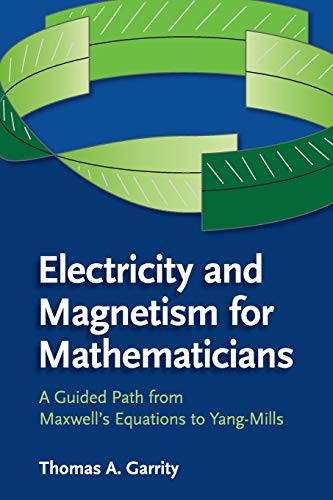
This text is an introduction to some of the mathematical wonders of Maxwell’s equations. These equations led to the prediction of radio waves, the realization that light is a type of electromagnetic wave, and the discovery of the special theory of relativity. In fact, almost all current descriptions of the fundamental laws of the universe can be viewed as deep generalizations of Maxwell’s equations. Even more surprising is that these equations and their generalizations have led to some of the most important mathematical discoveries of the past thirty years. It seems that the mathematics behind Maxwell’s equations is endless. The goal of this book is to explain to mathematicians the underlying physics behind electricity and magnetism and to show their connections to mathematics. Starting with Maxwell’s equations, the reader is led to such topics as the special theory of relativity, differential forms, quantum mechanics, manifolds, tangent bundles, connections, and curvature.
User’s Reviews
Editorial Reviews: Book Description Maxwell’s equations have led to many important mathematical discoveries. This text introduces mathematics students to some of their wonders. About the Author Thomas A. Garrity is the William R. Kenan, Jr Professor of Mathematics at Williams College, where he was the director of the Williams College Project for Effective Teaching for many years. He has written a number of research papers and has authored or coauthored two other books, All the Mathematics You Missed (But Need to Know for Graduate School) and Algebraic Geometry: A Problem Solving Approach. Among his awards and honors is the MAA Deborah and Franklin Tepper Haimo Award for outstanding college or university teaching.
Reviews from Amazon users which were colected at the time this book was published on the website:
⭐PLUS: I benefited from Prof. Garrity exposition of the nuts and bolts of differential forms as applied to Maxwell’s Eqns.MINUS: The level of rigor is quite uneven. For example his section on Hilbert Spaces is quite mathematical and would take a big effort by the average reader to understand (I had never heard about Schwartz spaces before)MINUS: The book has a limited level/coverage of Maxwell’s Eqn.(Prof Zee’s Gravitation in a nutshell book covers with much more insight the “differential form” description of Maxwell’s Eqns.)PLUS: The latter chapters of the book are quite valuable because they provide at an elementary level the connection between current abstract math concepts and the physics of Non-Abelian (Yang Mills) Gauge Theories.PLUS: Though the subject is covered in little detail, he makes it possible for a “physicist” with limited abstract math knowledge to have a glimpse at the connection between abstract math and the physics of the Yang Mills fields.
⭐A brilliant survey of the mathematical framework of electrodynamics, field theories, and more. This book is not (and is not intended to be) a comprehensive introduction to “electricity and magnetism” or any other topic in physics, nor is it a text on mathematical physics. Although one need not actually be a mathematician to appreciate the material, a certain amount of mathematical sophistication and background is required. The author himself requires students to have taken multivariable calculus and linear algebra when using the text to teach. The book’s value is found in the presentation of a variety of topics, from classical and quantum physics to vector bundles and differential forms, together with references for further study all in a remarkably concise form. In under 300 pages, the manages to introduce the readers to 200+ years of developments in physics and mathematics with an emphasis on the mathematical formalisms and frameworks of or relating to electromagnetism. The order of presentation mostly follows that of historical discovery, moving from Maxwell and early work in atomic physics (e.g., Coulomb’s law) to special relativity, the (mostly) 20th century developments in mathematical physics (e.g., Noether’s theorem, exterior calculus, forms, connections, etc.), quantum physics, and even the basic use of such mathematics in the standard model. Apart from a survey of such topics for those with a fair degree of mathematical sophistication, this text can serve well as a complementary text in courses in (or self-study of) physical mathematics, differential geometry, advanced multivariable calculus, analytical dynamics, advanced courses in electrodynamics and classical field theories, or surveys of physics for students majoring in mathematics, engineering, etc.
⭐Really a set of lecture notes. Not really for the mathematician in that it isn’t very rigorous. Rather, it tries to develop the reader’s physical understanding which is a fine goal but done more successfully in standard intermediate and advanced physics text books. The author “follows” i.e., borrows extensively from other authors’ books. The book reviews topics in linear algebta, Hilbert space, differential forms, differential geometry and Lagrangian mechanics in order to discuss topics in Maxwell’s theory and quantum theory. This is useful for physicists but I would expect a mathematician to know this material.
⭐I really enjoyed this book! It gives a truly well-explained tour through physics and explaining everything needed in understanding the framework of modern physics. Concluding in force=curvature and gauge=connection, an integral part of physics and then Yang-Mills theory.
⭐It’s an OK book. It seems to serve as a rushed introduction to electricity and magnetism but a good portion can be understood from the mathematics. As you delve deeper there’s a lot more mathematics involved. But the beginning chapters seem to have concepts of physics overpower the underlying mathematics
⭐I was trained as a differential geometer and over the years have periodically made an effort to learn E&M. I am, of course, fully aware of all the “fancy” approaches that can be taken, but that’s not what I needed. Some people think that if a mathematician wants to learn physics, then they want to read books like Sachs and Wu’s Relativity for Mathematicians, or other mathematically sophisticated sources. That is not always the case. Sometimes they want to have another mathematician explain elementary physics to them in precise and clear language. (Spivak’s mechanics book is in this vein.) I’ve learned a lot from Garrity’s book – it is a first rate piece of exposition. I wish that there were more books like this.
⭐This is not in any sense “electricity and magnetism for mathematicians”. Rather, it’s an introductory and fairly rushed text on electromagnetism and calculus on manifolds for undergraduates. Readers looking for the connection with Yang-Mills theories should look elsewhere – only a single page is devoted to this topic.
⭐The subtitle of the book is more informative than the main title. The book really is “a guided path from Maxwell’s equations to Yang-Mills.” It does not go into the kind of exercises you’d find in on an electrical engineering homework assignment, but it presents Maxwell’s equations from several increasingly sophisticated perspectives, culminating in a glimpse of Yang-Mills theory. Along the way it gives an introduction to special relativity, Lagrangian mechanics, calculus on manifolds, and quantum mechanics.
⭐This is a book for would be mathematicians. If you already are a matematician it is a bit elementary, at least the early parts. I think the book presents the mathematical structures behind basic electromagnetism quite well. Focus is on variational principles and Lagrangians and later on differential forms and gauge theories. History and experimental background are necessarily discussed extremly briefly. This book is, like many books presenting the theoretical foundations of electromagnetism, a two fields (E, B) book. Media and the D, H fields are not mentioned at all.There are things I do’nt like about the book. The notation for everything is a italic character. There is no notational distinction between scalars, (three or four) vectors, tensors etc. I find this a pedagogical drawback. Good notation aids thought much more that is normally recognized. An example of a bad consequence is that (italic) F denotes force (a three vector) early in the book, while exactly the same symbol denotes the electromagnetic two-form later in the book. In the list of symbols these notations are not even mentioned so there is no help from there. The text has often the character of lecture notes. There is no equation numbering. The necessary equations are simply repeated once again, when needed. This can be comfortable, but it also leads to a lot of redundancy.
⭐I was initially hoping for perhaps a brief introduction to the experimental results of electromagnetism and then from these build up on the actually derivations. There was some nice derivations regarding electromagnetic waves though but nothing which couldn’t be found in any standard book on electromagnetism though.The chapter on relativity was very disappointing, if this is for mathematicians then why simply not the standard 4-vector approach rather than the usual approach given to undergraduate physicists.The author spends a number of relatively rushed chapters on introducing differential geometry and then in ONE PAGE mentions the geometric formulation of electromagnetism, I wonder why he bothered in the first place.Im summary, interesting in places but disappointing in many others.
Keywords
Free Download Electricity and Magnetism for Mathematicians: A Guided Path from Maxwell’s Equations to Yang–Mills 1st Edition in PDF format
Electricity and Magnetism for Mathematicians: A Guided Path from Maxwell’s Equations to Yang–Mills 1st Edition PDF Free Download
Download Electricity and Magnetism for Mathematicians: A Guided Path from Maxwell’s Equations to Yang–Mills 1st Edition 2015 PDF Free
Electricity and Magnetism for Mathematicians: A Guided Path from Maxwell’s Equations to Yang–Mills 1st Edition 2015 PDF Free Download
Download Electricity and Magnetism for Mathematicians: A Guided Path from Maxwell’s Equations to Yang–Mills 1st Edition PDF
Free Download Ebook Electricity and Magnetism for Mathematicians: A Guided Path from Maxwell’s Equations to Yang–Mills 1st Edition